
Mapa mental
Attachment
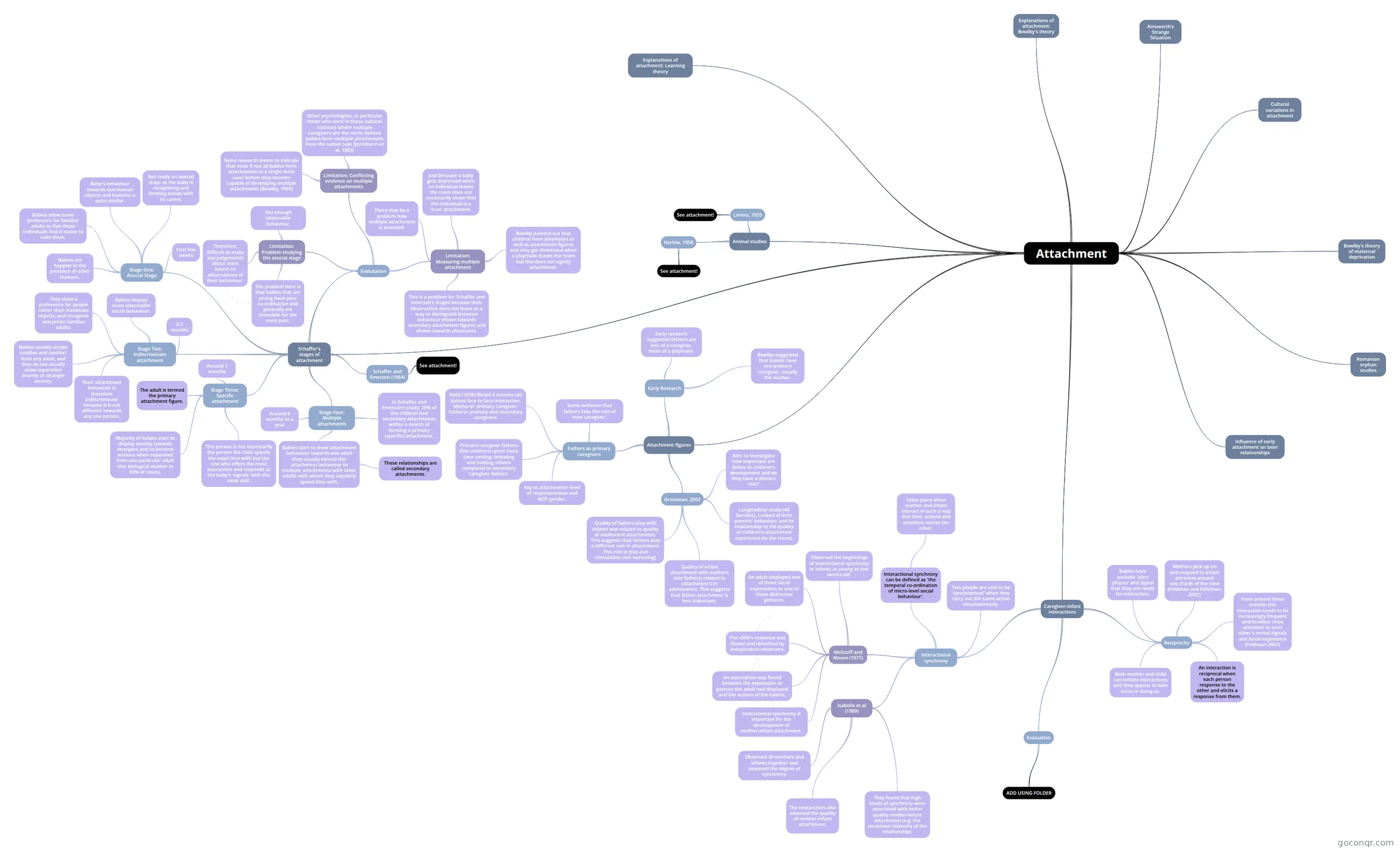
Mind map: Attachment psychology
Contenido del mapa
Attachment
Caregiver-infant interactions
- Reciprocity
- Babies have periodic 'alert phases' and signal that they are ready for interaction.
- Mothers pick up on and respond to infant alertness around two-thirds of the time (Feldman and Eidelman 2007)
- From around three months this interaction tends to be increasingly frequent and involves close attention to each other's verbal signals and facial expression (Feldman 2007)
- An interaction is reciprocal when each person response to the other and elicits a response from them.
- Both mother and child can initiate interactions and they appear to take turns in doing so.
- Interactional synchrony
- Two people are said to be 'synchronised' when they carry out the same action simultaneously.
- Interactional synchrony can be defined as 'the temporal co-ordination of micro-level social behaviour'.
- Takes place when mother and infant interact in such a way that their actions and emotions mirror the other.
- Meltzoff and Moore (1977)
- Observed the beginnings of interactional synchrony in infants as young as two weeks old.
- An adult displayed one of three facial expressions or one of three distinctive gestures.
- The child's response was filmed and identified by independent observers.
- An association was found between the expression or gesture the adult had displayed and the actions of the babies.
- Interactional synchrony is important for the development of mother-infant attachment.
- Isabella et al (1989)
- Observed 30 mothers and infants together and assessed the degree of synchrony.
- The researchers also assessed the quality of mother-infant attachment.
- They found that high levels of synchrony were associated with better quality mother-infant attachment (e.g. the emotional intensity of the relationship).
- Evaluation
- ADD USING FOLDER
- Reciprocity
Attachment figures
- Early Research
- Bowlby suggested that babies have one primary caregiver, usually the mother.
- Early research suggested fathers are less of a caregiver, more of a playmate.
- Grossman, 2002
- Aim: to investigate how important are father in children's development and do they have a distinct role?
- Longitudinal study (44 families). Looked at both parents' behaviour and its relationship to the quality of children's attachment experience (to the teens).
- Quality of infant attachment with mothers (not fathers) related to attachment's in adolescence. This suggests that father attachment is less important.
- Quality of fathers play with infants was related to quality of adolescent attachments. This suggests that fathers play a different role in attachment. This role is play and stimulation (not nurturing)
- Fathers as primary caregivers
- Some evidence that fathers take the role of 'man caregiver'.
- Field (1978) filmed 4 months old babies face to face interaction. Mothers= primary caregiver. Fathers= primary and secondary caregivers.
- Primary caregiver fathers (like mothers) spent more time smiling, imitating and holding infants compared to secondary caregiver fathers.
- Key to attachment= level of responsiveness and NOT gender.
- Early Research
Schaffer's stages of attachment
- Schaffer and Emerson (1964)
- See attachment!
- Stage One: Asocial Stage
- First few weeks
- Not really an asocial stage as the baby is recognising and forming bonds with its carers.
- Baby's behaviour towards non-human objects and humans is quite similar.
- Babies show some preference for familiar adults in that those individuals find it easier to calm them.
- Babies are happier in the presence of other humans.
- Stage Two: Indiscriminate attachment
- 2-7 months
- Babies display more observable social behaviour.
- They show a preference for people rather than inanimate objects, and recognise and prefer familiar adults.
- Babies usually accept cuddles and comfort from any adult, and they do not usually show separation anxiety or stranger anxiety.
- Their attachment behaviour is therefore indiscriminate because it is not different towards any one person.
- Stage Three: Specific attachment
- Around 7 months
- Majority of babies start to display anxiety towards strangers and to become anxious when separated from one particular adult (the biological mother in 65% of cases).
- The adult is termed the primary attachment figure.
- This person is not necessarily the person the child spends the most time with but the one who offers the most interaction and responds to the baby's 'signals' with the most skill.
- Stage Four: Multiple attachments
- Babies start to show attachment behaviour towards one adult they usually extend this attachment behaviour to multiple attachments with other adults with whom they regularly spend time with.
- These relationships are called secondary attachments.
- In Schaffer and Emerson's study, 29% of the children had secondary attachments within a month of forming a primary (specific) attachment.
- Around 9 months to a year
- Babies start to show attachment behaviour towards one adult they usually extend this attachment behaviour to multiple attachments with other adults with whom they regularly spend time with.
- Evalutation
- Limitation: Problem studying the asocial stage
- The problem here is that babies that are young have poor co-ordination and generally are immobile for the most part.
- Therefore, difficult to make any judgements about them based on observations of their behaviour.
- Not enough observable behaviour.
- Limitation: Conflicting evidence on multiple attachments
- Some research seems to indicate that most if not all babies form attachments to a single main carer before they become capable of developing multiple attachments (Bowlby, 1969)
- Other psychologists, in particular those who work in those cultural contexts where multiple caregivers are the norm, believe babies form multiple attachments from the outset (van IJzendoorn et al, 1963)
- Limitation: Measuring multiple attachment
- There may be a problem how multiple attachment is assessed.
- Just because a baby gets distressed when an individual leaves the room does not necessarily mean that the individual is a 'true' attachment.
- Bowlby pointed out that children have playmates as well as attachment figures and may get distressed when a playmate leaves the room but this does not signify attachment.
- This is a problem for Schaffer and Emerson's stages because their observation does not leave us a way to distinguish between behaviour shown towards secondary attachment figures and shown towards playmates.
- Limitation: Problem studying the asocial stage
- Schaffer and Emerson (1964)
Animal studies
- Harlow, 1958
- See attachment!
- Lorenz, 1935
- See attachment!
- Harlow, 1958
Explanations of attachment: Learning theory
Explanations of attachment: Bowlby's theory
Ainsworth's Strange Situation
Cultural variations in attachment
Bowlby's theory of maternal deprivation
Romanian orphan studies
Influence of early attachment on later relationships
Información
- Descripción
- A level (Attachment) Psychology Mapa Mental sobre Attachment, creado por Amy Johnson el 11/06/2021.
- Creado por
- Amy Johnson
- Visitas
- 8
- Valoración