
Mapa mental
Attachment
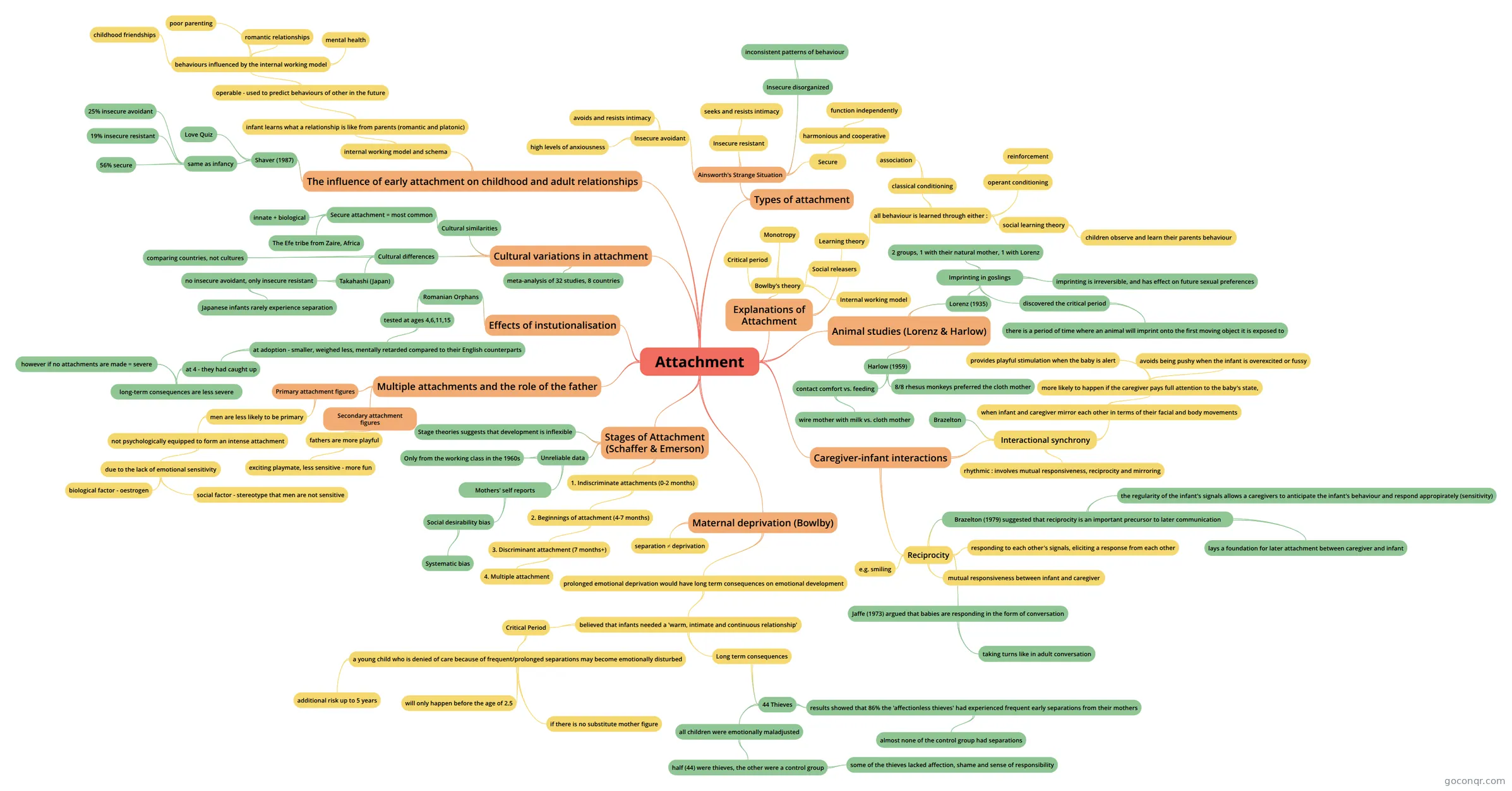
Mind map: Attachment
Contenido del mapa
Attachment
Stages of Attachment (Schaffer & Emerson)
- 1. Indiscriminate attachments (0-2 months)
- 2. Beginnings of attachment (4-7 months)
- 3. Discriminant attachment (7 months+)
- 4. Multiple attachment
- 3. Discriminant attachment (7 months+)
- 2. Beginnings of attachment (4-7 months)
- Unreliable data
- Mothers' self reports
- Social desirability bias
- Systematic bias
- Social desirability bias
- Only from the working class in the 1960s
- Mothers' self reports
- Stage theories suggests that development is inflexible
- 1. Indiscriminate attachments (0-2 months)
Explanations of Attachment
- Learning theory
- all behaviour is learned through either :
- classical conditioning
- association
- operant conditioning
- reinforcement
- social learning theory
- children observe and learn their parents behaviour
- classical conditioning
- all behaviour is learned through either :
- Bowlby's theory
- Critical period
- Internal working model
- Monotropy
- Social releasers
- Learning theory
Caregiver-infant interactions
- Reciprocity
- mutual responsiveness between infant and caregiver
- responding to each other's signals, eliciting a response from each other
- e.g. smiling
- Brazelton (1979) suggested that reciprocity is an important precursor to later communication
- the regularity of the infant's signals allows a caregivers to anticipate the infant's behaviour and respond appropirately (sensitivity)
- lays a foundation for later attachment between caregiver and infant
- Jaffe (1973) argued that babies are responding in the form of conversation
- taking turns like in adult conversation
- Interactional synchrony
- when infant and caregiver mirror each other in terms of their facial and body movements
- more likely to happen if the caregiver pays full attention to the baby's state,
- provides playful stimulation when the baby is alert
- avoids being pushy when the infant is overexcited or fussy
- more likely to happen if the caregiver pays full attention to the baby's state,
- rhythmic : involves mutual responsiveness, reciprocity and mirroring
- Brazelton
- when infant and caregiver mirror each other in terms of their facial and body movements
- Reciprocity
Multiple attachments and the role of the father
- Primary attachment figures
- men are less likely to be primary
- not psychologically equipped to form an intense attachment
- due to the lack of emotional sensitivity
- biological factor - oestrogen
- social factor - stereotype that men are not sensitive
- due to the lack of emotional sensitivity
- not psychologically equipped to form an intense attachment
- men are less likely to be primary
- Secondary attachment figures
- fathers are more playful
- exciting playmate, less sensitive - more fun
- fathers are more playful
- Primary attachment figures
Types of attachment
- Ainsworth's Strange Situation
- Insecure avoidant
- avoids and resists intimacy
- high levels of anxiousness
- Insecure resistant
- seeks and resists intimacy
- Secure
- harmonious and cooperative
- function independently
- harmonious and cooperative
- Insecure disorganized
- inconsistent patterns of behaviour
- Insecure avoidant
- Ainsworth's Strange Situation
Maternal deprivation (Bowlby)
- prolonged emotional deprivation would have long term consequences on emotional development
- believed that infants needed a 'warm, intimate and continuous relationship'
- Critical Period
- a young child who is denied of care because of frequent/prolonged separations may become emotionally disturbed
- will only happen before the age of 2.5
- if there is no substitute mother figure
- additional risk up to 5 years
- a young child who is denied of care because of frequent/prolonged separations may become emotionally disturbed
- Long term consequences
- 44 Thieves
- all children were emotionally maladjusted
- half (44) were thieves, the other were a control group
- some of the thieves lacked affection, shame and sense of responsibility
- half (44) were thieves, the other were a control group
- results showed that 86% the 'affectionless thieves' had experienced frequent early separations from their mothers
- almost none of the control group had separations
- all children were emotionally maladjusted
- 44 Thieves
- Critical Period
- believed that infants needed a 'warm, intimate and continuous relationship'
- separation ≠ deprivation
- prolonged emotional deprivation would have long term consequences on emotional development
Animal studies (Lorenz & Harlow)
- Harlow (1959)
- contact comfort vs. feeding
- wire mother with milk vs. cloth mother
- 8/8 rhesus monkeys preferred the cloth mother
- contact comfort vs. feeding
- Lorenz (1935)
- Imprinting in goslings
- 2 groups, 1 with their natural mother, 1 with Lorenz
- discovered the critical period
- there is a period of time where an animal will imprint onto the first moving object it is exposed to
- imprinting is irreversible, and has effect on future sexual preferences
- Imprinting in goslings
- Harlow (1959)
Effects of instutionalisation
- Romanian Orphans
- tested at ages 4,6,11,15
- at adoption - smaller, weighed less, mentally retarded compared to their English counterparts
- at 4 - they had caught up
- long-term consequences are less severe
- however if no attachments are made = severe
- long-term consequences are less severe
- at 4 - they had caught up
- at adoption - smaller, weighed less, mentally retarded compared to their English counterparts
- tested at ages 4,6,11,15
- Romanian Orphans
The influence of early attachment on childhood and adult relationships
- internal working model and schema
- infant learns what a relationship is like from parents (romantic and platonic)
- operable - used to predict behaviours of other in the future
- behaviours influenced by the internal working model
- childhood friendships
- poor parenting
- romantic relationships
- mental health
- behaviours influenced by the internal working model
- operable - used to predict behaviours of other in the future
- infant learns what a relationship is like from parents (romantic and platonic)
- Shaver (1987)
- Love Quiz
- same as infancy
- 56% secure
- 25% insecure avoidant
- 19% insecure resistant
- internal working model and schema
Cultural variations in attachment
- Cultural similarities
- Secure attachment = most common
- innate + biological
- The Efe tribe from Zaire, Africa
- Secure attachment = most common
- Cultural differences
- Takahashi (Japan)
- no insecure avoidant, only insecure resistant
- Japanese infants rarely experience separation
- no insecure avoidant, only insecure resistant
- comparing countries, not cultures
- Takahashi (Japan)
- meta-analysis of 32 studies, 8 countries
- Cultural similarities
Información
- Descripción
- A level Psychology Mapa Mental sobre Attachment, creado por Leanne Tan el 29/01/2022.
- Creado por
- Leanne Tan
- Visitas
- 0
- Etiquetas
- Valoración