
Mapa mental
Communication within and between neurons
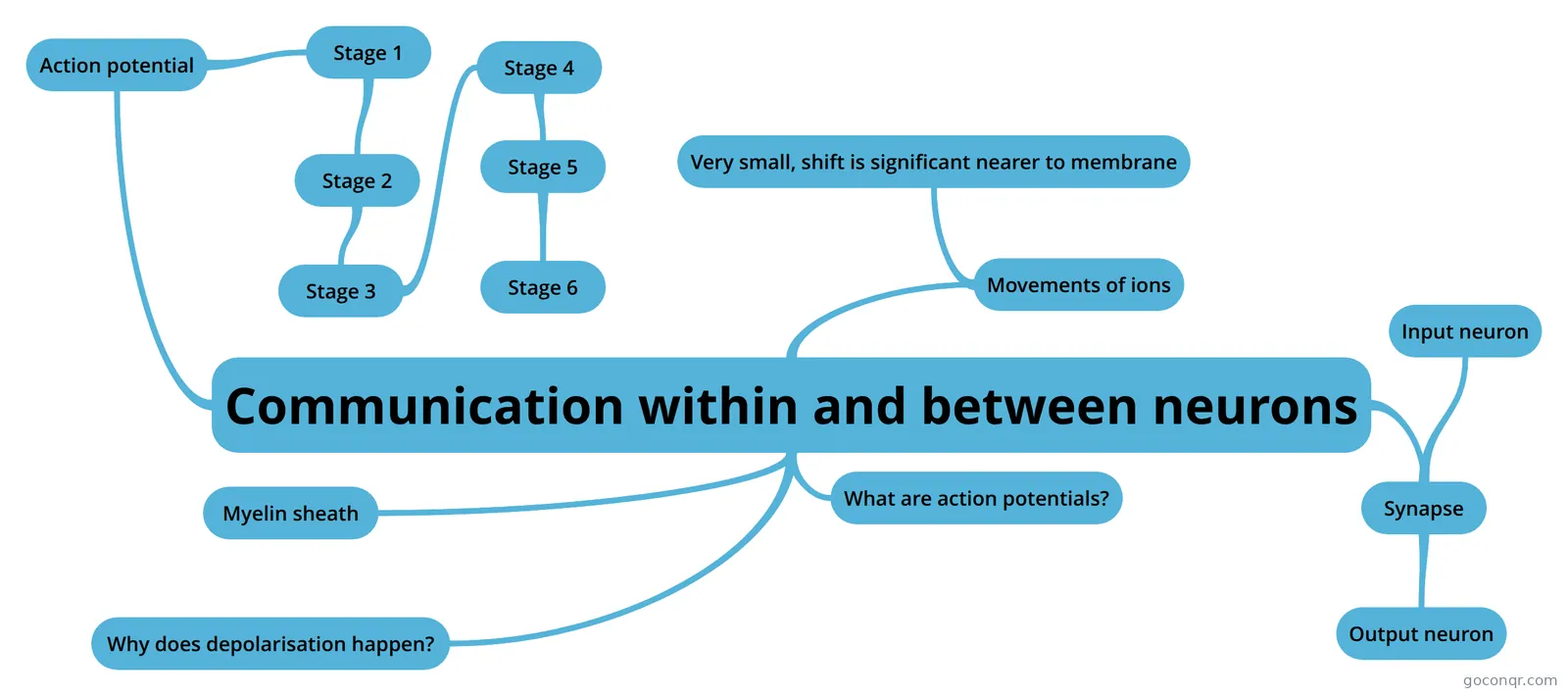
Mind map: Communication within and between neurons
Contenido del mapa
Communication within and between neurons
Action potential
- Fundamental concept of "electrical excitability", depends on the resting membrane potential in a passive state. Energy is expended to maintain an unstable state. Trigger -> release of energy -> signal Inside of cell is -70mV Resting potential is the key to allowing activity, sodium would flood the cell rapidly if allowed to cross the membrane and this would change membrane potential. Na+ channels- preferentially let sodium through, are not one directional.
- Stage 1
- Membrane depolarisation, sodium channels open at ~ -55mV, potassium channels also open Voltage gated channels- depend on voltage
- Stage 2
- Sodium cations flood into the cell (via diffusion and electrostatic pressure), membrane potential becomes less negative and more positive. Eventually reaches 0mV.
- Stage 3
- Membrane potential is now positive, potassium cations will leave cell (no longer an opposing electrostatic pressure). Sodium channel closes at +40mV, no more can enter and none can leave.
- Stage 4
- Potassium channels remain open, potassium cations continue to leave the cell (diffusion and electrostatic pressure), membrane repolarises.
- Stage 5
- Potassium cations are still leaving the cell, membrane hyperpolarises, reaching ~ -80mV
- Stage 6
- Potassium channels close, other processes then restore the balance to resting membrane potential
Movements of ions
- Very small, shift is significant nearer to membrane
Myelin sheath
- Made from oligodendrocytes, action potential (AP) jumps between (Ranvier) nodes, AP actually decreases as it travels under the sheath due to it's insulating properties, full AP regenerates at nodes, saves energy
What are action potentials?
- Basic code for information in the brain, the code is of a specific nature (always the same size and shape), they either occur or don't, size of the AP has not have any information, frequency that codes information
Why does depolarisation happen?
- AP in the adjacent part of the axon, sensory receptors respond to sensory stimulation with depolarisation, chemical transmission between neurons, recipient neuron needs to be deoplarised gap between them is ~20nm.
Synapse
- Usually called the chemical synapse, actual physical gap between 2 neurons.
- Input neuron
- Brings information to the synapse, axon terminals, inside, vesicles that contain neurotransmitters, release into the synaptic cleft via the fusion of vesicles into the cell membrane of the terminal
- Output neuron
- Receives information at the synapse. Dendrites- usual position of the synapse on the post synaptic neuron. Receptors- neurotransmitters bind to these, may also be ion channels, binding opens them, conductance of post synaptic neuron changes, post synaptic potentials (PSPs). Small PSPs- hypopolarisation: depolarisation, excitatory, opening of cation channels, EPSPs. Hyperpolarisation: inhibitory, opening of anion channels, IPSPs
Información
- Descripción
- (Psychobiology) Psychology Mapa Mental sobre Communication within and between neurons, creado por Emily Baldwin el 19/12/2024.
- Creado por
- Emily Baldwin
- Visitas
- 4
- Valoración
Más sobre Synaptic transmission and neurotransmitters