
Mapa mental
The creature
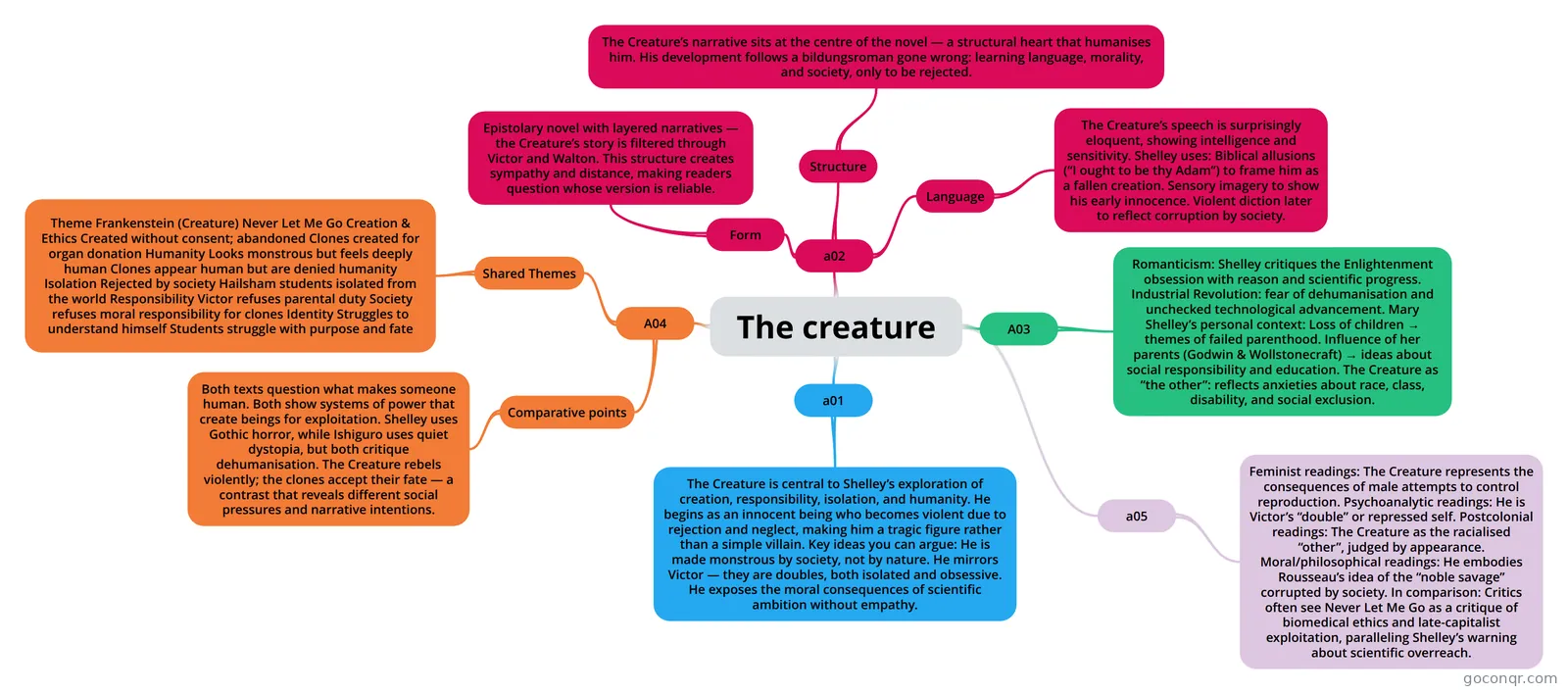
Mind map: The Creature in Frankenstein
Contenido del mapa
The creature
a01
- The Creature is central to Shelley’s exploration of creation, responsibility, isolation, and humanity. He begins as an innocent being who becomes violent due to rejection and neglect, making him a tragic figure rather than a simple villain. Key ideas you can argue: He is made monstrous by society, not by nature. He mirrors Victor — they are doubles, both isolated and obsessive. He exposes the moral consequences of scientific ambition without empathy.
a02
- Language
- The Creature’s speech is surprisingly eloquent, showing intelligence and sensitivity. Shelley uses: Biblical allusions (“I ought to be thy Adam”) to frame him as a fallen creation. Sensory imagery to show his early innocence. Violent diction later to reflect corruption by society.
- Form
- Epistolary novel with layered narratives — the Creature’s story is filtered through Victor and Walton. This structure creates sympathy and distance, making readers question whose version is reliable.
- Structure
- The Creature’s narrative sits at the centre of the novel — a structural heart that humanises him. His development follows a bildungsroman gone wrong: learning language, morality, and society, only to be rejected.
- Language
A03
- Romanticism: Shelley critiques the Enlightenment obsession with reason and scientific progress. Industrial Revolution: fear of dehumanisation and unchecked technological advancement. Mary Shelley’s personal context: Loss of children → themes of failed parenthood. Influence of her parents (Godwin & Wollstonecraft) → ideas about social responsibility and education. The Creature as “the other”: reflects anxieties about race, class, disability, and social exclusion.
A04
- Shared Themes
- Theme Frankenstein (Creature) Never Let Me Go Creation & Ethics Created without consent; abandoned Clones created for organ donation Humanity Looks monstrous but feels deeply human Clones appear human but are denied humanity Isolation Rejected by society Hailsham students isolated from the world Responsibility Victor refuses parental duty Society refuses moral responsibility for clones Identity Struggles to understand himself Students struggle with purpose and fate
- Comparative points
- Both texts question what makes someone human. Both show systems of power that create beings for exploitation. Shelley uses Gothic horror, while Ishiguro uses quiet dystopia, but both critique dehumanisation. The Creature rebels violently; the clones accept their fate — a contrast that reveals different social pressures and narrative intentions.
- Shared Themes
a05
- Feminist readings: The Creature represents the consequences of male attempts to control reproduction. Psychoanalytic readings: He is Victor’s “double” or repressed self. Postcolonial readings: The Creature as the racialised “other”, judged by appearance. Moral/philosophical readings: He embodies Rousseau’s idea of the “noble savage” corrupted by society. In comparison: Critics often see Never Let Me Go as a critique of biomedical ethics and late‑capitalist exploitation, paralleling Shelley’s warning about scientific overreach.
Información
- Descripción
- A level History Mapa Mental sobre The creature, creado por Tegan Flynn el 05/02/2026.
- Creado por
- Tegan Flynn
- Visitas
- 1
- Valoración
Más sobre Frankenstein Characters