
Mapa mental
Chaney et al (2004)
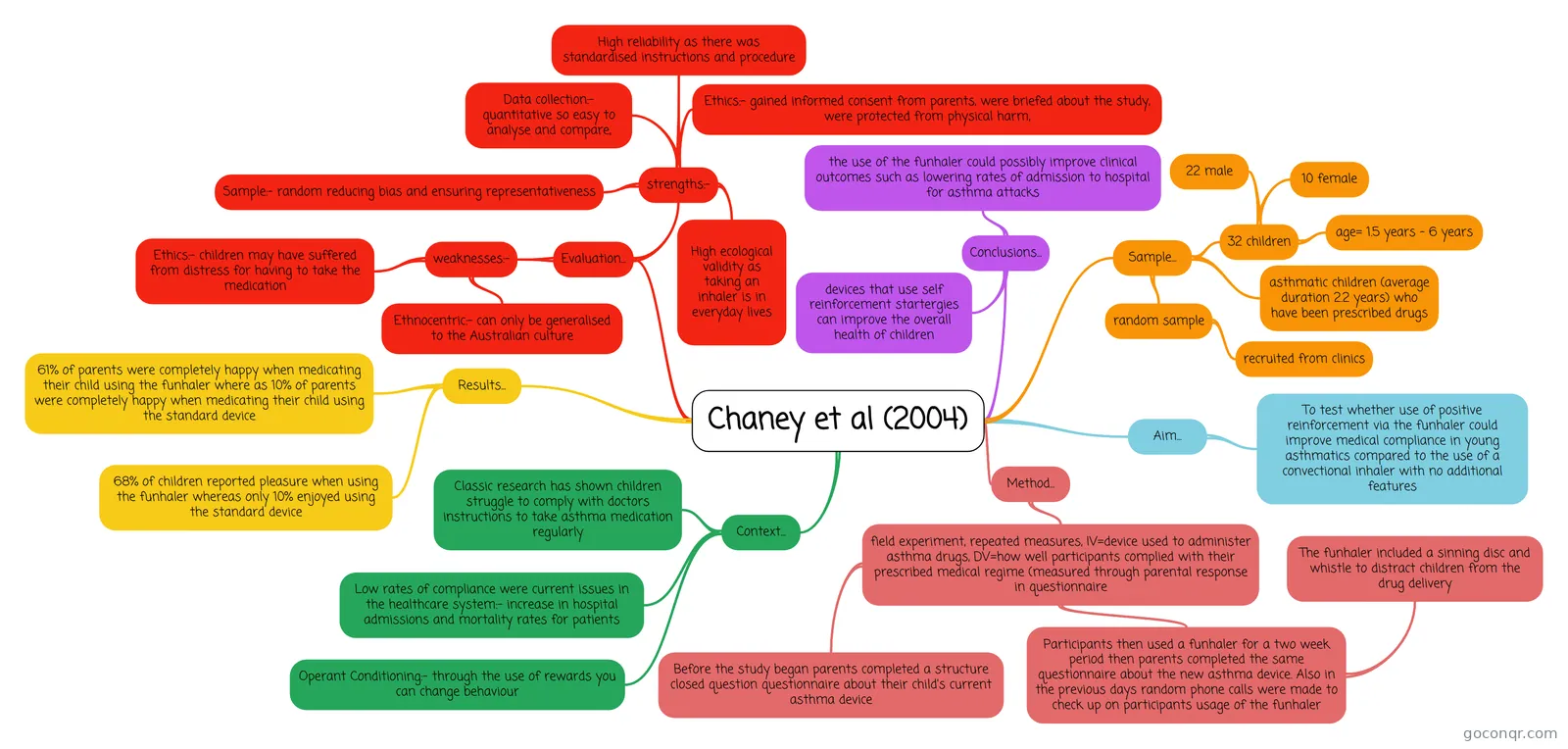
Mind map: Chaney et al (2004) study
Contenido del mapa
Chaney et al (2004)
Sample...
- 32 children
- 22 male
- 10 female
- age= 1.5 years - 6 years
- random sample
- recruited from clinics
- asthmatic children (average duration 2.2 years) who have been prescribed drugs
- 32 children
Method...
- field experiment, repeated measures, IV=device used to administer asthma drugs, DV=how well participants complied with their prescribed medical regime (measured through parental response in questionnaire
- Before the study began parents completed a structure closed question questionnaire about their child's current asthma device
- Participants then used a funhaler for a two week period then parents completed the same questionnaire about the new asthma device. Also in the previous days random phone calls were made to check up on participants usage of the funhaler
- The funhaler included a sinning disc and whistle to distract children from the drug delivery
- field experiment, repeated measures, IV=device used to administer asthma drugs, DV=how well participants complied with their prescribed medical regime (measured through parental response in questionnaire
Aim...
- To test whether use of positive reinforcement via the funhaler could improve medical compliance in young asthmatics compared to the use of a convectional inhaler with no additional features
Context...
- Operant Conditioning:- through the use of rewards you can change behaviour
- Low rates of compliance were current issues in the healthcare system:- increase in hospital admissions and mortality rates for patients
- Classic research has shown children struggle to comply with doctors instructions to take asthma medication regularly
Conclusions...
- the use of the funhaler could possibly improve clinical outcomes such as lowering rates of admission to hospital for asthma attacks
- devices that use self reinforcement startergies can improve the overall health of children
Results...
- 68% of children reported pleasure when using the funhaler whereas only 10% enjoyed using the standard device
- 61% of parents were completely happy when medicating their child using the funhaler where as 10% of parents were completely happy when medicating their child using the standard device
Evaluation...
- strengths:-
- Ethics:- gained informed consent from parents, were briefed about the study, were protected from physical harm,
- High ecological validity as taking an inhaler is in everyday lives
- High reliability as there was standardised instructions and procedure
- Data collection:- quantitative so easy to analyse and compare,
- Sample:- random reducing bias and ensuring representativeness
- weaknesses:-
- Ethnocentric:- can only be generalised to the Australian culture
- Ethics:- children may have suffered from distress for having to take the medication
- strengths:-
Información
- Descripción
- AS - Level Psychology Mapa Mental sobre Chaney et al (2004), creado por courtn3y.mcilvan el 04/03/2016.
- Creado por
- courtn3y.mcilvan
- Visitas
- 18
- Valoración