
Mapa mental
Attachment
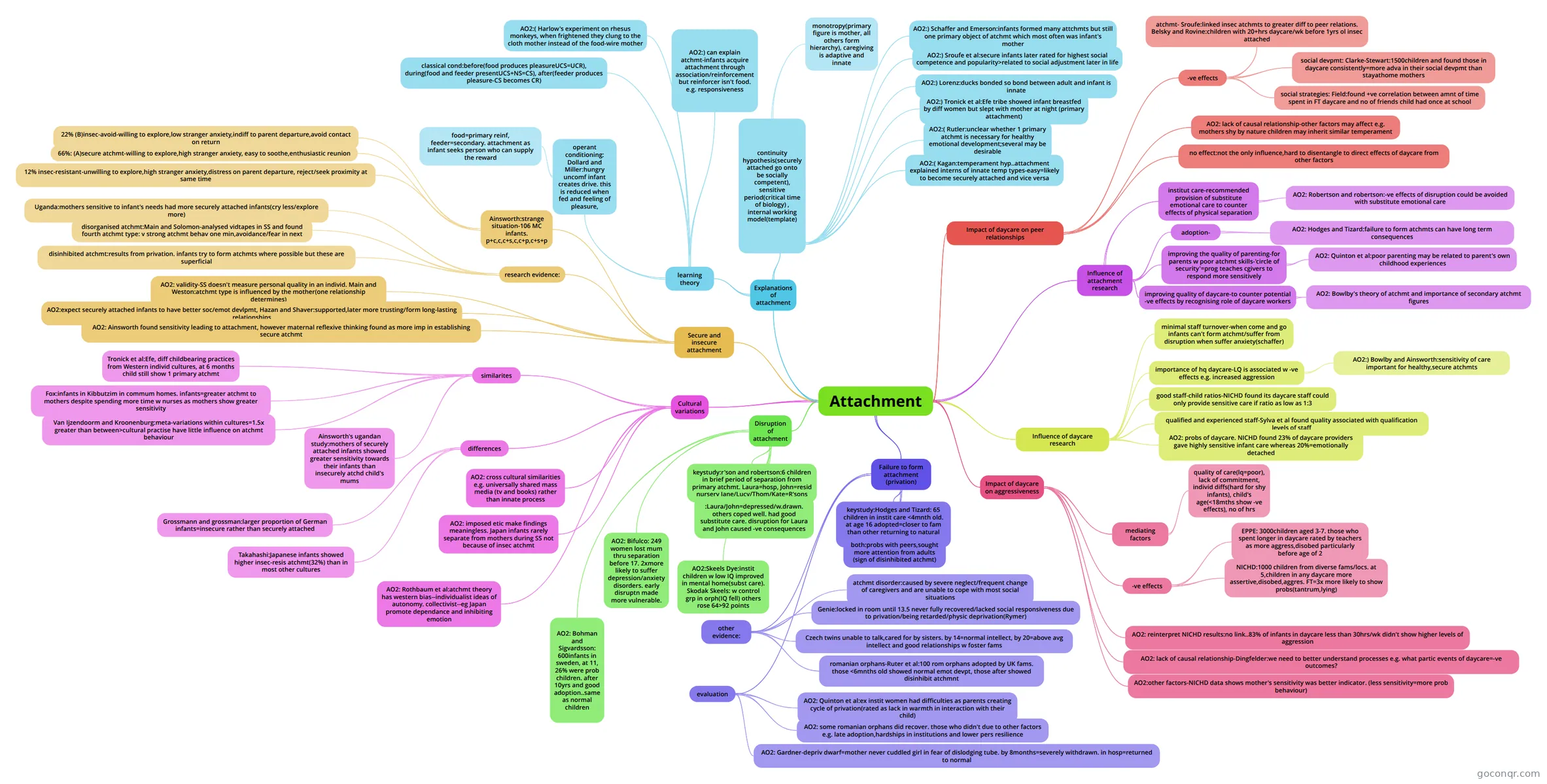
Mind map: Attachment
Contenido del mapa
Attachment
Explanations of attachment
- learning theory
- AO2:) can explain atchmt-infants acquire attachment through association/reinforcement but reinforcer isn't food. e.g. responsiveness
- AO2:( Harlow's experiment on rhesus monkeys, when frightened they clung to the cloth mother instead of the food-wire mother
- classical cond:before(food produces pleasureUCS=UCR), during(food and feeder presentUCS+NS=CS), after(feeder produces pleasure-CS becomes CR)
- operant conditioning: Dollard and Miller:hungry uncomf infant creates drive. this is reduced when fed and feeling of pleasure,
- food=primary reinf, feeder=secondary. attachment as infant seeks person who can supply the reward
- bowlby
- continuity hypothesis(securely attached go onto be socially competent), sensitive period(critical time of biology) , internal working model(template)
- monotropy(primary figure is mother, all others form hierarchy), caregiving is adaptive and innate
- AO2:) Lorenz:ducks bonded so bond between adult and infant is innate
- AO2:) Schaffer and Emerson:infants formed many attchmts but still one primary object of atchmt which most often was infant's mother
- AO2:) Tronick et al:Efe tribe showed infant breastfed by diff women but slept with mother at night (primary attachment)
- AO2:( Rutler:unclear whether 1 primary atchmt is necessary for healthy emotional development;several may be desirable
- AO2:( Kagan:temperament hyp..attachment explained interns of innate temp types-easy=likely to become securely attached and vice versa
- AO2:) Sroufe et al:secure infants later rated for highest social competence and popularity>related to social adjustment later in life
- continuity hypothesis(securely attached go onto be socially competent), sensitive period(critical time of biology) , internal working model(template)
- learning theory
Secure and insecure attachment
- Ainsworth:strange situation-106 MC infants. p+c,c,c+s,c,c+p,c+s+p
- 66%: (A)secure atchmt-willing to explore,high stranger anxiety, easy to soothe,enthusiastic reunion
- 22% (B)insec-avoid-willing to explore,low stranger anxiety,indiff to parent departure,avoid contact on return
- 12% insec-resistant-unwilling to explore,high stranger anxiety,distress on parent departure, reject/seek proximity at same time
- research evidence:
- Uganda:mothers sensitive to infant's needs had more securely attached infants(cry less/explore more)
- disorganised atchmt:Main and Solomon-analysed vidtapes in SS and found fourth atchmt type: v strong atchmt behav one min,avoidance/fear in next
- disinhibited atchmt:results from privation. infants try to form atchmts where possible but these are superficial
- AO2: validity-SS doesn't measure personal quality in an individ. Main and Weston:atchmt type is influenced by the mother(one relationship determines)
- AO2:expect securely attached infants to have better soc/emot devlpmt, Hazan and Shaver:supported,later more trusting/form long-lasting relationships
- AO2: Ainsworth found sensitivity leading to attachment, however maternal reflexive thinking found as more imp in establishing secure atchmt
- Ainsworth:strange situation-106 MC infants. p+c,c,c+s,c,c+p,c+s+p
Cultural variations
- similarites
- Tronick et al:Efe, diff childbearing practices from Western individ cultures, at 6 months child still show 1 primary atchmt
- Fox:infants in Kibbutzim in commum homes. infants=greater atchmt to mothers despite spending more time w nurses as mothers show greater sensitivity
- Van Ijzendoorm and Kroonenburg:meta-variations within cultures=1.5x greater than between>cultural practise have little influence on atchmt behaviour
- Ainsworth's ugandan study:mothers of securely attached infants showed greater sensitivity towards their infants than insecurely atchd child's mums
- differences
- Grossmann and grossman:larger proportion of German infants=insecure rather than securely attached
- Takahashi:Japanese infants showed higher insec-resis atchmt(32%) than in most other cultures
- AO2: imposed etic make findings meaningless. Japan infants rarely separate from mothers during SS not because of insec atchmt
- AO2: Rothbaum et al:atchmt theory has western bias--individualist ideas of autonomy. collectivist--eg Japan promote dependance and inhibiting emotion
- AO2: cross cultural similarities e.g. universally shared mass media (tv and books) rather than innate process
- similarites
Disruption of attachment
- keystudy:r'son and robertson:6 children in brief period of separation from primary atchmt. Laura=hosp, John=resid nursery Jane/Lucy/Thom/Kate=R'sons
- AO2:Skeels Dye:instit children w low IQ improved in mental home(subst care). Skodak Skeels: w control grp in orph(IQ fell) others rose 64>92 points
- AO2: Bohman and Sigvardsson: 600infants in sweden, at 11, 26% were prob children. after 10yrs and good adoption..same as normal children
- AO2: Bifulco: 249 women lost mum thru separation before 17. 2xmore likely to suffer depression/anxiety disorders. early disruptn made more vulnerable.
- :Laura/John=depressed/w.drawn. others coped well. had good substitute care. disruption for Laura and John caused -ve consequences
Failure to form attachment (privation)
- keystudy:Hodges and Tizard: 65 children in instit care <4mnth old. at age 16 adopted=closer to fam than other returning to natural family
- other evidence:
- romanian orphans-Ruter et al:100 rom orphans adopted by UK fams. those <6mnths old showed normal emot devpt, those after showed disinhibit atchmnt
- atchmt disorder:caused by severe neglect/frequent change of caregivers and are unable to cope with most social situations
- Genie:locked in room until 13.5 never fully recovered/lacked social responsiveness due to privation/being retarded/physic deprivation(Rymer)
- Czech twins unable to talk,cared for by sisters. by 14=normal intellect, by 20=above avg intellect and good relationships w foster fams
- both:probs with peers,sought more attention from adults (sign of disinhibited atchmt)
- evaluation
- AO2: Quinton et al:ex instit women had difficulties as parents creating cycle of privation(rated as lack in warmth in interaction with their child)
- AO2: some romanian orphans did recover. those who didn't due to other factors e.g. late adoption,hardships in institutions and lower pers resilience
- AO2: Gardner-depriv dwarf=mother never cuddled girl in fear of dislodging tube. by 8months=severely withdrawn. in hosp=returned to normal
Impact of daycare on aggressiveness
- -ve effects
- NICHD:1000 children from diverse fams/locs. at 5,children in any daycare more assertive,disobed,aggres. FT=3x more likely to show probs(tantrum,lying)
- EPPE: 3000children aged 3-7. those who spent longer in daycare rated by teachers as more aggress,disobed particularly before age of 2
- AO2:other factors-NICHD data shows mother's sensitivity was better indicator. (less sensitivity=more prob behaviour)
- AO2: lack of causal relationship-Dingfelder:we need to better understand processes e.g. what partic events of daycare=-ve outcomes?
- AO2: reinterpret NICHD results:no link..83% of infants in daycare less than 30hrs/wk didn't show higher levels of aggression
- mediating factors
- quality of care(lq=poor), lack of commitment, individ diffs(hard for shy infants), child's age(<18mths show -ve effects), no of hrs
- -ve effects
Impact of daycare on peer relationships
- -ve effects
- atchmt- Sroufe:linked insec atchmts to greater diff to peer relations. Belsky and Rovine:children with 20+hrs daycare/wk before 1yrs ol insec attached
- social devpmt: Clarke-Stewart:1500children and found those in daycare consistently=more adva in their social devpmt than stayathome mothers
- social strategies: Field:found +ve correlation between amnt of time spent in FT daycare and no of friends child had once at school
- AO2: lack of causal relationship-other factors may affect e.g. mothers shy by nature children may inherit similar temperament
- no effect:not the only influence,hard to disentangle to direct effects of daycare from other factors
- -ve effects
Influence of attachment research
- institut care-recommended provision of substitute emotional care to counter effects of physical separation
- AO2: Robertson and robertson:-ve effects of disruption could be avoided with substitute emotional care
- adoption-
- AO2: Hodges and Tizard:failure to form atchmts can have long term consequences
- improving the quality of parenting-for parents w poor atchmt skills-'circle of security'=prog teaches cgivers to respond more sensitively
- AO2: Quinton et al:poor parenting may be related to parent's own childhood experiences
- improving quality of daycare-to counter potential -ve effects by recognising role of daycare workers
- AO2: Bowlby's theory of atchmt and importance of secondary atchmt figures
- institut care-recommended provision of substitute emotional care to counter effects of physical separation
Influence of daycare research
- importance of hq daycare-LQ is associated w -ve effects e.g. increased aggression
- AO2:) Bowlby and Ainsworth:sensitivity of care important for healthy,secure atchmts
- good staff-child ratios-NICHD found its daycare staff could only provide sensitive care if ratio as low as 1:3
- minimal staff turnover-when come and go infants can't form atchmt/suffer from disruption when suffer anxiety(schaffer)
- qualified and experienced staff-Sylva et al found quality associated with qualification levels of staff
- AO2: probs of daycare. NICHD found 23% of daycare providers gave highly sensitive infant care whereas 20%=emotionally detached
- importance of hq daycare-LQ is associated w -ve effects e.g. increased aggression
Información
- Descripción
- psychology Mapa Mental sobre Attachment, creado por raid001 el 21/04/2013.
- Creado por
- raid001
- Visitas
- 129
- Etiquetas
- Valoración