
Mapa mental
Attachment
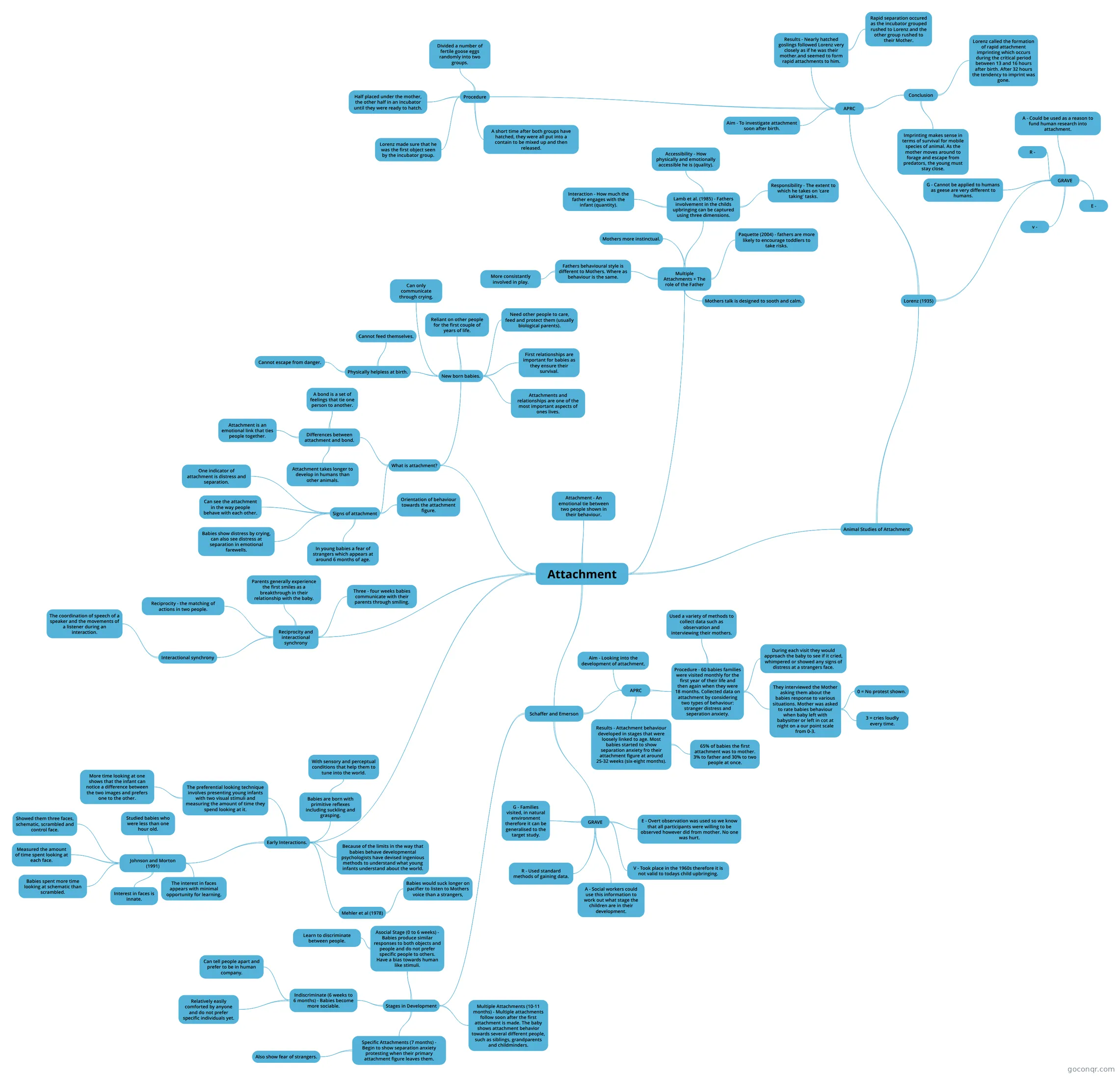
Mind map: Attachment psychology
Contenido del mapa
Attachment
Attachment - An emotional tie between two people shown in their behaviour.
What is attachment?
- New born babies.
- Physically helpless at birth.
- Cannot feed themselves.
- Cannot escape from danger.
- Can only communicate through crying.
- Reliant on other people for the first couple of years of life.
- Need other people to care, feed and protect them (usually biological parents).
- First relationships are important for babies as they ensure their survival.
- Attachments and relationships are one of the most important aspects of ones lives.
- Physically helpless at birth.
- Differences between attachment and bond.
- A bond is a set of feelings that tie one person to another.
- Attachment is an emotional link that ties people together.
- Attachment takes longer to develop in humans than other animals.
- Signs of attachment
- Can see the attachment in the way people behave with each other.
- One indicator of attachment is distress and separation.
- Babies show distress by crying, can also see distress at separation in emotional farewells.
- Orientation of behaviour towards the attachment figure.
- In young babies a fear of strangers which appears at around 6 months of age.
- New born babies.
Early Interactions.
- Babies are born with primitive reflexes including suckling and grasping.
- With sensory and perceptual conditions that help them to tune into the world.
- Because of the limits in the way that babies behave developmental psychologists have devised ingenious methods to understand what young infants understand about the world.
- The preferential looking technique involves presenting young infants with two visual stimuli and measuring the amount of time they spend looking at it.
- More time looking at one shows that the infant can notice a difference between the two images and prefers one to the other.
- Johnson and Morton (1991)
- Studied babies who were less than one hour old.
- Showed them three faces, schematic, scrambled and control face.
- Measured the amount of time spent looking at each face.
- Babies spent more time looking at schematic than scrambled.
- Interest in faces is innate.
- The interest in faces appears with minimal opportunity for learning.
- Mehler et al (1978)
- Babies would suck longer on pacifier to listen to Mothers voice than a strangers,
- Babies are born with primitive reflexes including suckling and grasping.
Reciprocity and interactional synchrony
- Three - four weeks babies communicate with their parents through smiling.
- Parents generally experience the first smiles as a breakthrough in their relationship with the baby.
- Reciprocity - the matching of actions in two people.
- Interactional synchrony
- The coordination of speech of a speaker and the movements of a listener during an interaction.
Schaffer and Emerson
- APRC
- Aim - Looking into the development of attachment.
- Procedure - 60 babies families were visited monthly for the first year of their life and then again when they were 18 months. Collected data on attachment by considering two types of behaviour: stranger distress and seperation anxiety.
- Used a variety of methods to collect data such as observation and interviewing their mothers.
- During each visit they would approach the baby to see if it cried, whimpered or showed any signs of distress at a strangers face.
- They interviewed the Mother asking them about the babies response to various situations. Mother was asked to rate babies behaviour when baby left with babysitter or left in cot at night on a our point scale from 0-3.
- 0 = No protest shown.
- 3 = cries loudly every time.
- Results - Attachment behaviour developed in stages that were loosely linked to age. Most babies started to show separation anxiety fro their attachment figure at around 25-32 weeks (six-eight months).
- 65% of babies the first attachment was to mother. 3% to father and 30% to two people at once.
- Stages in Development
- Asocial Stage (0 to 6 weeks) - Babies produce similar responses to both objects and people and do not prefer specific people to others. Have a bias towards human like stimuli.
- Learn to discriminate between people.
- Indiscriminate (6 weeks to 6 months) - Babies become more sociable.
- Can tell people apart and prefer to be in human company.
- Relatively easily comforted by anyone and do not prefer specific individuals yet.
- Specific Attachments (7 months) - Begin to show separation anxiety protesting when their primary attachment figure leaves them.
- Also show fear of strangers.
- Multiple Attachments (10-11 months) - Multiple attachments follow soon after the first attachment is made. The baby shows attachment behavior towards several different people, such as siblings, grandparents and childminders.
- Asocial Stage (0 to 6 weeks) - Babies produce similar responses to both objects and people and do not prefer specific people to others. Have a bias towards human like stimuli.
- GRAVE
- G - Families visited, in natural environment therefore it can be generalised to the target study.
- R - Used standard methods of gaining data.
- A - Social workers could use this information to work out what stage the children are in their development.
- V - Took place in the 1960s therefore it is not valid to todays child upbringing.
- E - Overt observation was used so we know that all participants were willing to be observed however did from mother. No one was hurt.
- APRC
Multiple Attachments + The role of the Father
- Fathers behavioural style is different to Mothers. Where as behaviour is the same.
- More consistantly involved in play.
- Mothers more instinctual.
- Paquette (2004) - fathers are more likely to encourage toddlers to take risks.
- Mothers talk is designed to sooth and calm.
- Lamb et al. (1985) - Fathers involvement in the childs upbringing can be captured using three dimensions.
- Interaction - How much the father engages with the infant (quantity).
- Accessibility - How physically and emotionally accessible he is (quality).
- Responsibility - The extent to which he takes on 'care taking' tasks.
- Fathers behavioural style is different to Mothers. Where as behaviour is the same.
Animal Studies of Attachment
- Lorenz (1935)
- APRC
- Aim - To investigate attachment soon after birth.
- Procedure
- Divided a number of fertile goose eggs randomly into two groups.
- Half placed under the mother, the other half in an incubator until they were ready to hatch.
- Lorenz made sure that he was the first object seen by the incubator group.
- A short time after both groups have hatched, they were all put into a contain to be mixed up and then released.
- Results - Nearly hatched goslings followed Lorenz very closely as if he was their mother.and seemed to form rapid attachments to him.
- Rapid separation occured as the incubator grouped rushed to Lorenz and the other group rushed to their Mother.
- Conclusion
- Lorenz called the formation of rapid attachment imprinting which occurs during the critical period between 13 and 16 hours after birth. After 32 hours the tendency to imprint was gone.
- Imprinting makes sense in terms of survival for mobile species of animal. As the mother moves around to forage and escape from predators, the young must stay close.
- GRAVE
- G - Cannot be applied to humans as geese are very different to humans.
- R -
- A - Could be used as a reason to fund human research into attachment.
- v -
- E -
- APRC
- Lorenz (1935)
Información
- Descripción
- A-Level (Attachment) Psychology Mapa Mental sobre Attachment, creado por elliot9678 el 06/05/2016.
- Creado por
- elliot9678
- Visitas
- 0
- Valoración