
Mapa mental
Effects of Plague
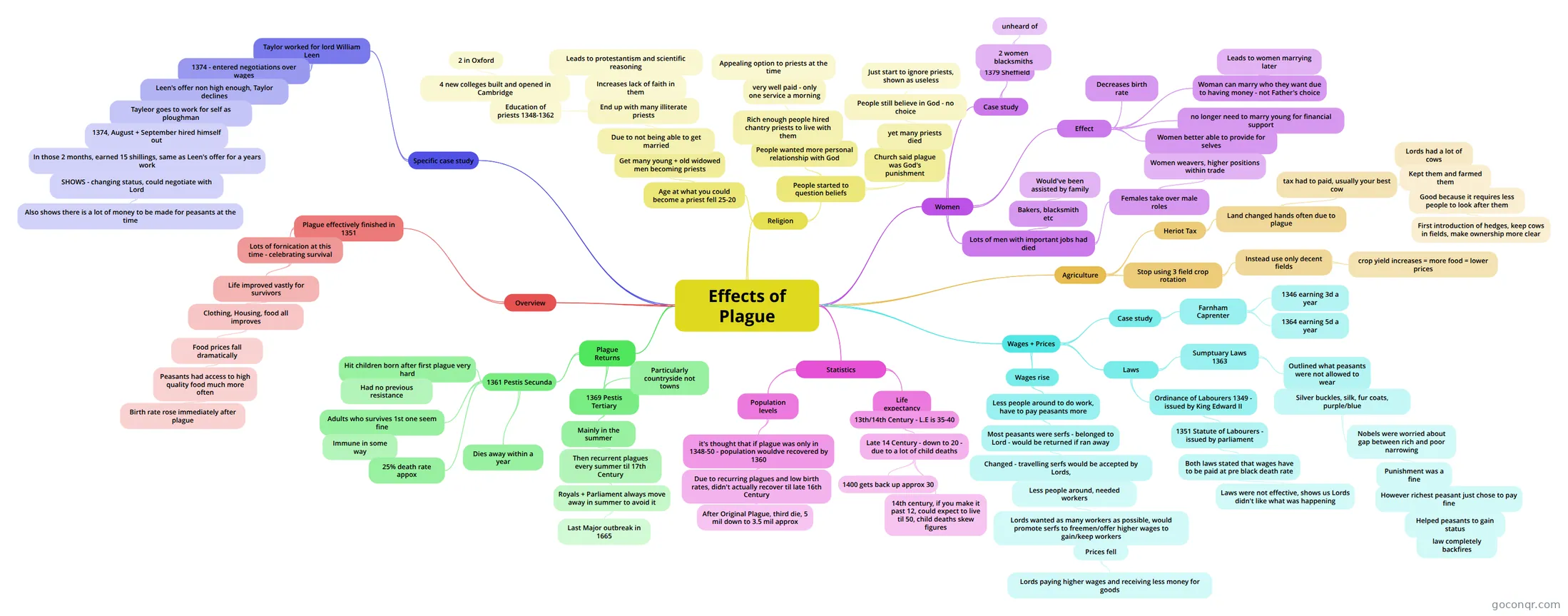
Mind map: Effects of the plague
Contenido del mapa
Effects of Plague
Overview
- Plague effectively finished in 1351
- Lots of fornication at this time - celebrating survival
- Life improved vastly for survivors
- Clothing, Housing, food all improves
- Food prices fall dramatically
- Peasants had access to high quality food much more often
- Birth rate rose immediately after plague
- Peasants had access to high quality food much more often
- Food prices fall dramatically
- Clothing, Housing, food all improves
- Life improved vastly for survivors
- Lots of fornication at this time - celebrating survival
- Plague effectively finished in 1351
Plague Returns
- 1361 Pestis Secunda
- Hit children born after first plague very hard
- Had no previous resistance
- Adults who survives 1st one seem fine
- Immune in some way
- 25% death rate appox
- Dies away within a year
- Hit children born after first plague very hard
- 1369 Pestis Tertiary
- Mainly in the summer
- Then recurrent plagues every summer til 17th Century
- Royals + Parliament always move away in summer to avoid it
- Last Major outbreak in 1665
- Royals + Parliament always move away in summer to avoid it
- Then recurrent plagues every summer til 17th Century
- Particularly countryside not towns
- Mainly in the summer
- 1361 Pestis Secunda
Statistics
- Population levels
- it's thought that if plague was only in 1348-50 - population wouldve recovered by 1360
- Due to recurring plagues and low birth rates, didn't actually recover til late 16th Century
- After Original Plague, third die, 5 mil down to 3.5 mil approx
- Due to recurring plagues and low birth rates, didn't actually recover til late 16th Century
- it's thought that if plague was only in 1348-50 - population wouldve recovered by 1360
- Life expectancy
- 13th/14th Century - L.E is 35-40
- Late 14 Century - down to 20 - due to a lot of child deaths
- 1400 gets back up approx 30
- 14th century, if you make it past 12, could expect to live til 50, child deaths skew figures
- Late 14 Century - down to 20 - due to a lot of child deaths
- 13th/14th Century - L.E is 35-40
- Population levels
Wages + Prices
- Wages rise
- Less people around to do work, have to pay peasants more
- Most peasants were serfs - belonged to Lord - would be returned if ran away
- Changed - travelling serfs would be accepted by Lords,
- Less people around, needed workers
- Lords wanted as many workers as possible, would promote serfs to freemen/offer higher wages to gain/keep workers
- Prices fell
- Lords paying higher wages and receiving less money for goods
- Prices fell
- Lords wanted as many workers as possible, would promote serfs to freemen/offer higher wages to gain/keep workers
- Less people around, needed workers
- Changed - travelling serfs would be accepted by Lords,
- Most peasants were serfs - belonged to Lord - would be returned if ran away
- Less people around to do work, have to pay peasants more
- Laws
- Ordinance of Labourers 1349 - issued by King Edward II
- 1351 Statute of Labourers - issued by parliament
- Both laws stated that wages have to be paid at pre black death rate
- Laws were not effective, shows us Lords didn't like what was happening
- Both laws stated that wages have to be paid at pre black death rate
- 1351 Statute of Labourers - issued by parliament
- Sumptuary Laws 1363
- Outlined what peasants were not allowed to wear
- Silver buckles, silk, fur coats, purple/blue
- Nobels were worried about gap between rich and poor narrowing
- Punishment was a fine
- However richest peasant just chose to pay fine
- Helped peasants to gain status
- law completely backfires
- Helped peasants to gain status
- However richest peasant just chose to pay fine
- Punishment was a fine
- Nobels were worried about gap between rich and poor narrowing
- Silver buckles, silk, fur coats, purple/blue
- Outlined what peasants were not allowed to wear
- Ordinance of Labourers 1349 - issued by King Edward II
- Case study
- Farnham Caprenter
- 1346 earning 3d a year
- 1364 earning 5d a year
- Farnham Caprenter
- Wages rise
Agriculture
- Stop using 3 field crop rotation
- Instead use only decent fields
- crop yield increases = more food = lower prices
- Instead use only decent fields
- Heriot Tax
- Land changed hands often due to plague
- tax had to paid, usually your best cow
- Lords had a lot of cows
- Kept them and farmed them
- Good because it requires less people to look after them
- First introduction of hedges, keep cows in fields, make ownership more clear
- Good because it requires less people to look after them
- Kept them and farmed them
- Lords had a lot of cows
- tax had to paid, usually your best cow
- Land changed hands often due to plague
- Stop using 3 field crop rotation
Women
- Lots of men with important jobs had died
- Bakers, blacksmith etc
- Would've been assisted by family
- Females take over male roles
- Women weavers, higher positions within trade
- Bakers, blacksmith etc
- Effect
- Women better able to provide for selves
- no longer need to marry young for financial support
- Woman can marry who they want due to having money - not Father's choice
- Leads to women marrying later
- Decreases birth rate
- Case study
- 1379 Sheffield
- 2 women blacksmiths
- unheard of
- 2 women blacksmiths
- 1379 Sheffield
- Lots of men with important jobs had died
Religion
- People started to question beliefs
- Church said plague was God's punishment
- yet many priests died
- People still believe in God - no choice
- Just start to ignore priests, shown as useless
- People still believe in God - no choice
- yet many priests died
- People wanted more personal relationship with God
- Rich enough people hired chantry priests to live with them
- very well paid - only one service a morning
- Appealing option to priests at the time
- very well paid - only one service a morning
- Rich enough people hired chantry priests to live with them
- Church said plague was God's punishment
- Age at what you could become a priest fell 25-20
- Get many young + old widowed men becoming priests
- Due to not being able to get married
- End up with many illiterate priests
- Increases lack of faith in them
- Leads to protestantism and scientific reasoning
- Education of priests 1348-1362
- 4 new colleges built and opened in Cambridge
- 2 in Oxford
- 4 new colleges built and opened in Cambridge
- Increases lack of faith in them
- End up with many illiterate priests
- Due to not being able to get married
- Get many young + old widowed men becoming priests
- People started to question beliefs
Specific case study
- Taylor worked for lord William Leen
- 1374 - entered negotiations over wages
- Leen's offer non high enough, Taylor declines
- Tayleor goes to work for self as ploughman
- 1374, August + September hired himself out
- In those 2 months, earned 15 shillings, same as Leen's offer for a years work
- SHOWS - changing status, could negotiate with Lord
- Also shows there is a lot of money to be made for peasants at the time
- SHOWS - changing status, could negotiate with Lord
- In those 2 months, earned 15 shillings, same as Leen's offer for a years work
- 1374, August + September hired himself out
- Tayleor goes to work for self as ploughman
- Leen's offer non high enough, Taylor declines
- 1374 - entered negotiations over wages
- Taylor worked for lord William Leen
Información
- Descripción
- A-Levels 14th Century History Mapa Mental sobre Effects of Plague, creado por jacksearle el 01/05/2013.
- Creado por
- jacksearle
- Visitas
- 191
- Etiquetas
- Valoración