
Mapa mental
Cells
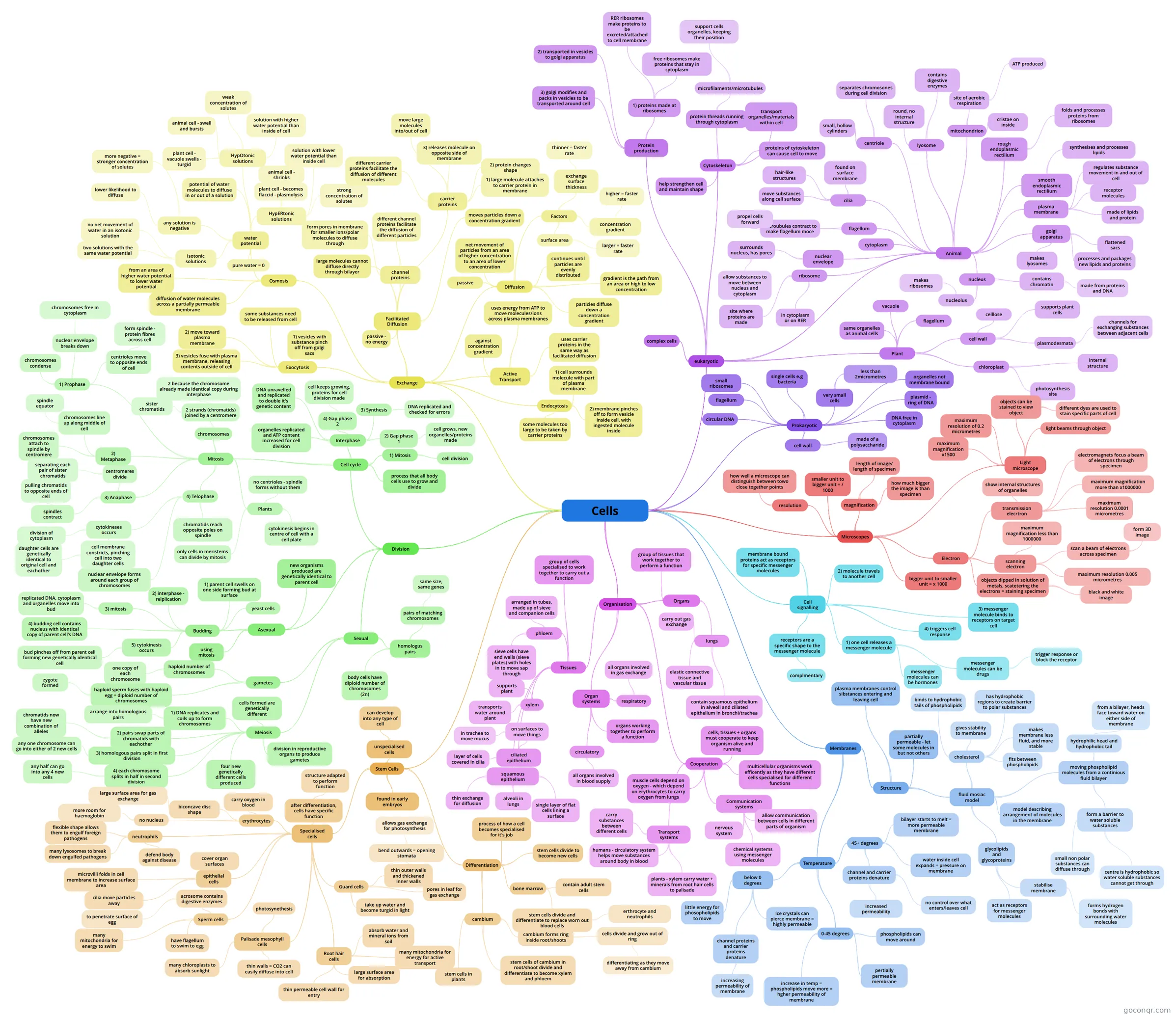
Mind map: Cells
Contenido del mapa
Cells
Prokaryotic
- single cells e.g bacteria
- DNA free in cytoplasm
- circular DNA
- cell wall
- made of a polysaccharide
- organelles not membrane bound
- small ribosomes
- very small cells
- less than 2micrometres
- flagellum
- plasmid - ring of DNA
eukaryotic
- complex cells
- Animal
- plasma membrane
- made of lipids and protein
- regulates substance movement in and out of cell
- receptor molecules
- nucleus
- nucleolus
- makes ribosomes
- contains chromatin
- made from proteins and DNA
- nucleolus
- golgi apparatus
- flattened sacs
- processes and packages new lipids and proteins
- makes lyosomes
- nuclear envelope
- surrounds nucleus, has pores
- allow substances to move between nucleus and cytoplasm
- surrounds nucleus, has pores
- ribosome
- in cytoplasm or on RER
- site where proteins are made
- rough endoplasmic rectilium
- folds and processes proteins from ribosomes
- smooth endoplasmic rectilium
- synthesises and processes lipids
- cytoplasm
- mitochondrion
- cristae on inside
- site of aerobic respiration
- ATP produced
- lyosome
- round, no internal structure
- contains digestive enzymes
- centriole
- small, hollow cylinders
- separates chromosones during cell division
- cilia
- hair-like structures
- found on surface membrane
- move substances along cell surface
- flagellum
- microubules contract to make flagellum moce
- propel cells forward
- microubules contract to make flagellum moce
- plasma membrane
- Plant
- same organelles as animal cells
- chloroplast
- internal structure
- photosynthesis site
- vacuole
- cell wall
- plasmodesmata
- channels for exchanging substances between adjacent cells
- celllose
- supports plant cells
- plasmodesmata
- flagellum
- Protein production
- 1) proteins made at ribosomes
- RER ribosomes make proteins to be excreted/attached to cell membrane
- free ribosomes make proteins that stay in cytoplasm
- 2) transported in vesicles to golgi apparatus
- 3) golgi modifies and packs in vesicles to be transported around cell
- 1) proteins made at ribosomes
- Cytoskeleton
- protein threads running through cytoplasm
- microfilaments/microtubules
- support cells organelles, keeping their position
- microfilaments/microtubules
- help strengthen cell and maintain shape
- transport organelles/materials within cell
- proteins of cytoskeleton can cause cell to move
- protein threads running through cytoplasm
Microscopes
- magnification
- length of image/ length of specimen
- how much bigger the image is than specimen
- bigger unit to smaller unit = x 1000
- smaller unit to bigger unit = / 1000
- resolution
- how well a microscope can distinguish between towo close together points
- Light microscope
- maximum resolution of 0.2 micrometres
- maximum magnification x1500
- light beams through object
- objects can be stained to view object
- different dyes are used to stain specific parts of cell
- Electron
- transmission elecrtron
- electromagnets focus a beam of electrons through specimen
- maximum resolution 0.0001 micrometres
- show internal structures of organelles
- maximum magnification more than x1000000
- objects dipped in solution of metals, scatetering the electrons = staining specimen
- black and white image
- scanning electron
- scan a beam of electrons across specimen
- form 3D image
- maximum resolution 0.005 micrometres
- maximum magnification less than 1000000
- scan a beam of electrons across specimen
- transmission elecrtron
- magnification
Membranes
- Structure
- fluid mosiac model
- model describing arrangement of molecules in the membrane
- moving phospholipid molecules from a continious fluid bilayer
- form a barrier to water soluble substances
- centre is hydrophobic so water soluble substances cannot get through
- small non polar substances can diffuse through
- hydrophilic head and hydrophobic tail
- from a bilayer, heads face toward water on either side of membrane
- form a barrier to water soluble substances
- cholesterol
- gives stability to membrane
- fits between phospholipids
- binds to hydrophobic tails of phospholipids
- makes membrane less fluid, and more stable
- has hydrophobic regions to create barrier to polar substances
- glycolipids and glycoproteins
- stabilise membrane
- forms hydrogen bonds with surrounding water molecules
- act as receptors for messenger molecules
- stabilise membrane
- plasma membranes control sibstances entering and leaving cell
- partially permeable - let some molecules in but not others
- fluid mosiac model
- Temperature
- below 0 degrees
- little energy for phosopholipids to move
- channel proteins and carrier proteins denature
- increasing permeability of membrane
- ice crystals can pierce membrane = highly permeable
- 0-45 degrees
- phospholipids can move around
- pertially permeable membrane
- increase in temp = phospholipids move more = hgher permeability of membrane
- 45+ degrees
- bilayer starts to melt = more permeable membrane
- water inside cell expands = pressure on membrane
- channel and carrier proteins denature
- no control over what enters/leaves cell
- increased permeability
- below 0 degrees
- Structure
Cell signalling
- 1) one cell releases a messenger molecule
- messenger molecules can be hormones
- messenger molecules can be drugs
- trigger response or block the receptor
- 2) molecule travels to another cell
- 3) messenger molecule binds to receptors on target cell
- 4) triggers cell response
- membrane bound proteins act as receptors for specific messenger molecules
- receptors are a specific shape to the messenger molecule
- complmentary
- 1) one cell releases a messenger molecule
Exchange
- Diffusion
- net movement of particles from an area of higher concentration to an area of lower concentration
- gradient is the path from an area or high to low concentration
- particles diffuse down a concentration gradient
- continues until particles are evenly distributed
- passive
- Factors
- concentration gradient
- higher = faster rate
- exchange surface thickness
- thinner = faster rate
- surface area
- larger = faster rate
- concentration gradient
- Osmosis
- diffusion of water molecules across a partially permeable membrane
- from an area of higher water potential to lower water potential
- water potential
- potential of water molecules to diffuse in or out of a solution
- pure water = 0
- any solution is negative
- lower likelihood to diffuse
- more negative = stronger concentration of solutes
- Isotonic solutions
- two solutions with the same water potential
- no net movement of water in an isotonic solution
- HypOtonic solutions
- solution with higher water potential than inside of cell
- weak concentration of solutes
- plant cell - vacuole swells - turgid
- animal cell - swell and bursts
- HypERtonic solutions
- solution with lower water potential than inside cell
- plant cell - becomes flaccid - plasmolysis
- animal cell - shrinks
- strong concentration of solutes
- Facilitated Diffusion
- large molecules cannot diffuse directly through bilayer
- moves particles down a concentration gradient
- passive - no energy
- carrier proteins
- move large molecules into/out of cell
- 1) large molecule attaches to carrier protein in membrane
- 2) protein changes shape
- 3) releases molecule on opposite side of membrane
- different carrier proteins facilitate the diffusion of different molecules
- channel proteins
- form pores in membrane for smaller ions/polar molecules to diffuse through
- different channel proteins facilitate the diffusion of different particles
- Active Transport
- uses energy from ATP to move molecules/ions across plasma membranes
- against concentration gradient
- uses carrier proteins in the same way as facilitated diffusion
- Endocytosis
- 1) cell surrounds molecule with part of plasma membrane
- 2) membrane pinches off to form vesicle inside cell, with ingested molecule inside
- some molecules too large to be taken by carrier proteins
- Exocytosis
- some substances need to be released from cell
- 1) vesicles with substance pinch off from golgi sacs
- 2) move toward plasma membrane
- 3) vesicles fuse with plasma membrane, releasing contents outside of cell
- Diffusion
Division
- Cell cycle
- process that all body cells use to grow and divide
- 1) Mitosis
- cell division
- Interphase
- 2) Gap phase 1
- cell grows, new organelles/proteins made
- 3) Synthesis
- DNA replicated and checked for errors
- 4) Gap phase 2
- cell keeps growing, proteins for cell division made
- DNA unravelled and replicated to double it's genetic content
- organelles replicated and ATP content increased for cell division
- 2) Gap phase 1
- Mitosis
- chromosomes
- 2 strands (chromatids) joined by a centromere
- sister chromatids
- 2 because the chromosome already made identical copy during interphase
- 2 strands (chromatids) joined by a centromere
- 1) Prophase
- chromosomes condense
- centrioles move to opposite ends of cell
- form spindle - protein fibres across cell
- nuclear envelope breaks down
- chromosomes free in cytoplasm
- 2) Metaphase
- chromosomes line up along middle of cell
- spindle equator
- chromosomes attach to spindle by centromere
- chromosomes line up along middle of cell
- 3) Anaphase
- centromeres divide
- separating each pair of sister chromatids
- spindles contract
- pulling chromatids to opposite ends of cell
- centromeres divide
- 4) Telophase
- chromatids reach opposite poles on spindle
- nuclear envelope forms around each group of chromosomes
- cytokineses occurs
- division of cytoplasm
- cell membrane constricts, pinching cell into two daughter cells
- daughter cells are genetically identical to original cell and eachother
- Plants
- only cells in meristems can divide by mitosis
- no centrioles - spindle forms without them
- cytokinesis begins in centre of cell with a cell plate
- chromosomes
- Asexual
- using mitosis
- new organisms produced are genetically identical to parent cell
- Budding
- 1) parent cell swells on one side forming bud at surface
- yeast cells
- 2) interphase - relplication
- 3) mitosis
- replicated DNA, cytoplasm and organelles move into bud
- 4) budding cell contains nucleus with identical copy of parent cell's DNA
- 5) cytokinesis occurs
- bud pinches off from parent cell forming new genetically identical cell
- Sexual
- homologus pairs
- pairs of matching chromosomes
- same size, same genes
- body cells have diploid number of chromosomes (2n)
- pairs of matching chromosomes
- gametes
- haploid number of chromosomes
- one copy of each chromosome
- haploid sperm fuses with haploid egg = diploid number of chromosomes
- zygote formed
- haploid number of chromosomes
- Meiosis
- division in reproductive organs to produce gametes
- cells formed are genetically different
- 1) DNA replicates and coils up to form chromosomes
- arrange into homologous pairs
- 2) pairs swap parts of chromatids with eachother
- chromatids now have new combination of alleles
- 3) homologous pairs split in first division
- any one chromosome can go into either of 2 new cells
- 4) each chromosome splits in half in second division
- any half can go into any 4 new cells
- four new genetically different cells produced
- homologus pairs
- Cell cycle
Stem Cells
- unspecialised cells
- can develop into any type of cell
- found in early embryos
- Differentiation
- stem cells divide to become new cells
- process of how a cell becomes specialised for it's job
- bone marrow
- contain adult stem cells
- stem cells divide and differentiate to replace worn out blood cells
- erthrocyte and neutrophils
- cambium
- stem cells in plants
- stem cells of cambium in root/shoot divide and differentiate to become xylem and phloem
- cambium forms ring inside root/shoots
- cells divide and grow out of ring
- differentiating as they move away from cambium
- cells divide and grow out of ring
- Specialised cells
- after differentiation, cells have specific function
- structure adapted to perform function
- erythrocytes
- carry oxygen in blood
- biconcave disc shape
- large surface area for gas exchange
- no nucleus
- more room for haemoglobin
- neutrophils
- defend body against disease
- flexible shape allows them to engulf foreign pathogens
- many lysosomes to break down engulfed pathogens
- epithelial cells
- cover organ surfaces
- cilia move particles away
- microvilli folds in cell membrane to increase surface area
- Sperm cells
- have flagellum to swim to egg
- many mitochondria for energy to swim
- acrosome contains digestive enzymes
- to penetrate surface of egg
- Palisade mesophyll cells
- many chloroplasts to absorb sunlight
- photosynethesis
- thin walls = CO2 can easily diffuse into cell
- Root hair cells
- absorb water and mineral ions from soil
- large surface area for absorption
- thin permeable cell wall for entry
- many mitochondria for energy for active transport
- Guard cells
- pores in leaf for gas exchange
- thin outer walls and thickened inner walls
- bend outwards = opening stomata
- allows gas exchange for photosynthesis
- bend outwards = opening stomata
- take up water and become turgid in light
- after differentiation, cells have specific function
- unspecialised cells
Organisation
- Tissues
- group of cells specialised to work together to carry out a function
- squamous epithelium
- single layer of flat cells lining a surface
- thin exchange for diffusion
- alveoli in lungs
- ciliated epithelium
- layer of cells covered in cilia
- on surfaces to move things
- in trachea to move mucus
- xylem
- transports water around plant
- supports plant
- phloem
- arranged in tubes, made up of sieve and companion cells
- sieve cells have end walls (sieve plates) with holes in to move sap through
- Cooperation
- multicellular organisms work efficently as they have different cells specialised for different functions
- cells, tissues + organs must cooperate to keep organism alive and running
- Transport systems
- carry substances between different cells
- plants - xylem carry water + minerals from root hair cells to palisade
- humans - circulatory system helps move substances around body in blood
- Communication systems
- allow communication between cells in different parts of organism
- chemical systems using messenger molecules
- nervous system
- muscle cells depend on oxygen - which depend on erythrocytes to carry oxygen from lungs
- Organs
- group of tissues that work together to perform a function
- lungs
- carry out gas exchange
- contain squamous epithelium in alveoli and ciliated epithelium in bronchi/trachea
- elastic connective tissue and vascular tissue
- Organ systems
- organs working together to perform a function
- respiratory
- all organs involved in gas exchange
- circulatory
- all organs involved in blood supply
- Tissues
Información
- Descripción
- A-Levels Biology f211 Mapa Mental sobre Cells, creado por Gemma Bradford el 02/05/2013.
- Creado por
- Gemma Bradford
- Visitas
- 74
- Etiquetas
- Valoración