
Mapa mental
Chapter Six
Contenido del mapa
Chapter Six
Learning = relatively durable change in behaviour or knowledge due to experience
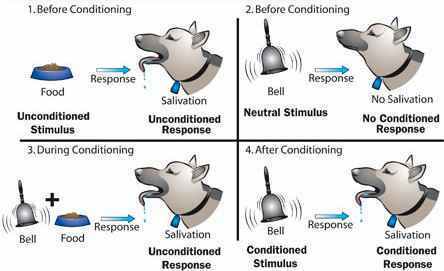
Classic conditioning = type of learning in which stimulus acquires capacity to evoke response that originally evoked by another stimulus
- Pavlovian conditioning
- Psychic reflexes
- Classic Cond. - elicited (automatic)
- Psychic reflexes
- Neutral stimulus paired with unconditioned stimulus elicits unconditioned response
- Neutral becomes conditioned and elicits conditioned responce
- Conditioned responses include involuntary reflexes and visceral responses
- CS = through conditioning acquires capacity to evoke conditioned response
- CR = learned reaction because of conditioning
- Trial = presentation of stimulus
- UCS = evokes UCR without previous conditioning
- UCR = unlearned reaction to UCS without previous conditioning
- Neutral becomes conditioned and elicits conditioned responce
- Fear and anxiety
- Phobias = irrational fears
- Attitudes
- Evaluative conditioning = changes in liking of stimulus that result from pairing stimulus with positive of negative stimuli
- Physiological response
- immunosuppression = decrease in production of antibodies
- allergic reactions
- Drug effects
- drug tolerance
- Conditioned response are reactions opposite of normal effects of drugs
- Compensatory CRS - maintain homeostasis
- Basic processes
- Acquisition = initial stage of learning
- Depends on stimulus contiguity (occur together)
- Extinction = gradual weakening or disappearance of CR
- Due to consistent presentation of stimulus ALONE
- Spontaneous recovery
- Reappearance of extinguished response after period of nonexposure of CS
- Renewal Effect = response extinguished in different enviroment that it was acquired, extinguished response will appear if animal is returned to original enviroment
- Stimulus generalization = occurs when organism that has learned specific response to stimulus, responses in same way to similar stimulus
- the more similar new stimuli are to original CS the greater the generalization
- John B Watson
- Examined generalization of conditioned fear on "Little Albert"
- Initially afraid of white rat, paired with loud noise, showing fear to noise
- rat - CS eliciting fear (generalizing fear with white objects)
- Initially afraid of white rat, paired with loud noise, showing fear to noise
- Examined generalization of conditioned fear on "Little Albert"
- Stimulus discrimination = organism learned response to specific stimulus does not respond the same way to similar stimuli
- Less similar new stimuli are to original CS, greater likelihood of discrimination
- Higher order conditioning = conditioned stimulus functions as if it was an unconditioned stimulus
- new CR are built on foundation of already established CR
- Cognition - predictions/expectations
- Response followed by positive outcome is strengthened
- Acquisition = initial stage of learning
- Biological Effects
- "Sauce Bearnaise Syndrome" - develop aversions to food followed by illness
- sauce (NS) paired with the flu (US) created nausea (UCR) Sauce became the CS
- Aversions selectively seek flavors o the exclusion of other stimuli
- Preparedness = species specific predisposition to be conditioned in certain ways
- "Sauce Bearnaise Syndrome" - develop aversions to food followed by illness
- Pavlovian conditioning
Operant Conditioning (instrumental learning) = form of learning in which responses come to be controlled by consequences
- Thorndike's law of effect = response to presence of stimulus leads to satisfying effects, association between stimulus and response is strengthened
- Skinner
- Baby Box - organisms tend to repeat responses followed by favorable consequences
- Reinforcement: event following a response increases tendency to make response
- Primary - events that inherently reinforcing because they satisfy biological needs
- Secondary/conditioned - events acquire reinforcing qualities by association with primary reinforcers
- Schedule of reinforcement - determines which occurrences of specific response result in presentation of reinforcer
- Continuous reinforcement - every instance of response is enforced
- Partial reinforcement - response is reinforced some of the time
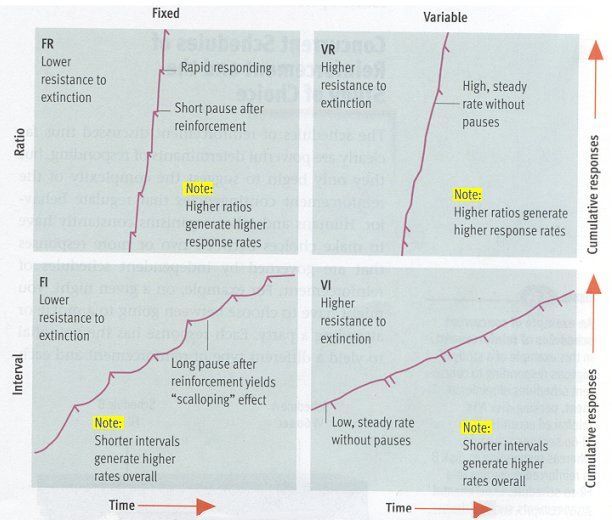
- Fixed ratio schedule: reinforcer is given after fixed number of nonreinforced responses
- Variable ration response: reinforcer is given after variable number of nonreinforced responses
- Fixed interval schedule: reinforcer is given for first response that occurs after a fixed time interval
- Variable interval schedule: reinforcer is given for first response after variable time interval
- Positive reinforcement: occurs when response is strengthened by followed by rewarding stimulus
- Eg.) promotions, good grades, etc
- Negative reinforcement: response is strengthened after removal of unpleasant stimulus
- Eg.) Cleaning to get rid of mess, medication to get better, etc
- Escape learning: organism acquires response that ends aversive stimulation
- Avoidance learning: Organism acquires response that prevent aversive stimulation
- Punishment - event following response weakens tendency to make response
- Positive punishment: application of aversive consequences
- Negative punishment: removal of reward
- Operant chamber (skinner box); animal can make specific response that is recorded while consequences of response are controlled
- Reinforcement contingencies: rules that determine if responses lead to presentation of reinforcers
- Experimenter manipulates if positive consequences occur when animal makes correct response
- cumulative recorder: graphic recording and reinforcement in box as function of time
- dependent variable - response rate
- Rapid response = steep slope Slow response = shallow slope
- Reinforcement contingencies: rules that determine if responses lead to presentation of reinforcers
- Reinforcement: event following a response increases tendency to make response
- Baby Box - organisms tend to repeat responses followed by favorable consequences
- Shaping: reinforcement of closer and closer approximations of desired response
- When organism does not emit response on its own
- Terms
- Extinction - When previous available reinforcement is stopped (CS presented alone until it no longer elicits CR)
- Resistance to extinction: organism continues to make response after reinforcement has been eliminated
- Discriminative stimuli: cues that influence operant behaviour by indicating probable consequences
- Stimulus generalization: responding to stimulus as if it was original
- Stimulus discrimination: Respond to only original stimulus
- Latent learning: learning not apparent from behaviour when first occurs
- Instinctive drift: innate response interfere with conditioning response
- Extinction - When previous available reinforcement is stopped (CS presented alone until it no longer elicits CR)
Observational Learning= organisms responding is influenced by observation of others (models)
- Observer attends to models behaviour and its consequences
- Tendency to emit response strengthened or weakened depending on consequences observed
- Basic Processes
- Attention - pay attention to behaviour and consequences
- Retention - store in memory a mental representation until response is used
- Reproduction - Ability to copy behaviour
- Motivation - Motivation in situation where behaviour is likely to pay off
- Albert Bandura
- Mirror neurons: activated by performing an action or by seeing another person perform same action
- Observer attends to models behaviour and its consequences
Imágenes y archivos del mapa
Información
- Descripción
- Psychology Mapa Mental sobre Chapter Six, creado por Mackenzie Fabbro el 17/02/2017.
- Creado por
- Mackenzie Fabbro
- Visitas
- 7
- Etiquetas
- Valoración