
Mapa mental
Attachment
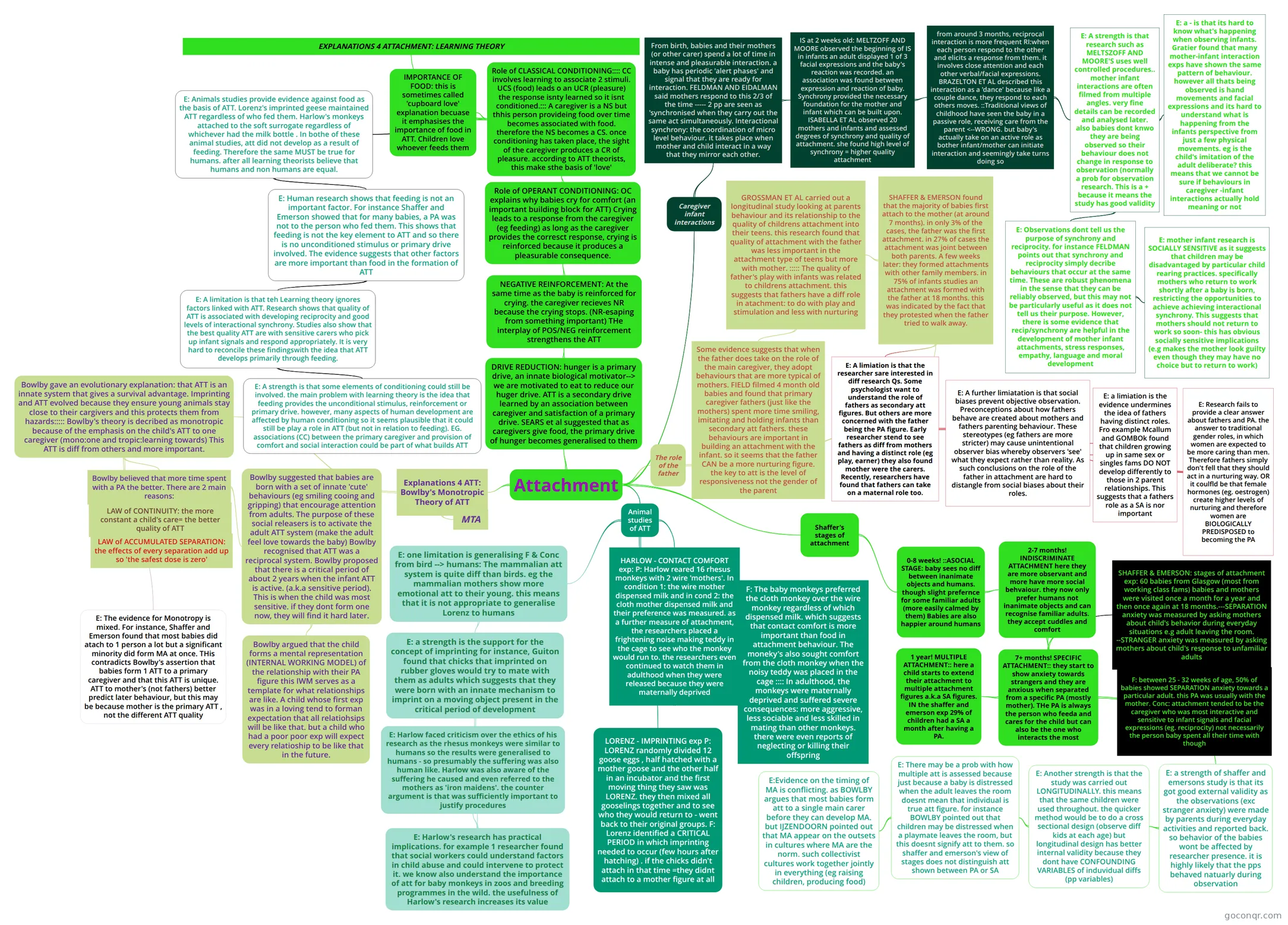
Mind map: Attachment psychology
Contenido del mapa
Attachment
Caregiver infant interactions
- From birth, babies and their mothers (or other carer) spend a lot of time in intense and pleasurable interaction. a baby has periodic 'alert phases' and signal that they are ready for interaction. FELDMAN AND EIDALMAN said mothers respond to this 2/3 of the time ----- 2 pp are seen as 'synchronised when they carry out the same act simultaneously. Interactional synchrony: the coordination of micro level behaviour. it takes place when mother and child interact in a way that they mirror each other.
- IS at 2 weeks old: MELTZOFF AND MOORE observed the beginning of IS in infants an adult displayed 1 of 3 facial expressions and the baby's reaction was recorded. an association was found between expression and reaction of baby. Synchrony provided the necessary foundation for the mother and infant which can be built upon. ISABELLA ET AL observed 20 mothers and infants and assessed degrees of synchrony and quality of attachment. she found high level of synchrony = higher quality attachment
- from around 3 months, reciprocal interaction is more frequent RI:when each person respond to the other and elicits a response from them. it involves close attention and each other verbal/facial expressions. BRAZELTON ET AL described this interaction as a 'dance' because like a couple dance, they respond to each others moves. ::Traditional views of childhood have seen the baby in a passive role, receiving care from the parent <--WRONG. but baby's actually take on an active role as bother infant/mother can initiate interaction and seemingly take turns doing so
- E: A strength is that research such as MELTSZOFF AND MOORE'S uses well controlled procedures.. mother infant interactions are often filmed from multiple angles. very fine details can be recorded and analysed later. also babies dont knwo they are being observed so their behaviour does not change in response to observation (normally a prob for observation research. This is a + because it means the study has good validity
- E: a - is that its hard to know what's happening when observing infants. Gratier found that many mother-infant interaction exps have shown the same pattern of behaviour. however all thats being observed is hand movements and facial expressions and its hard to understand what is happening from the infants perspective from just a few physical movements. eg is the child's imitation of the adult deliberate? this means that we cannot be sure if behaviours in caregiver -infant interactions actually hold meaning or not
- E: Observations dont tell us the purpose of synchrony and reciprocity. for instance FELDMAN points out that synchrony and reciprocity simply decribe behaviours that occur at the same time. These are robust phenomena in the sense that they can be reliably observed, but this may not be particularly useful as it does not tell us their purpose. However, there is some evidence that recip/synchrony are helpful in the development of mother infant attachments, stress responses, empathy, language and moral development
- E: mother infant research is SOCIALLY SENSITIVE as it suggests that children may be disadvantaged by particular child rearing practices. specifically mothers who return to work shortly after a baby is born, restricting the opportunities to achieve achieving interactional synchrony. This suggests that mothers should not return to work so soon- this has obvious socially sensitive implications (e.g makes the mother look guilty even though they may have no choice but to return to work)
- E: A strength is that research such as MELTSZOFF AND MOORE'S uses well controlled procedures.. mother infant interactions are often filmed from multiple angles. very fine details can be recorded and analysed later. also babies dont knwo they are being observed so their behaviour does not change in response to observation (normally a prob for observation research. This is a + because it means the study has good validity
- from around 3 months, reciprocal interaction is more frequent RI:when each person respond to the other and elicits a response from them. it involves close attention and each other verbal/facial expressions. BRAZELTON ET AL described this interaction as a 'dance' because like a couple dance, they respond to each others moves. ::Traditional views of childhood have seen the baby in a passive role, receiving care from the parent <--WRONG. but baby's actually take on an active role as bother infant/mother can initiate interaction and seemingly take turns doing so
- IS at 2 weeks old: MELTZOFF AND MOORE observed the beginning of IS in infants an adult displayed 1 of 3 facial expressions and the baby's reaction was recorded. an association was found between expression and reaction of baby. Synchrony provided the necessary foundation for the mother and infant which can be built upon. ISABELLA ET AL observed 20 mothers and infants and assessed degrees of synchrony and quality of attachment. she found high level of synchrony = higher quality attachment
- From birth, babies and their mothers (or other carer) spend a lot of time in intense and pleasurable interaction. a baby has periodic 'alert phases' and signal that they are ready for interaction. FELDMAN AND EIDALMAN said mothers respond to this 2/3 of the time ----- 2 pp are seen as 'synchronised when they carry out the same act simultaneously. Interactional synchrony: the coordination of micro level behaviour. it takes place when mother and child interact in a way that they mirror each other.
The role of the father
- SHAFFER & EMERSON found that the majority of babies first attach to the mother (at around 7 months). in only 3% of the cases, the father was the first attachment. in 27% of cases the attachment was joint between both parents. A few weeks later: they formed attachments with other family members. in 75% of infants studies an attachment was formed with the father at 18 months. this was indicated by the fact that they protested when the father tried to walk away.
- GROSSMAN ET AL carried out a longitudinal study looking at parents behaviour and its relationship to the quality of childrens attachment into their teens. this research found that quality of attachment with the father was less important in the attachment type of teens but more with mother. ::::: The quality of father's play with infants was related to childrens attachment. this suggests that fathers have a diff role in atachment: to do with play and stimulation and less with nurturing
- Some evidence suggests that when the father does take on the role of the main caregiver, they adopt behaviours that are more typical of mothers. FIELD filmed 4 month old babies and found that primary caregiver fathers (just like the mothers) spent more time smiling, imitating and holding infants than secondary att fathers. these behaviours are important in building an attachment with the infant. so it seems that the father CAN be a more nurturing figure. the key to att is the level of responsiveness not the gender of the parent
- E: A limiation is that the researcher sare interested in diff research Qs. Some psychologist want to understand the role of fathers as secondary att figures. But others are more concerned with the father being the PA figure. Early researcher stend to see fathers as diff from mothers and having a distinct role (eg play, earner) they also found mother were the carers. Recently, researchers have found that fathers can take on a maternal role too.
- E: a limiation is the evidence undermines the idea of fathers having distinct roles. Fro example Mcallum and GOMBOk found that children growing up in same sex or singles fams DO NOT develop differently to those in 2 parent relationships. This suggests that a fathers role as a SA is nor important
- E: Research fails to provide a clear answer about fathers and PA. the answer to traditional gender roles, in which women are expected to be more caring than men. Therefore fathers simply don't fell that they should act in a nurturing way. OR it coulfld be that female hormones (eg. oestrogen) create higher levels of nurturing and therefore women are BIOLOGICALLY PREDISPOSED to becoming the PA
- E: A further limiatation is that social biases prevent objective observation. Preconceptions about how fathers behave are created about mothers and fathers parenting behaviour. These stereotypes (eg fathers are more stricter) may cause unintentional observer bias whereby observers 'see' what they expect rather than reality. As such conclusions on the role of the father in attachment are hard to distangle from social biases about their roles.
- GROSSMAN ET AL carried out a longitudinal study looking at parents behaviour and its relationship to the quality of childrens attachment into their teens. this research found that quality of attachment with the father was less important in the attachment type of teens but more with mother. ::::: The quality of father's play with infants was related to childrens attachment. this suggests that fathers have a diff role in atachment: to do with play and stimulation and less with nurturing
- SHAFFER & EMERSON found that the majority of babies first attach to the mother (at around 7 months). in only 3% of the cases, the father was the first attachment. in 27% of cases the attachment was joint between both parents. A few weeks later: they formed attachments with other family members. in 75% of infants studies an attachment was formed with the father at 18 months. this was indicated by the fact that they protested when the father tried to walk away.
Shaffer's stages of attachment
- 0-8 weeks! ::ASOCIAL STAGE: baby sees no diff between inanimate objects and humans. though slight prefernce for some familiar adults (more easily calmed by them) Babies are also happier around humans
- 2-7 months! INDISCRIMINATE ATTACHMENT here they are more observant and more have more social behvaiour. they now only prefer humans not inanimate objects and can recognise familiar adults. they accept cuddles and comfort
- 7+ months! SPECIFIC ATTACHMENT:: they start to show anxiety towards strangers and they are anxious when separated from a specific PA (mostly mother). THe PA is always the person who feeda and cares for the child but can also be the one who interacts the most
- 1 year! MULTIPLE ATTACHMENT:: here a child starts to extend their attachment to multiple attachment figures a.k.a SA figures. IN the shaffer and emerson exp 29% of children had a SA a month after having a PA.
- SHAFFER & EMERSON: stages of attachment exp: 60 babies from Glasgow (most from working class fams) babies and mothers were visited once a month for a year and then once again at 18 months.---SEPARATION anxiety was measured by asking mothers about child's behavior during everyday situations e.g adult leaving the room. --STRANGER anxiety was measured by asking mothers about child's response to unfamiliar adults
- F: between 25 - 32 weeks of age, 50% of babies showed SEPARATION anxiety towards a particular adult. this PA was usually with the mother. Conc: attachment tended to be the caregiver who was most interactive and sensitive to infant signals and facial expressions (eg. reciprocity) not necessarily the person baby spent all their time with though
- E: a strength of shaffer and emersons study is that its got good external validity as the observations (exc stranger anxiety) were made by parents during everyday activities and reported back. so behavior of the babies wont be affected by researcher presence. it is highly likely that the pps behaved natuarly during observation
- E: Another strength is that the study was carried out LONGITUDINALLY. this means that the same children were used throughout. the quicker method would be to do a cross sectional design (observe diff kids at each age) but longitudinal design has better internal validity because they dont have CONFOUNDING VARIABLES of induvidual diffs (pp variables)
- E: There may be a prob with how multiple att is assessed because just because a baby is distressed when the adult leaves the room doesnt mean that individual is true att figure. for instance BOWLBY pointed out that children may be distressed when a playmate leaves the room, but this doesnt signify att to them. so shaffer and emerson's view of stages does not distinguish att shown between PA or SA
- E:Evidence on the timing of MA is conflicting. as BOWLBY argues that most babies form att to a single main carer before they can develop MA. but IJZENDOORN pointed out that MA appear on the outsets in cultures where MA are the norm. such collectivist cultures work together jointly in everything (eg raising children, producing food)
- E: There may be a prob with how multiple att is assessed because just because a baby is distressed when the adult leaves the room doesnt mean that individual is true att figure. for instance BOWLBY pointed out that children may be distressed when a playmate leaves the room, but this doesnt signify att to them. so shaffer and emerson's view of stages does not distinguish att shown between PA or SA
- E: Another strength is that the study was carried out LONGITUDINALLY. this means that the same children were used throughout. the quicker method would be to do a cross sectional design (observe diff kids at each age) but longitudinal design has better internal validity because they dont have CONFOUNDING VARIABLES of induvidual diffs (pp variables)
- 7+ months! SPECIFIC ATTACHMENT:: they start to show anxiety towards strangers and they are anxious when separated from a specific PA (mostly mother). THe PA is always the person who feeda and cares for the child but can also be the one who interacts the most
- 2-7 months! INDISCRIMINATE ATTACHMENT here they are more observant and more have more social behvaiour. they now only prefer humans not inanimate objects and can recognise familiar adults. they accept cuddles and comfort
- 0-8 weeks! ::ASOCIAL STAGE: baby sees no diff between inanimate objects and humans. though slight prefernce for some familiar adults (more easily calmed by them) Babies are also happier around humans
Animal studies of ATT
- LORENZ - IMPRINTING exp P: LORENZ randomly divided 12 goose eggs , half hatched with a mother goose and the other half in an incubator and the first moving thing they saw was LORENZ. they then mixed all gooselings together and to see who they would return to - went back to their original groups. F: Lorenz identified a CRITICAL PERIOD in which imprinting needed to occur (few hours after hatching) . if the chicks didn't attach in that time =they didnt attach to a mother figure at all
- HARLOW - CONTACT COMFORT exp: P: Harlow reared 16 rhesus monkeys with 2 wire 'mothers'. In condition 1: the wire mother dispensed milk and in cond 2: the cloth mother dispensed milk and their preference was measured. as a further measure of attachment, the researchers placed a frightening noise making teddy in the cage to see who the monkey would run to. the researchers even continued to watch them in adulthood when they were released because they were maternally deprived
- F: The baby monkeys preferred the cloth monkey over the wire monkey regardless of which dispensed milk. which suggests that contact comfort is more important than food in attachment behaviour. The moneky's also sought comfort from the cloth monkey when the noisy teddy was placed in the cage :::: In adulthood, the monkeys were maternally deprived and suffered severe consequences: more aggressive, less sociable and less skilled in mating than other monkeys. there were even reports of neglecting or killing their offspring
- E: one limitation is generalising F & Conc from bird --> humans: The mammalian att system is quite diff than birds. eg the mammalian mothers show more emotional att to their young. this means that it is not appropriate to generalise Lorenz to humans
- E: a strength is the support for the concept of imprinting for instance, Guiton found that chicks that imprinted on rubber gloves would try to mate with them as adults which suggests that they were born with an innate mechanism to imprint on a moving object present in the critical period of development
- E: Harlow's research has practical implications. for example 1 researcher found that social workers could understand factors in child abuse and could intervene to protect it. we know also understand the importance of att for baby monkeys in zoos and breeding programmes in the wild. the usefulness of Harlow's research increases its value
- E: Harlow faced criticism over the ethics of his research as the rhesus monkeys were similar to humans so the results were generalised to humans - so presumably the suffering was also human like. Harlow was also aware of the suffering he caused and even referred to the mothers as 'iron maidens'. the counter argument is that was sufficiently important to justify procedures
- E: Harlow's research has practical implications. for example 1 researcher found that social workers could understand factors in child abuse and could intervene to protect it. we know also understand the importance of att for baby monkeys in zoos and breeding programmes in the wild. the usefulness of Harlow's research increases its value
- E: a strength is the support for the concept of imprinting for instance, Guiton found that chicks that imprinted on rubber gloves would try to mate with them as adults which suggests that they were born with an innate mechanism to imprint on a moving object present in the critical period of development
DRIVE REDUCTION: hunger is a primary drive, an innate biological motivator--> we are motivated to eat to reduce our huger drive. ATT is a secondary drive learned by an association between caregiver and satisfaction of a primary drive. SEARS et al suggested that as caregivers give food, the primary drive of hunger becomes generalised to them
- NEGATIVE REINFORCEMENT: At the same time as the baby is reinforced for crying. the caregiver recieves NR because the crying stops. (NR-esaping from something important) THe interplay of POS/NEG reinforcement strengthens the ATT
- Role of OPERANT CONDITIONING: OC explains why babies cry for comfort (an important building block for ATT) Crying leads to a response from the caregiver (eg feeding) as long as the caregiver provides the corresct response, crying is reinforced because it produces a pleasurable consequence.
- Role of CLASSICAL CONDITIONING:::: CC involves learning to associate 2 stimuli. UCS (food) leads o an UCR (pleasure) the response isnty learned so it isnt conditioned.::: A caregiver is a NS but thhis person provideing food over time becomes associated with food. therefore the NS becomes a CS. once conditioning has taken place, the sight of the caregiver produces a CR of pleasure. according to ATT theorists, this make sthe basis of 'love'
- EXPLANATIONS 4 ATTACHMENT: LEARNING THEORY
- IMPORTANCE OF FOOD: this is sometimes called 'cupboard love' explanation becuase it emphasises the importance of food in ATT. Children love whoever feeds them
- E: Animals studies provide evidence against food as the basis of ATT. Lorenz's imprinted geese maintained ATT regardless of who fed them. Harlow's monkeys attached to the soft surrogate regardless of whichever had the milk bottle . In bothe of these animal studies, att did not develop as a result of feeding. Therefore the same MUST be true for humans. after all learning theorists believe that humans and non humans are equal.
- E: Human research shows that feeding is not an important factor. For instance Shaffer and Emerson showed that for many babies, a PA was not to the person who fed them. This shows that feeding is not the key element to ATT and so there is no unconditioned stimulus or primary drive involved. The evidence suggests that other factors are more important than food in the formation of ATT
- E: A limitation is that teh Learning theory ignores factors linked with ATT. Research shows that quality of ATT is associated with developing reciprocity and good levels of interactional synchrony. Studies also show that the best quality ATT are with sensitive carers who pick up infant signals and respond appropriately. It is very hard to reconcile these findingswith the idea that ATT develops primarily through feeding.
- E: A strength is that some elements of conditioning could still be involved. the main problem with learning theory is the idea that feeding provides the unconditional stimulus, reinforcement or primary drive. however, many aspects of human development are affected by human conditioning so it seems plausible that it could still be play a role in ATT (but not in relation to feeding). EG. associations (CC) between the primary caregiver and provision of comfort and social interaction could be part of what builds ATT
- E: A limitation is that teh Learning theory ignores factors linked with ATT. Research shows that quality of ATT is associated with developing reciprocity and good levels of interactional synchrony. Studies also show that the best quality ATT are with sensitive carers who pick up infant signals and respond appropriately. It is very hard to reconcile these findingswith the idea that ATT develops primarily through feeding.
- E: Human research shows that feeding is not an important factor. For instance Shaffer and Emerson showed that for many babies, a PA was not to the person who fed them. This shows that feeding is not the key element to ATT and so there is no unconditioned stimulus or primary drive involved. The evidence suggests that other factors are more important than food in the formation of ATT
- Role of CLASSICAL CONDITIONING:::: CC involves learning to associate 2 stimuli. UCS (food) leads o an UCR (pleasure) the response isnty learned so it isnt conditioned.::: A caregiver is a NS but thhis person provideing food over time becomes associated with food. therefore the NS becomes a CS. once conditioning has taken place, the sight of the caregiver produces a CR of pleasure. according to ATT theorists, this make sthe basis of 'love'
- Role of OPERANT CONDITIONING: OC explains why babies cry for comfort (an important building block for ATT) Crying leads to a response from the caregiver (eg feeding) as long as the caregiver provides the corresct response, crying is reinforced because it produces a pleasurable consequence.
- NEGATIVE REINFORCEMENT: At the same time as the baby is reinforced for crying. the caregiver recieves NR because the crying stops. (NR-esaping from something important) THe interplay of POS/NEG reinforcement strengthens the ATT
Explanations 4 ATT: Bowlby's Monotropic Theory of ATT
- Bowlby gave an evolutionary explanation: that ATT is an innate system that gives a survival advantage. Imprinting and ATT evolved because they ensure young animals stay close to their cargivers and this protects them from hazards::::: Bowlby's theory is decribed as monotropic because of the emphasis on the child's ATT to one caregiver (mono:one and tropic:learning towards) This ATT is diff from others and more important.
- Bowlby believed that more time spent with a PA the better. There are 2 main reasons:
- LAW of CONTINUITY: the more constant a child's care= the better quality of ATT
- LAW of ACCUMULATED SEPARATION: the effects of every separation add up so 'the safest dose is zero'
- Bowlby suggested that babies are born with a set of innate 'cute' behaviours (eg smiling cooing and gripping) that encourage attention from adults. The purpose of these social releasers is to activate the adult ATT system (make the adult feel love towards the baby) Bowlby recognised that ATT was a reciprocal system. Bowlby proposed that there is a critical period of about 2 years when the infant ATT is active. (a.k.a sensitive period). This is when the child was most sensitive. if they dont form one now, they will find it hard later.
- Bowlby argued that the child forms a mental representation (INTERNAL WORKING MODEL) of the relationship with their PA figure this IWM serves as a template for what relationships are like. A child whose first exp was in a loving tend to forman expectation that all relatiohsips will be like that. but a child who had a poor poor exp will expect every relatioship to be like that in the future.
- LAW of CONTINUITY: the more constant a child's care= the better quality of ATT
- E: The evidence for Monotropy is mixed. For instance, Shaffer and Emerson found that most babies did atach to 1 person a lot but a significant minority did form MA at once. THis contradicts Bowlby's assertion that babies form 1 ATT to a primary caregiver and that this ATT is unique. ATT to mother's (not fathers) better predict later behaviour, but this may be because mother is the primary ATT , not the different ATT quality
- Bowlby believed that more time spent with a PA the better. There are 2 main reasons:
- MTA
- Bowlby gave an evolutionary explanation: that ATT is an innate system that gives a survival advantage. Imprinting and ATT evolved because they ensure young animals stay close to their cargivers and this protects them from hazards::::: Bowlby's theory is decribed as monotropic because of the emphasis on the child's ATT to one caregiver (mono:one and tropic:learning towards) This ATT is diff from others and more important.
Información
- Descripción
- A level Psychology Mapa Mental sobre Attachment, creado por Zaynab Raza el 28/02/2017.
- Creado por
- Zaynab Raza
- Visitas
- 1
- Valoración