
Mapa mental
Psychology - Attachment
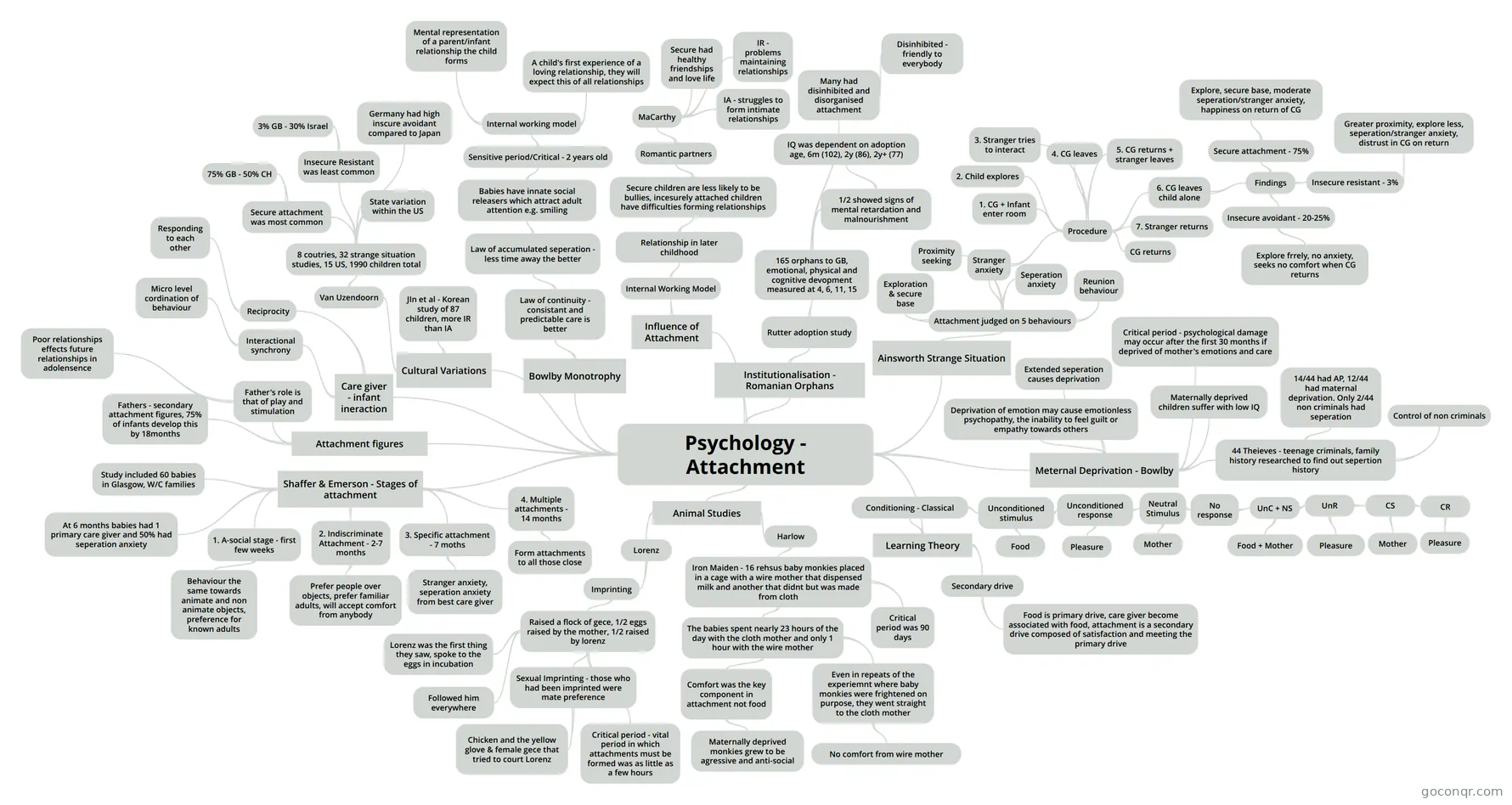
Mind map: Psychology attachment
Contenido del mapa
Psychology - Attachment
Care giver - infant ineraction
- Reciprocity
- Responding to each other
- Interactional synchrony
- Micro level cordination of behaviour
- Reciprocity
Attachment figures
- Fathers - secondary attachment figures, 75% of infants develop this by 18months
- Father's role is that of play and stimulation
- Poor relationships effects future relationships in adolensence
Shaffer & Emerson - Stages of attachment
- Study included 60 babies in Glasgow, W/C families
- At 6 months babies had 1 primary care giver and 50% had seperation anxiety
- 1. A-social stage - first few weeks
- Behaviour the same towards animate and non animate objects, preference for known adults
- 2. Indiscriminate Attachment - 2-7 months
- Prefer people over objects, prefer familiar adults, will accept comfort from anybody
- 3. Specific attachment - 7 moths
- Stranger anxiety, seperation anxiety from best care giver
- 4. Multiple attachments - 14 months
- Form attachments to all those close
Animal Studies
- Lorenz
- Imprinting
- Raised a flock of gece, 1/2 eggs raised by the mother, 1/2 raised by lorenz
- Lorenz was the first thing they saw, spoke to the eggs in incubation
- Followed him everywhere
- Critical period - vital period in which attachments must be formed was as little as a few hours
- Sexual Imprinting - those who had been imprinted were mate preference
- Chicken and the yellow glove & female gece that tried to court Lorenz
- Raised a flock of gece, 1/2 eggs raised by the mother, 1/2 raised by lorenz
- Imprinting
- Harlow
- Iron Maiden - 16 rehsus baby monkies placed in a cage with a wire mother that dispensed milk and another that didnt but was made from cloth
- The babies spent nearly 23 hours of the day with the cloth mother and only 1 hour with the wire mother
- Comfort was the key component in attachment not food
- Maternally deprived monkies grew to be agressive and anti-social
- Even in repeats of the experiemnt where baby monkies were frightened on purpose, they went straight to the cloth mother
- No comfort from wire mother
- Comfort was the key component in attachment not food
- Critical period was 90 days
- The babies spent nearly 23 hours of the day with the cloth mother and only 1 hour with the wire mother
- Iron Maiden - 16 rehsus baby monkies placed in a cage with a wire mother that dispensed milk and another that didnt but was made from cloth
- Lorenz
Learning Theory
- Conditioning - Classical
- Unconditioned stimulus
- Food
- Unconditioned response
- Pleasure
- Neutral Stimulus
- Mother
- No response
- UnC + NS
- Food + Mother
- UnR
- Pleasure
- CS
- CR
- Pleasure
- Mother
- CR
- UnC + NS
- Unconditioned stimulus
- Secondary drive
- Food is primary drive, care giver become associated with food, attachment is a secondary drive composed of satisfaction and meeting the primary drive
- Conditioning - Classical
Meternal Deprivation - Bowlby
- Extended seperation causes deprivation
- Critical period - psychological damage may occur after the first 30 months if deprived of mother's emotions and care
- Maternally deprived children suffer with low IQ
- Deprivation of emotion may cause emotionless psychopathy, the inability to feel guilt or empathy towards others
- 44 Theieves - teenage criminals, family history researched to find out sepertion history
- Control of non criminals
- 14/44 had AP, 12/44 had maternal deprivation. Only 2/44 non criminals had seperation
Cultural Variations
- Van Uzendoorn
- 8 coutries, 32 strange situation studies, 15 US, 1990 children total
- Secure attachment was most common
- 75% GB - 50% CH
- Insecure Resistant was least common
- 3% GB - 30% Israel
- Germany had high inscure avoidant compared to Japan
- State variation within the US
- Secure attachment was most common
- 8 coutries, 32 strange situation studies, 15 US, 1990 children total
- JIn et al - Korean study of 87 children, more IR than IA
- Van Uzendoorn
Bowlby Monotrophy
- Law of continuity - consistant and predictable care is better
- Law of accumulated seperation - less time away the better
- Babies have innate social releasers which attract adult attention e.g. smiling
- Sensitive period/Critical - 2 years old
- Internal working model
- Mental representation of a parent/infant relationship the child forms
- A child's first experience of a loving relationship, they will expect this of all relationships
- Internal working model
- Sensitive period/Critical - 2 years old
- Babies have innate social releasers which attract adult attention e.g. smiling
- Law of accumulated seperation - less time away the better
- Law of continuity - consistant and predictable care is better
Ainsworth Strange Situation
- Attachment judged on 5 behaviours
- Exploration & secure base
- Proximity seeking
- Stranger anxiety
- Procedure
- 1. CG + Infant enter room
- 2. Child explores
- 3. Stranger tries to interact
- 4. CG leaves
- 5. CG returns + stranger leaves
- 6. CG leaves child alone
- Findings
- Secure attachment - 75%
- Explore, secure base, moderate seperation/stranger anxiety, happiness on return of CG
- Insecure avoidant - 20-25%
- Explore frrely, no anxiety, seeks no comfort when CG returns
- Insecure resistant - 3%
- Greater proximity, explore less, seperation/stranger anxiety, distrust in CG on return
- Secure attachment - 75%
- Findings
- 7. Stranger returns
- CG returns
- Procedure
- Seperation anxiety
- Reunion behaviour
- Attachment judged on 5 behaviours
Institutionalisation - Romanian Orphans
- Rutter adoption study
- 165 orphans to GB, emotional, physical and cognitive devopment measured at 4, 6, 11, 15
- 1/2 showed signs of mental retardation and malnourishment
- IQ was dependent on adoption age, 6m (102), 2y (86), 2y+ (77)
- Many had disinhibited and disorganised attachment
- Disinhibited - friendly to everybody
- 1/2 showed signs of mental retardation and malnourishment
- 165 orphans to GB, emotional, physical and cognitive devopment measured at 4, 6, 11, 15
- Rutter adoption study
Influence of Attachment
- Internal Working Model
- Relationship in later childhood
- Secure children are less likely to be bullies, incesurely attached children have difficulties forming relationships
- Romantic partners
- MaCarthy
- Secure had healthy friendships and love life
- IR - problems maintaining relationships
- IA - struggles to form intimate relationships
- MaCarthy
- Romantic partners
- Secure children are less likely to be bullies, incesurely attached children have difficulties forming relationships
- Relationship in later childhood
- Internal Working Model
Información
- Descripción
- A level revision, AS psychology Attachment
- Creado por
- Evie-Anne Davis
- Visitas
- 46
- Etiquetas
- Valoración