
Mapa mental
ATTACHMENT
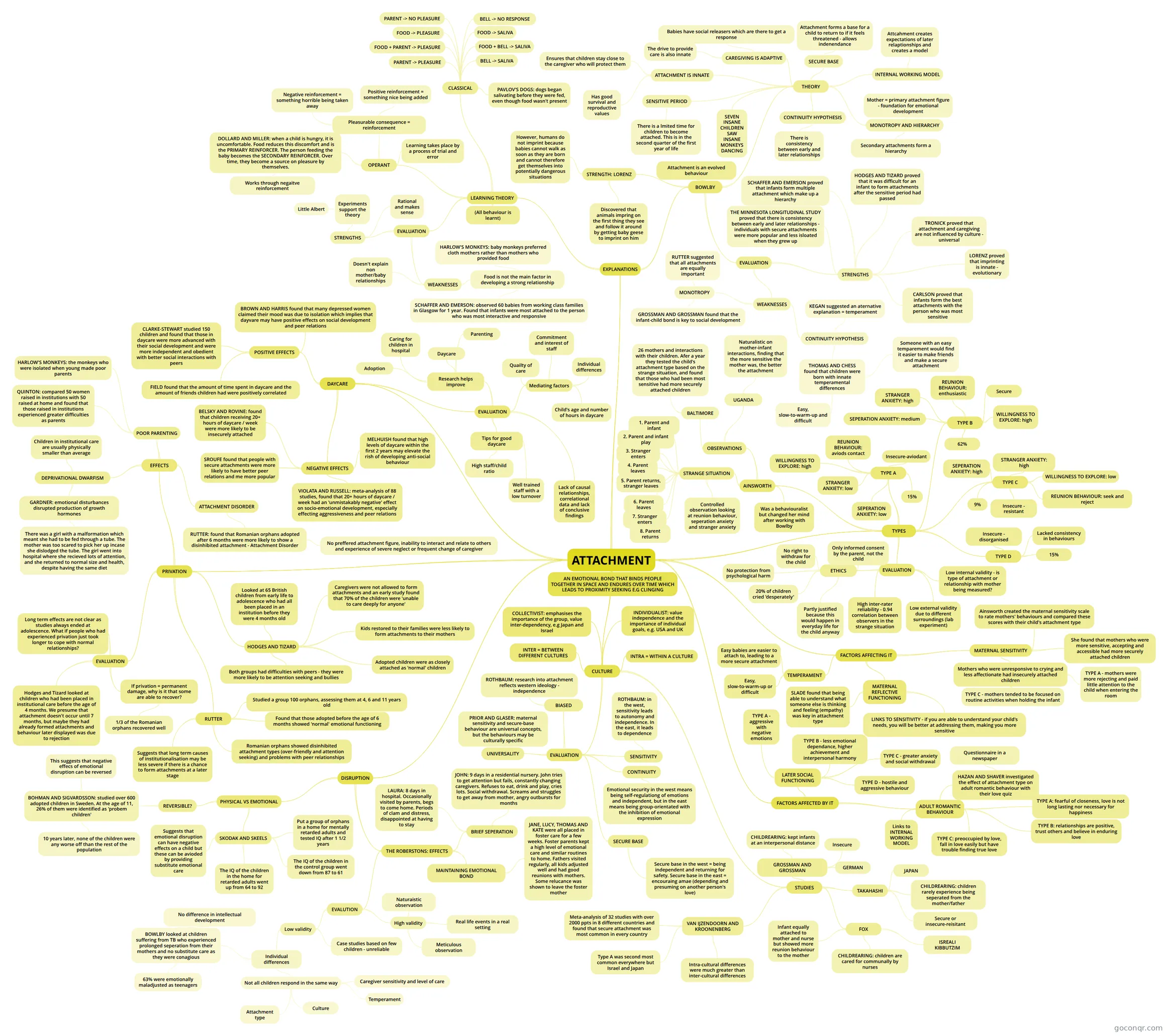
Mind map: Attachment: Definition, Types, and Factors
Contenido del mapa
ATTACHMENT
EXPLANATIONS
- LEARNING THEORY
- CLASSICAL
- PAVLOV'S DOGS: dogs began salivating before they were fed, even though food wasn't present
- BELL -> NO RESPONSE
- FOOD -> SALIVA
- FOOD + BELL -> SALIVA
- BELL -> SALIVA
- PARENT -> PLEASURE
- FOOD + PARENT -> PLEASURE
- PARENT -> NO PLEASURE
- FOOD -> PLEASURE
- OPERANT
- Learning takes place by a process of trial and error
- Pleasurable consequence = reinforcement
- Positive reinforcement = something nice being added
- Negative reinforcement = something horrible being taken away
- DOLLARD AND MILLER: when a child is hungry, it is uncomfortable. Food reduces this discomfort and is the PRIMARY REINFORCER. The person feeding the baby becomes the SECONDARY REINFORCER. Over time, they become a source on pleasure by themselves.
- Works through negaitve reinforcement
- EVALUATION
- STRENGTHS
- Experiments support the theory
- Little Albert
- Rational and makes sense
- Experiments support the theory
- WEAKNESSES
- Doesn't explain non mother/baby relationships
- Food is not the main factor in developing a strong relationship
- HARLOW'S MONKEYS: baby monkeys preferred cloth mothers rather than mothers who provided food
- SCHAFFER AND EMERSON: observed 60 babies from working class families in Glasgow for 1 year. Found that infants were most attached to the person who was most interactive and responsive
- STRENGTHS
- (All behaviour is learnt)
- CLASSICAL
- BOWLBY
- STRENGTH: LORENZ
- Discovered that animals impring on the first thing they see and follow it around by getting baby geese to imprint on him
- However, humans do not imprint because babies cannot walk as soon as they are born and cannot therefore get themselves into potentially dangerous situations
- THEORY
- SEVEN INSANE CHILDREN SAW INSANE MONKEYS DANCING
- SENSITIVE PERIOD
- There is a lmited time for children to become attached. This is in the second quarter of the first year of life
- ATTACHMENT IS INNATE
- Has good survival and reproductive values
- Ensures that children stay close to the caregiver who will protect them
- CAREGIVING IS ADAPTIVE
- The drive to provide care is also innate
- Babies have social releasers which are there to get a response
- SECURE BASE
- Attachment forms a base for a child to return to if it feels threatened - allows indenendance
- INTERNAL WORKING MODEL
- Attcahment creates expectations of later relaptionships and creates a model
- MONOTROPY AND HIERARCHY
- Mother = primary attachment figure - foundation for emotional development
- Secondary attachments form a hierarchy
- CONTINUITY HYPOTHESIS
- There is consistency between early and later relationships
- EVALUATION
- STRENGTHS
- LORENZ proved that imprinting is innate - evolutionary
- HODGES AND TIZARD proved that it was difficult for an infant to form attachments after the sensitive period had passed
- TRONICK proved that attachment and caregiving are not influenced by culture - universal
- SCHAFFER AND EMERSON proved that infants form multiple attachment which make up a hierarchy
- CARLSON proved that infants form the best attachments with the person who was most sensitive
- THE MINNESOTA LONGITUDINAL STUDY proved that there is consistency between early and later relationships - individuals with secure attachments were more popular and less isloated when they grew up
- WEAKNESSES
- MONOTROPY
- RUTTER suggested that all attachments are equally important
- GROSSMAN AND GROSSMAN found that the infant-child bond is key to social development
- CONTINUITY HYPOTHESIS
- KEGAN suggested an aternative explanation = temperament
- THOMAS AND CHESS found that children were born with innate temperamental differences
- Easy, slow-to-warm-up and difficult
- Someone with an easy temparement would find it easier to make friends and make a secure attachment
- MONOTROPY
- STRENGTHS
- Attachment is an evolved behaviour
- STRENGTH: LORENZ
- LEARNING THEORY
TYPES
- AINSWORTH
- STRANGE SITUATION
- Controlled observation looking at reunion behaviour, seperation anxiety and stranger anxiety
- 1. Parent and infant
- 3. Stranger enters
- 2. Parent and infant play
- 5. Parent returns, stranger leaves
- 4. Parent leaves
- 6. Parent leaves
- 7. Stranger enters
- 8. Parent returns
- OBSERVATIONS
- UGANDA
- Naturalistic on mother-infant interactions, finding that the more sensitive the mother was, the better the attachment
- BALTIMORE
- 26 mothers and interactions with their children. Afer a year they tested the child's attachment type based on the strange situation, and found that those who had been most sensitive had more securely attached children
- UGANDA
- Was a behaviouralist but changed her mind after working with Bowlby
- STRANGE SITUATION
- TYPE A
- Insecure-aviodant
- WILLINGNESS TO EXPLORE: high
- SEPERATION ANXIETY: low
- STRANGER ANXIETY: low
- REUNION BEHAVIOUR: aviods contact
- 15%
- TYPE B
- SEPERATION ANXIETY: medium
- STRANGER ANXIETY: high
- REUNION BEHAVIOUR: enthusiastic
- Secure
- WILLINGNESS TO EXPLORE: high
- 62%
- TYPE C
- SEPERATION ANXIETY: high
- STRANGER ANXIETY: high
- REUNION BEHAVIOUR: seek and reject
- Insecure - resistant
- 9%
- WILLINGNESS TO EXPLORE: low
- TYPE D
- Insecure - disorganised
- Lacked consistency in behaviours
- 15%
- EVALUATION
- ETHICS
- Only informed consent by the parent, not the child
- No right to withdraw for the child
- No protection from psychological harm
- 20% of children cried 'desperately'
- Partly justified because this would happen in everyday life for the child anyway
- Low internal validity - is type of attachment or relationship with mother being measured?
- Low external validity due to different surroundings (lab experiment)
- High inter-rater reliability - 0.94 correlation between observers in the strange situation
- ETHICS
- AINSWORTH
FACTORS AFFECTING IT
- MATERNAL SENSITIVITY
- Ainsworth created the maternal sensitivity scale to rate mothers' behaviours and compared these scores with their child's attachment type
- She found that mothers who were more sensitive, accepting and accessible had more securely attached children
- Mothers who were unresponsive to crying and less affectionate had insecurely attached children
- TYPE A - mothers were more rejecting and paid little attention to the child when entering the room
- TYPE C - mothers tended to be focused on routine activities when holding the infant
- MATERNAL REFLECTIVE FUNCTIONING
- SLADE found that being able to understand what someone else is thinking and feeling (empathy) was key in attachment type
- LINKS TO SENSITIVITY - if you are able to understand your child's needs, you will be better at addressing them, making you more sensitive
- TEMPERAMENT
- Easy, slow-to-warm-up or difficult
- Easy babies are easier to attach to, leading to a more secure attachment
- MATERNAL SENSITIVITY
FACTORS AFFECTED BY IT
- LATER SOCIAL FUNCTIONING
- TYPE A - aggressive with negative emotions
- TYPE B - less emotional dependance, higher achievement and interpersonal harmony
- TYPE C - greater anxiety and social withdrawal
- TYPE D - hostile and aggressive behaviour
- ADULT ROMANTIC BEHAVIOUR
- Links to INTERNAL WORKING MODEL
- HAZAN AND SHAVER investigated the effect of attachment type on adult romantic behaviour with their love quiz
- Questionnaire in a newspaper
- TYPE A: fearful of closeness, love is not long lasting nor necessary for happiness
- TYPE B: relationships are positive, trust others and believe in enduring love
- TYPE C: preoccupied by love, fall in love easily but have trouble finding true love
- LATER SOCIAL FUNCTIONING
CULTURE
- STUDIES
- GROSSMAN AND GROSSMAN
- GERMAN
- CHILDREARING: kept infants at an interpersonal distance
- Insecure
- TAKAHASHI
- JAPAN
- CHILDREARING: children rarely experience being seperated from the mother/father
- Secure or insecure-reisitant
- FOX
- ISREALI KIBBUTZIM
- CHILDREARING: children are cared for communally by nurses
- Infant equally attached to mother and nurse but showed more reunion behaviour to the mother
- VAN IJZENDOORN AND KROONENBERG
- Meta-analysis of 32 studies with over 2000 ppts in 8 different countries and found that secure attachment was most common in every country
- Type A was second most common everywhere but Israel and Japan
- Intra-cultural differences were much greater than inter-cultural differences
- GROSSMAN AND GROSSMAN
- EVALUATION
- BIASED
- ROTHBAUM: research into attachment reflects western ideology - independence
- SENSITIVITY
- ROTHBAUM: in the west, sensitivity leads to autonomy and independence. In the east, it leads to dependence
- CONTINUITY
- Emotional security in the west means being self-regulationg of emotions and independent, but in the east means being group-orientated with the inhibition of emotional expression
- SECURE BASE
- Secure base in the west = being independent and returning for safety. Secure base in the east = encouraing amae (depending and presuming on another person's love)
- UNIVERSALITY
- PRIOR AND GLASER: maternal sensitivity and secure-base behaviour are universal concepts, but the behaviours may be culturally specific
- BIASED
- INDIVIDUALIST: value independence and the importance of individual goals, e.g. USA and UK
- COLLECTIVIST: emphasises the importance of the group, value inter-dependency, e.g Japan and Israel
- INTER = BETWEEN DIFFERENT CULTURES
- INTRA = WITHIN A CULTURE
- STUDIES
DISRUPTION
- THE ROBERSTONS: EFFECTS
- BRIEF SEPERATION
- LAURA: 8 days in hospital. Occasionally visited by parents, begs to come home. Periods of clam and distress, disappointed at having to stay
- JOHN: 9 days in a residential nursery. John tries to get attention but fails, constantly changing caregivers. Refuses to eat, drink and play, cries lots. Social withdrawal. Screams and struggles to get away from mother, angry outbursts for months
- MAINTAINING EMOTIONAL BOND
- JANE, LUCY, THOMAS AND KATE were all placed in foster care for a few weeks. Foster parents kept a high level of emotional care and similar routines to home. Fathers visited regularly, all kids adjusted well and had good reunions with mothers. Some relucance was shown to leave the foster mother
- EVALUTION
- High validity
- Naturaistic observation
- Real life events in a real setting
- Meticulous observation
- Low validity
- Case studies based on few children - unreliable
- Individual differences
- Not all children respond in the same way
- Caregiver sensitivity and level of care
- Temperament
- Culture
- Attachment type
- BOWLBY looked at children suffering from TB who experienced prolonged seperation from their mothers and no substitute care as they were conagious
- 63% were emotionally maladjusted as teenagers
- No difference in intellectual development
- Not all children respond in the same way
- High validity
- BRIEF SEPERATION
- PHYSICAL VS EMOTIONAL
- SKODAK AND SKEELS
- Put a group of orphans in a home for mentally retarded adults and tested IQ after 1 1/2 years
- The IQ of the children in the control group went down from 87 to 61
- The IQ of the children in the home for retarded adults went up from 64 to 92
- Suggests that emotional disruption can have negative effects on a child but these can be avioded by providing substitute emotional care
- REVERSIBLE?
- BOHMAN AND SIGVARDSSON: studied over 600 adopted children in Sweden. At the age of 11, 26% of them were identified as 'probem children'
- 10 years later, none of the children were any worse off than the rest of the population
- This suggests that negative effecs of emotional disruption can be reversed
- BOHMAN AND SIGVARDSSON: studied over 600 adopted children in Sweden. At the age of 11, 26% of them were identified as 'probem children'
- SKODAK AND SKEELS
- THE ROBERSTONS: EFFECTS
PRIVATION
- HODGES AND TIZARD
- Looked at 65 British children from early life to adolescence who had all been placed in an institution before they were 4 months old
- Caregivers were not allowed to form attachments and an early study found that 70% of the children were 'unable to care deeply for anyone'
- Kids restored to their families were less likely to form attachments to their mothers
- Adopted children were as closely attached as 'normal' children
- Both groups had difficulties with peers - they were more likely to be attention seeking and bullies
- RUTTER
- Studied a group 100 orphans, assessing them at 4, 6 and 11 years old
- Found that those adopted before the age of 6 months showed 'normal' emotional functioning
- Romanian orphans showed disinhibited attachment types (over-friendly and attention seeking) and problems with peer relationships
- Suggests that long term causes of institutionalisation may be less severe if there is a chance to form attachments at a later stage
- EFFECTS
- ATTACHMENT DISORDER
- RUTTER: found that Romanian orphans adopted after 6 months were more likely to show a disinhibited attachment - Attachment Disorder
- No preffered attachment figure, inability to interact and relate to others and experience of severe neglect or frequent change of caregiver
- RUTTER: found that Romanian orphans adopted after 6 months were more likely to show a disinhibited attachment - Attachment Disorder
- POOR PARENTING
- HARLOW'S MONKEYS: the monkeys who were isolated when young made poor parents
- QUINTON: compared 50 women raised in institutions with 50 raised at home and found that those raised in institutions experienced greater difficulties as parents
- DEPRIVATIONAL DWARFISM
- Children in institutional care are usually physically smaller than average
- GARDNER: emotional disturbances disrupted production of growth hormones
- There was a girl with a malformation which meant she had to be fed through a tube. The mother was too scared to pick her up incase she dislodged the tube. The girl went into hospital where she recieved lots of attention, and she returned to normal size and health, despite having the same diet
- ATTACHMENT DISORDER
- EVALUATION
- If privation = permanent damage, why is it that some are able to recover?
- 1/3 of the Romanian orphans recovered well
- Hodges and Tizard looked at children who had been placed in institutional care before the age of 4 months. We presume that attachment doesn't occur until 7 months, but maybe they had already formed attachments and behaviour later displayed was due to rejection
- Long term effects are not clear as studies always ended at adolescence. What if people who had experienced privation just took longer to cope with normal relationships?
- If privation = permanent damage, why is it that some are able to recover?
- HODGES AND TIZARD
DAYCARE
- NEGATIVE EFFECTS
- VIOLATA AND RUSSELL: meta-analysis of 88 studies, found that 20+ hours of daycare / week had an 'unmistakably negative' effect on socio-emotional development, especially effecting aggressiveness and peer relations
- MELHUISH found that high levels of daycare within the first 2 years may elevate the rish of developing anti-social behaviour
- SROUFE found that people with secure attachments were more likely to have better peer relations and me more popular
- BELSKY AND ROVINE: found that children receiving 20+ hours of daycare / week were more likely to be insecurely attached
- POSITIVE EFFECTS
- BROWN AND HARRIS found that many depressed women claimed their mood was due to isolation which implies that dayvare may have positive effects on social development and peer relations
- CLARKE-STEWART studied 150 children and found that those in daycare were more advanced with their social development and were more independent and obedient with better social interactions with peers
- FIELD found that the amount of time spent in daycare and the amount of friends children had were positively correlated
- EVALUATION
- Lack of causal relationships, correlational data and lack of conclusive findings
- Mediating factors
- Quailty of care
- Commitment and interest of staff
- Individual differences
- Child's age and number of hours in daycare
- Tips for good daycare
- High staff/child ratio
- Well trained staff with a low turnover
- Research helps improve
- Adoption
- Parenting
- Caring for children in hospital
- Daycare
- NEGATIVE EFFECTS
AN EMOTIONAL BOND THAT BINDS PEOPLE TOGETHER IN SPACE AND ENDURES OVER TIME WHICH LEADS TO PROXIMITY SEEKING E.G CLINGING
Información
- Descripción
- mexican Psychology Mapa Mental sobre ATTACHMENT, creado por harrypacker el 11/05/2014.
- Creado por
- harrypacker
- Visitas
- 35
- Valoración