
Mapa mental
MEMORY
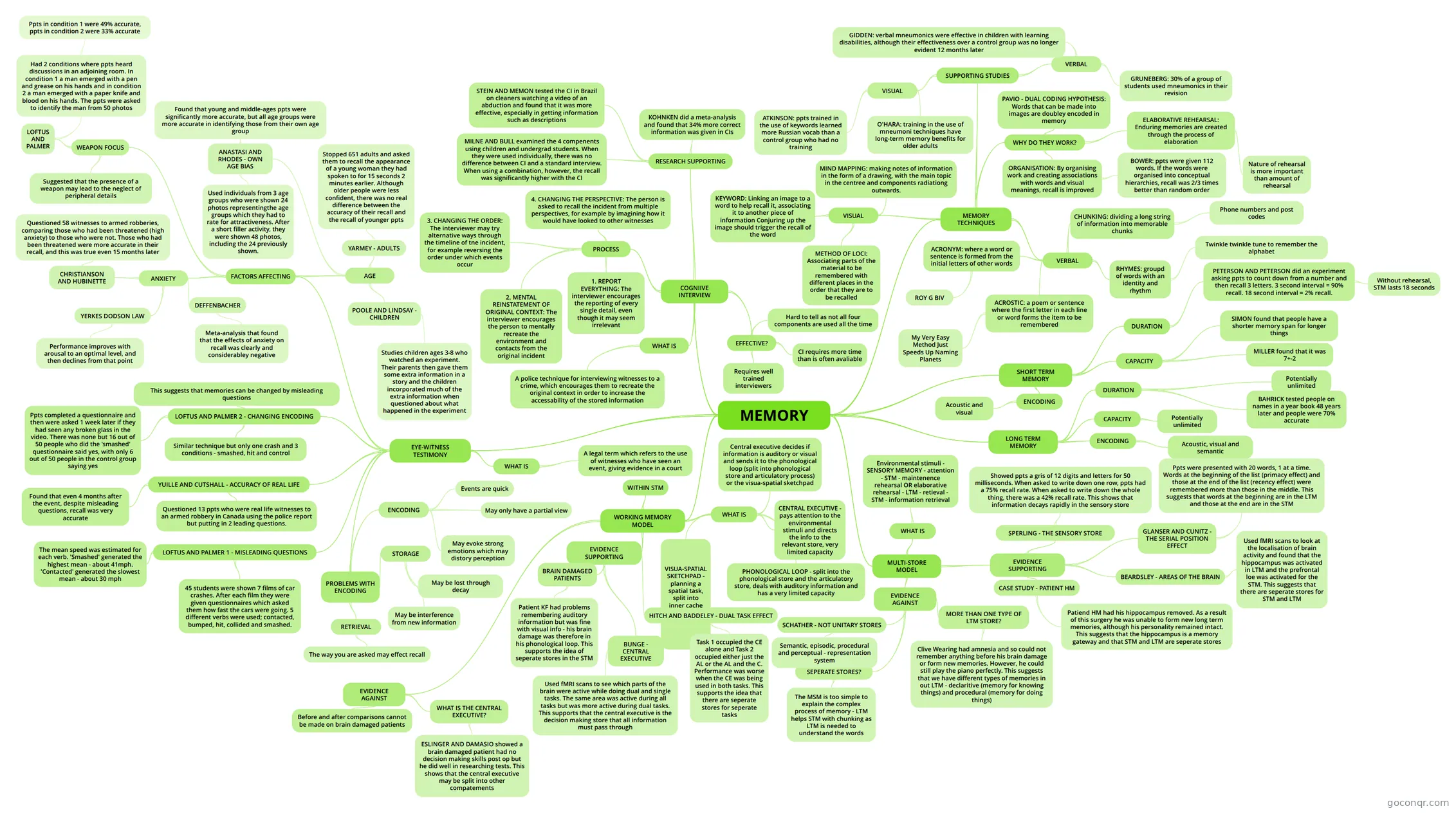
Mind map: Memory psychology
Contenido del mapa
MEMORY
SHORT TERM MEMORY
- DURATION
- PETERSON AND PETERSON did an experiment asking ppts to count down from a number and then recall 3 letters. 3 second interval = 90% recall. 18 second interval = 2% recall.
- Without rehearsal, STM lasts 18 seconds
- PETERSON AND PETERSON did an experiment asking ppts to count down from a number and then recall 3 letters. 3 second interval = 90% recall. 18 second interval = 2% recall.
- CAPACITY
- MILLER found that it was 7+-2
- SIMON found that people have a shorter memory span for longer things
- ENCODING
- Acoustic and visual
- DURATION
LONG TERM MEMORY
- DURATION
- Potentially unlimited
- BAHRICK tested people on names in a year book 48 years later and people were 70% accurate
- CAPACITY
- Potentially unlimited
- ENCODING
- Acoustic, visual and semantic
- DURATION
MULTI-STORE MODEL
- WHAT IS
- Environmental stimuli - SENSORY MEMORY - attention - STM - maintenence rehearsal OR elaborative rehearsal - LTM - retieval - STM - information retrieval
- EVIDENCE SUPPORTING
- SPERLING - THE SENSORY STORE
- Showed ppts a gris of 12 digits and letters for 50 milliseconds. When asked to write down one row, ppts had a 75% recall rate. When asked to write down the whole thing, there was a 42% recall rate. This shows that information decays rapidly in the sensory store
- GLANSER AND CUNITZ - THE SERIAL POSITION EFFECT
- Ppts were presented with 20 words, 1 at a time. Words at the beginning of the list (primacy effect) and those at the end of the list (recency effect) were remembered more than those in the middle. This suggests that words at the beginning are in the LTM and those at the end are in the STM
- BEARDSLEY - AREAS OF THE BRAIN
- Used fMRI scans to look at the localisation of brain activity and found that the hippocampus was activated in LTM and the prefrontal loe was activated for the STM. This suggests that there are seperate stores for STM and LTM
- CASE STUDY - PATIENT HM
- Patiend HM had his hippocampus removed. As a result of this surgery he was unable to form new long term memories, although his personality remained intact. This suggests that the hippocampus is a memory gateway and that STM and LTM are seperate stores
- SPERLING - THE SENSORY STORE
- EVIDENCE AGAINST
- MORE THAN ONE TYPE OF LTM STORE?
- Clive Wearing had amnesia and so could not remember anything before his brain damage or form new memories. However, he could still play the piano perfectly. This suggests that we have different types of memories in out LTM - declaritive (memory for knowing things) and procedural (memory for doing things)
- SEPERATE STORES?
- The MSM is too simple to explain the complex process of memory - LTM helps STM with chunking as LTM is needed to understand the words
- SCHATHER - NOT UNITARY STORES
- Semantic, episodic, procedural and perceptual - representation system
- MORE THAN ONE TYPE OF LTM STORE?
- WHAT IS
WORKING MEMORY MODEL
- WHAT IS
- Central executive decides if information is auditory or visual and sends it to the phonological loop (split into phonological store and articulatory process) or the visua-spatial sketchpad
- CENTRAL EXECUTIVE - pays attention to the environmental stimuli and directs the info to the relevant store, very limited capacity
- PHONOLOGICAL LOOP - split into the phonological store and the articulatory store, deals with auditory information and has a very limited capacity
- VISUA-SPATIAL SKETCHPAD - planning a spatial task, split into inner cache and inner scribe
- EVIDENCE SUPPORTING
- HITCH AND BADDELEY - DUAL TASK EFFECT
- Task 1 occupied the CE alone and Task 2 occupied either just the AL or the AL and the C. Performance was worse when the CE was being used in both tasks. This supports the idea that there are seperate stores for seperate tasks
- BUNGE - CENTRAL EXECUTIVE
- Used fMRI scans to see which parts of the brain were active while doing dual and single tasks. The same area was active during all tasks but was more active during dual tasks. This supports that the central executive is the decision making store that all information must pass through
- BRAIN DAMAGED PATIENTS
- Patient KF had problems remembering auditory information but was fine with visual info - his brain damage was therefore in his phonological loop. This supports the idea of seperate stores in the STM
- HITCH AND BADDELEY - DUAL TASK EFFECT
- EVIDENCE AGAINST
- WHAT IS THE CENTRAL EXECUTIVE?
- ESLINGER AND DAMASIO showed a brain damaged patient had no decision making skills post op but he did well in researching tests. This shows that the central executive may be split into other compatements
- Before and after comparisons cannot be made on brain damaged patients
- WHAT IS THE CENTRAL EXECUTIVE?
- WITHIN STM
- WHAT IS
EYE-WITNESS TESTIMONY
- WHAT IS
- A legal term which refers to the use of witnesses who have seen an event, giving evidence in a court
- PROBLEMS WITH ENCODING
- ENCODING
- Events are quick
- May only have a partial view
- May evoke strong emotions which may distory perception
- STORAGE
- May be lost through decay
- May be interference from new information
- RETRIEVAL
- The way you are asked may effect recall
- ENCODING
- FACTORS AFFECTING
- ANXIETY
- DEFFENBACHER
- Meta-analysis that found that the effects of anxiety on recall was clearly and considerabley negative
- CHRISTIANSON AND HUBINETTE
- Questioned 58 witnesses to armed robberies, comparing those who had been threatened (high anxiety) to those who were not. Those who had been threatened were more accurate in their recall, and this was true even 15 months later
- YERKES DODSON LAW
- Performance improves with arousal to an optimal level, and then declines from that point
- DEFFENBACHER
- WEAPON FOCUS
- Suggested that the presence of a weapon may lead to the neglect of peripheral details
- LOFTUS AND PALMER
- Had 2 conditions where ppts heard discussions in an adjoining room. In condition 1 a man emerged with a pen and grease on his hands and in condition 2 a man emerged with a paper knife and blood on his hands. The ppts were asked to identify the man from 50 photos
- Ppts in condition 1 were 49% accurate, ppts in condition 2 were 33% accurate
- Had 2 conditions where ppts heard discussions in an adjoining room. In condition 1 a man emerged with a pen and grease on his hands and in condition 2 a man emerged with a paper knife and blood on his hands. The ppts were asked to identify the man from 50 photos
- AGE
- POOLE AND LINDSAY - CHILDREN
- Studies children ages 3-8 who watched an experiment. Their parents then gave them some extra information in a story and the children incorporated much of the extra information when questioned about what happened in the experiment
- YARMEY - ADULTS
- Stopped 651 adults and asked them to recall the appearance of a young woman they had spoken to for 15 seconds 2 minutes earlier. Although older people were less confident, there was no real difference between the accuracy of their recall and the recall of younger ppts
- ANASTASI AND RHODES - OWN AGE BIAS
- Used individuals from 3 age groups who were shown 24 photos representingthe age groups which they had to rate for attractiveness. After a short filler activity, they were shown 48 photos, including the 24 previously shown.
- Found that young and middle-ages ppts were significantly more accurate, but all age groups were more accurate in identifying those from their own age group
- POOLE AND LINDSAY - CHILDREN
- ANXIETY
- LOFTUS AND PALMER 1 - MISLEADING QUESTIONS
- 45 students were shown 7 films of car crashes. After each film they were given questionnaires which asked them how fast the cars were going. 5 different verbs were used; contacted, bumped, hit, collided and smashed.
- The mean speed was estimated for each verb. 'Smashed' generated the highest mean - about 41mph. 'Contacted' generated the slowest mean - about 30 mph
- YUILLE AND CUTSHALL - ACCURACY OF REAL LIFE
- Questioned 13 ppts who were real life witnesses to an armed robbery in Canada using the police report but putting in 2 leading questions.
- Found that even 4 months after the event, despite misleading questions, recall was very accurate
- LOFTUS AND PALMER 2 - CHANGING ENCODING
- Similar technique but only one crash and 3 conditions - smashed, hit and control
- Ppts completed a questionnaire and then were asked 1 week later if they had seen any broken glass in the video. There was none but 16 out of 50 people who did the 'smashed' questionnaire said yes, with only 6 out of 50 people in the control group saying yes
- This suggests that memories can be changed by misleading questions
- WHAT IS
COGNIIVE INTERVIEW
- WHAT IS
- A police technique for interviewing witnesses to a crime, which encourages them to recreate the original context in order to increase the accessability of the stored information
- PROCESS
- 1. REPORT EVERYTHING: The interviewer encourages the reporting of every single detail, even though it may seem irrelevant
- 2. MENTAL REINSTATEMENT OF ORIGINAL CONTEXT: The interviewer encourages the person to mentally recreate the environment and contacts from the original incident
- 3. CHANGING THE ORDER: The interviewer may try alternative ways through the timeline of tne incident, for example reversing the order under which events occur
- 4. CHANGING THE PERSPECTIVE: The person is asked to recall the incident from multiple perspectives, for example by imagining how it would have looked to other witnesses
- RESEARCH SUPPORTING
- KOHNKEN did a meta-analysis and found that 34% more correct information was given in CIs
- STEIN AND MEMON tested the CI in Brazil on cleaners watching a video of an abduction and found that it was more effective, especially in getting information such as descriptions
- MILNE AND BULL examined the 4 compenents using children and undergrad students. When they were used individually, there was no difference between CI and a standard interview. When using a combination, however, the recall was significantly higher with the CI
- EFFECTIVE?
- Hard to tell as not all four components are used all the time
- CI requires more time than is often avaliable
- Requires well trained interviewers
- WHAT IS
MEMORY TECHNIQUES
- VERBAL
- ACRONYM: where a word or sentence is formed from the initial letters of other words
- ROY G BIV
- ACROSTIC: a poem or sentence where the first letter in each line or word forms the item to be remembered
- My Very Easy Method Just Speeds Up Naming Planets
- RHYMES: groupd of words with an identity and rhythm
- Twinkle twinkle tune to remember the alphabet
- CHUNKING: dividing a long string of information into memorable chunks
- Phone numbers and post codes
- ACRONYM: where a word or sentence is formed from the initial letters of other words
- VISUAL
- METHOD OF LOCI: Associating parts of the material to be remembered with different places in the order that they are to be recalled
- KEYWORD: Linking an image to a word to help recall it, associating it to another piece of information Conjuring up the image should trigger the recall of the word
- MIND MAPPING: making notes of information in the form of a drawing, with the main topic in the centree and components radiationg outwards.
- WHY DO THEY WORK?
- ORGANISATION: By organising work and creating associations with words and visual meanings, recall is improved
- BOWER: ppts were given 112 words. If the words were organised into conceptual hierarchies, recall was 2/3 times better than random order
- ELABORATIVE REHEARSAL: Enduring memories are created through the process of elaboration
- Nature of rehearsal is more important than amount of rehearsal
- PAVIO - DUAL CODING HYPOTHESIS: Words that can be made into images are doubley encoded in memory
- ORGANISATION: By organising work and creating associations with words and visual meanings, recall is improved
- SUPPORTING STUDIES
- VERBAL
- GRUNEBERG: 30% of a group of students used mneumonics in their revision
- GIDDEN: verbal mneumonics were effective in children with learning disabilities, although their effectiveness over a control group was no longer evident 12 months later
- VISUAL
- O'HARA: training in the use of mneumoni techniques have long-term memory benefits for older adults
- ATKINSON: ppts trained in the use of keywords learned more Russian vocab than a control group who had no training
- VERBAL
- VERBAL
Información
- Descripción
- mexican Psychology Mapa Mental sobre MEMORY, creado por harrypacker el 12/05/2014.
- Creado por
- harrypacker
- Visitas
- 25
- Valoración