
Mapa mental
Biology Unit 1.b
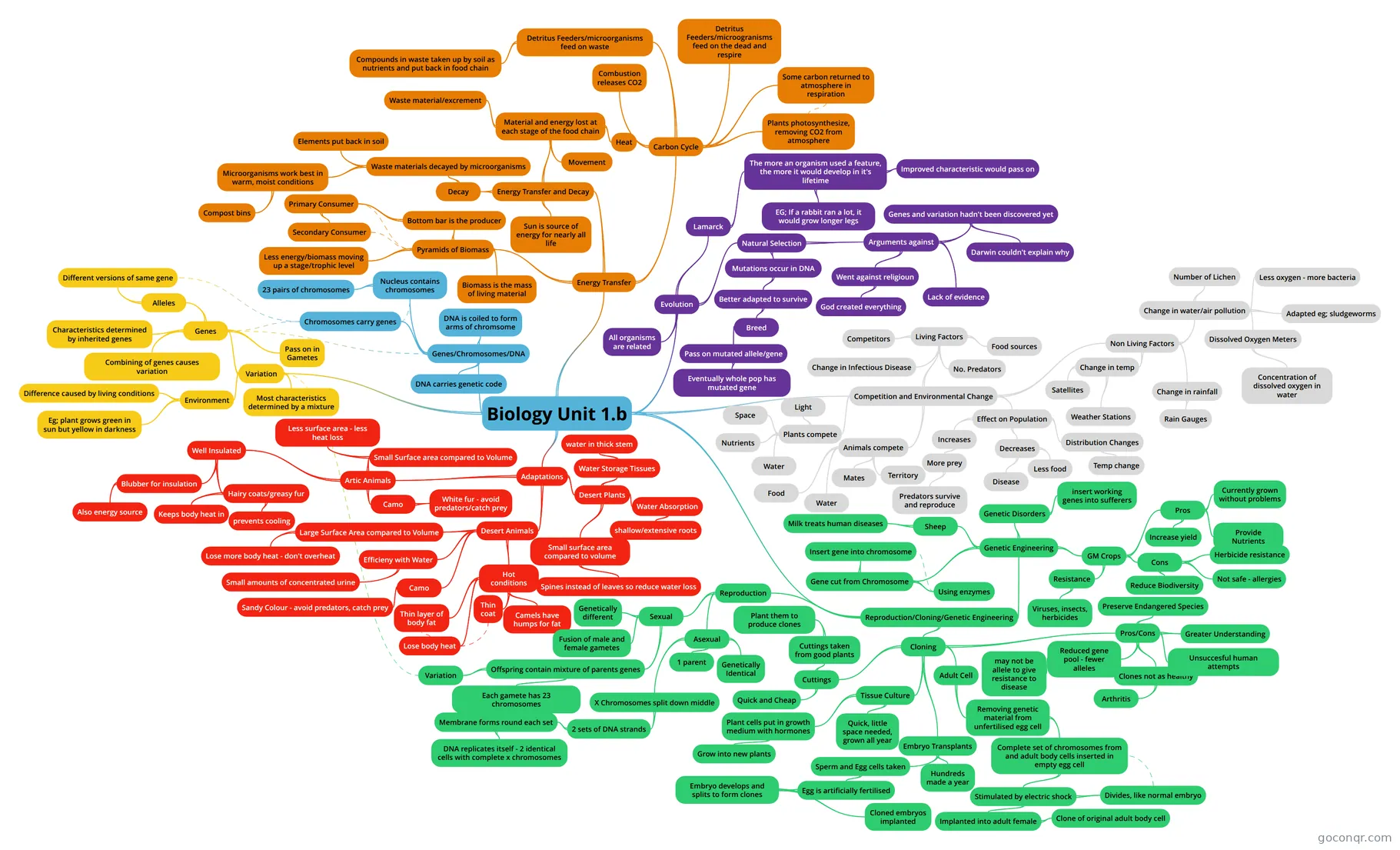
Mind map: Biology Unit 1.b
Contenido del mapa
Biology Unit 1.b
Adaptations
- Artic Animals
- Well Insulated
- Blubber for insulation
- Also energy source
- Hairy coats/greasy fur
- Keeps body heat in
- prevents cooling
- Blubber for insulation
- Camo
- White fur - avoid predators/catch prey
- Small Surface area compared to Volume
- Less surface area - less heat loss
- Well Insulated
- Desert Animals
- Large Surface Area compared to Volume
- Lose more body heat - don't overheat
- Efficieny with Water
- Small amounts of concentrated urine
- Camo
- Sandy Colour - avoid predators, catch prey
- Hot conditions
- Thin layer of body fat
- Thin coat
- Lose body heat
- Camels have humps for fat
- Large Surface Area compared to Volume
- Desert Plants
- Water Storage Tissues
- water in thick stem
- Water Absorption
- shallow/extensive roots
- Small surface area compared to volume
- Spines instead of leaves so reduce water loss
- Water Storage Tissues
- Artic Animals
Competition and Environmental Change
- Plants compete
- Light
- Space
- Water
- Nutrients
- Animals compete
- Territory
- Food
- Water
- Mates
- Effect on Population
- Increases
- More prey
- Predators survive and reproduce
- More prey
- Decreases
- Less food
- Disease
- Distribution Changes
- Temp change
- Increases
- Living Factors
- Change in Infectious Disease
- No. Predators
- Food sources
- Competitors
- Non Living Factors
- Change in temp
- Satellites
- Weather Stations
- Change in rainfall
- Rain Gauges
- Change in water/air pollution
- Dissolved Oxygen Meters
- Concentration of dissolved oxygen in water
- Number of Lichen
- Less oxygen - more bacteria
- Adapted eg; sludgeworms
- Dissolved Oxygen Meters
- Change in temp
- Plants compete
Energy Transfer
- Carbon Cycle
- Plants photosynthesize, removing CO2 from atmosphere
- Some carbon returned to atmosphere in respiration
- Detritus Feeders/microogranisms feed on the dead and respire
- Detritus Feeders/microorganisms feed on waste
- Compounds in waste taken up by soil as nutrients and put back in food chain
- Combustion releases CO2
- Pyramids of Biomass
- Less energy/biomass moving up a stage/trophic level
- Biomass is the mass of living material
- Bottom bar is the producer
- Primary Consumer
- Secondary Consumer
- Primary Consumer
- Energy Transfer and Decay
- Sun is source of energy for nearly all life
- Material and energy lost at each stage of the food chain
- Heat
- Movement
- Waste material/excrement
- Decay
- Waste materials decayed by microorganisms
- Microorganisms work best in warm, moist conditions
- Compost bins
- Elements put back in soil
- Microorganisms work best in warm, moist conditions
- Waste materials decayed by microorganisms
- Carbon Cycle
Genes/Chromosomes/DNA
- Nucleus contains chromosomes
- 23 pairs of chromosomes
- Chromosomes carry genes
- DNA carries genetic code
- DNA is coiled to form arms of chromsome
- Nucleus contains chromosomes
Variation
- Environment
- Difference caused by living conditions
- Eg; plant grows green in sun but yellow in darkness
- Genes
- Characteristics determined by inherited genes
- Pass on in Gametes
- Combining of genes causes variation
- Alleles
- Different versions of same gene
- Most characteristics determined by a mixture
- Environment
Reproduction/Cloning/Genetic Engineering
- Reproduction
- Sexual
- Fusion of male and female gametes
- Offspring contain mixture of parents genes
- Variation
- Each gamete has 23 chromosomes
- Genetically different
- Asexual
- Genetically Identical
- X Chromosomes split down middle
- 2 sets of DNA strands
- Membrane forms round each set
- DNA replicates itself - 2 identical cells with complete x chromosomes
- Membrane forms round each set
- 2 sets of DNA strands
- 1 parent
- Sexual
- Genetic Engineering
- Gene cut from Chromosome
- Using enzymes
- Insert gene into chromosome
- GM Crops
- Resistance
- Viruses, insects, herbicides
- Pros
- Increase yield
- Provide Nutrients
- Currently grown without problems
- Cons
- Reduce Biodiversity
- Not safe - allergies
- Herbicide resistance
- Resistance
- Sheep
- Milk treats human diseases
- Genetic Disorders
- insert working genes into sufferers
- Gene cut from Chromosome
- Cloning
- Cuttings
- Cuttings taken from good plants
- Plant them to produce clones
- Quick and Cheap
- Cuttings taken from good plants
- Tissue Culture
- Plant cells put in growth medium with hormones
- Grow into new plants
- Quick, little space needed, grown all year
- Plant cells put in growth medium with hormones
- Embryo Transplants
- Sperm and Egg cells taken
- Egg is artificially fertilised
- Embryo develops and splits to form clones
- Cloned embryos implanted
- Embryo develops and splits to form clones
- Egg is artificially fertilised
- Hundreds made a year
- Sperm and Egg cells taken
- Pros/Cons
- Reduced gene pool - fewer alleles
- may not be allele to give resistance to disease
- Clones not as healthy
- Arthritis
- Unsuccesful human attempts
- Greater Understanding
- Preserve Endangered Species
- Reduced gene pool - fewer alleles
- Adult Cell
- Removing genetic material from unfertilised egg cell
- Complete set of chromosomes from and adult body cells inserted in empty egg cell
- Stimulated by electric shock
- Divides, like normal embryo
- Implanted into adult female
- Clone of original adult body cell
- Stimulated by electric shock
- Complete set of chromosomes from and adult body cells inserted in empty egg cell
- Removing genetic material from unfertilised egg cell
- Cuttings
- Reproduction
Evolution
- Natural Selection
- Mutations occur in DNA
- Better adapted to survive
- Breed
- Pass on mutated allele/gene
- Eventually whole pop has mutated gene
- Pass on mutated allele/gene
- Breed
- Better adapted to survive
- Arguments against
- Went against religioun
- God created everything
- Lack of evidence
- Genes and variation hadn't been discovered yet
- Darwin couldn't explain why
- Went against religioun
- Mutations occur in DNA
- Lamarck
- The more an organism used a feature, the more it would develop in it's lifetime
- Improved characteristic would pass on
- EG; If a rabbit ran a lot, it would grow longer legs
- The more an organism used a feature, the more it would develop in it's lifetime
- All organisms are related
- Natural Selection
Información
- Descripción
- Year 11 GCSE Mapa Mental sobre Biology Unit 1.b, creado por Matthew Hams el 13/05/2017.
- Creado por
- Matthew Hams
- Visitas
- 0
- Valoración