
Mapa mental
Creativity
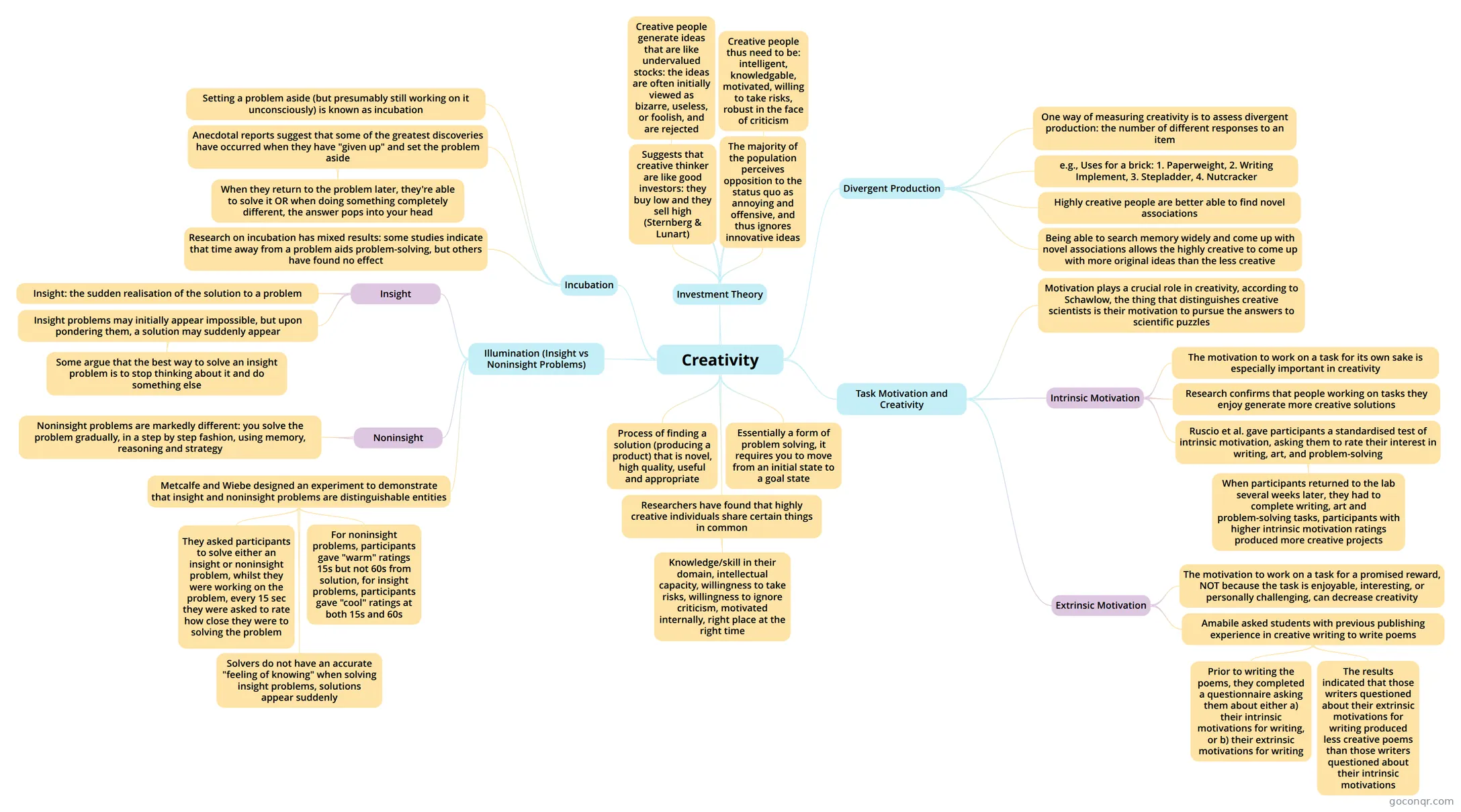
Mind map: Creativity
Contenido del mapa
Creativity
Process of finding a solution (producing a product) that is novel, high quality, useful and appropriate
Essentially a form of problem solving, it requires you to move from an initial state to a goal state
Researchers have found that highly creative individuals share certain things in common
- Knowledge/skill in their domain, intellectual capacity, willingness to take risks, willingness to ignore criticism, motivated internally, right place at the right time
Investment Theory
- Suggests that creative thinker are like good investors: they buy low and they sell high (Sternberg & Lunart)
- Creative people generate ideas that are like undervalued stocks: the ideas are often initially viewed as bizarre, useless, or foolish, and are rejected
- The majority of the population perceives opposition to the status quo as annoying and offensive, and thus ignores innovative ideas
- Creative people thus need to be: intelligent, knowledgable, motivated, willing to take risks, robust in the face of criticism
Divergent Production
- One way of measuring creativity is to assess divergent production: the number of different responses to an item
- e.g., Uses for a brick: 1. Paperweight, 2. Writing Implement, 3. Stepladder, 4. Nutcracker
- Highly creative people are better able to find novel associations
- Being able to search memory widely and come up with novel associations allows the highly creative to come up with more original ideas than the less creative
Incubation
- Setting a problem aside (but presumably still working on it unconsciously) is known as incubation
- Anecdotal reports suggest that some of the greatest discoveries have occurred when they have "given up" and set the problem aside
- When they return to the problem later, they're able to solve it OR when doing something completely different, the answer pops into your head
- Research on incubation has mixed results: some studies indicate that time away from a problem aids problem-solving, but others have found no effect
Illumination (Insight vs Noninsight Problems)
- Insight
- Insight: the sudden realisation of the solution to a problem
- Insight problems may initially appear impossible, but upon pondering them, a solution may suddenly appear
- Some argue that the best way to solve an insight problem is to stop thinking about it and do something else
- Noninsight
- Noninsight problems are markedly different: you solve the problem gradually, in a step by step fashion, using memory, reasoning and strategy
- Metcalfe and Wiebe designed an experiment to demonstrate that insight and noninsight problems are distinguishable entities
- They asked participants to solve either an insight or noninsight problem, whilst they were working on the problem, every 15 sec they were asked to rate how close they were to solving the problem
- For noninsight problems, participants gave "warm" ratings 15s but not 60s from solution, for insight problems, participants gave "cool" ratings at both 15s and 60s
- Solvers do not have an accurate "feeling of knowing" when solving insight problems, solutions appear suddenly
- Insight
Task Motivation and Creativity
- Motivation plays a crucial role in creativity, according to Schawlow, the thing that distinguishes creative scientists is their motivation to pursue the answers to scientific puzzles
- Intrinsic Motivation
- The motivation to work on a task for its own sake is especially important in creativity
- Research confirms that people working on tasks they enjoy generate more creative solutions
- Ruscio et al. gave participants a standardised test of intrinsic motivation, asking them to rate their interest in writing, art, and problem-solving
- When participants returned to the lab several weeks later, they had to complete writing, art and problem-solving tasks, participants with higher intrinsic motivation ratings produced more creative projects
- Extrinsic Motivation
- The motivation to work on a task for a promised reward, NOT because the task is enjoyable, interesting, or personally challenging, can decrease creativity
- Amabile asked students with previous publishing experience in creative writing to write poems
- Prior to writing the poems, they completed a questionnaire asking them about either a) their intrinsic motivations for writing, or b) their extrinsic motivations for writing
- The results indicated that those writers questioned about their extrinsic motivations for writing produced less creative poems than those writers questioned about their intrinsic motivations
Información
- Descripción
- (Problem-Solving and Creativity) PSY2COG Mapa Mental sobre Creativity, creado por Steph M el 12/06/2017.
- Creado por
- Steph M
- Visitas
- 0
- Valoración
Más sobre Problem Solving and Creativity