
Mapa mental
Medieval Japan
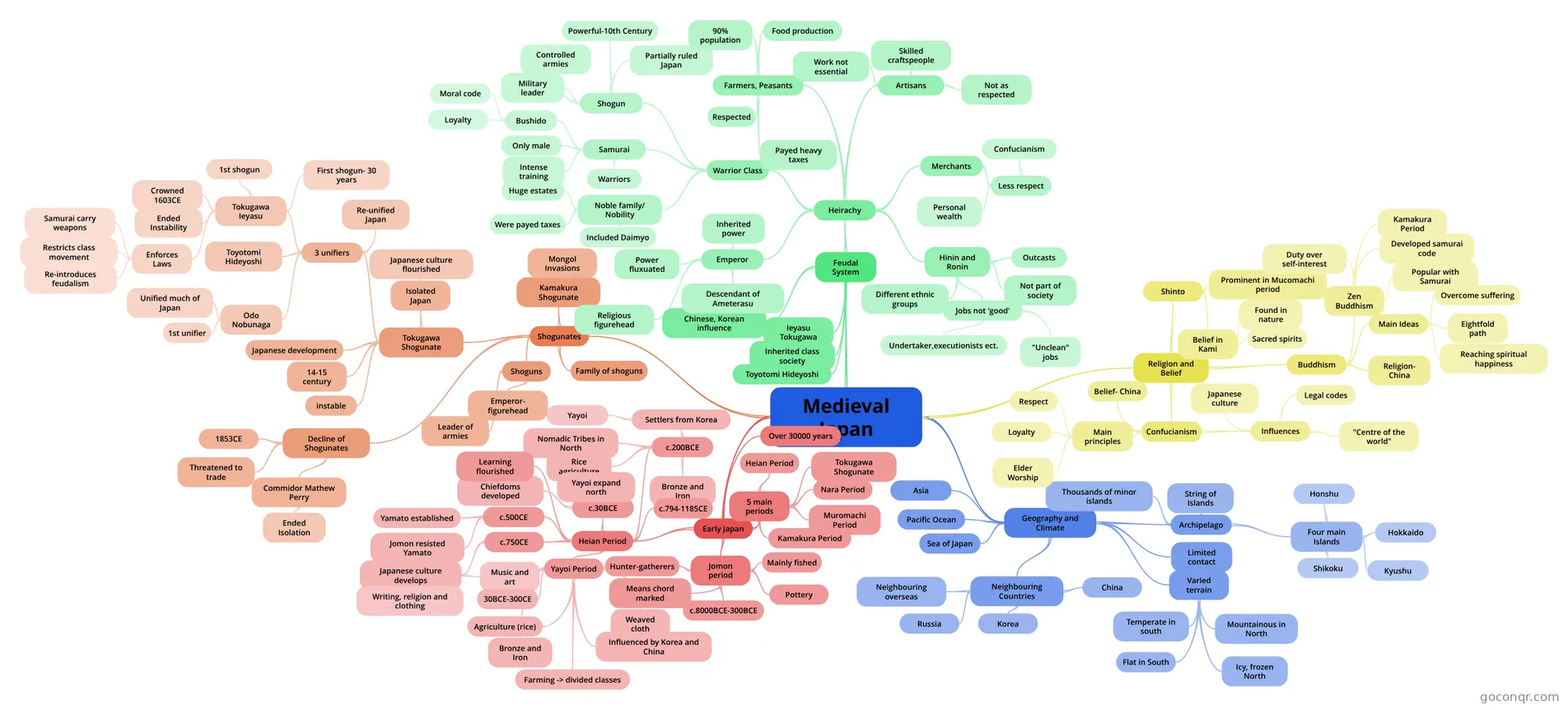
Mind map: Medieval Japan
Contenido del mapa
Medieval Japan
Feudal System
- Heirachy
- Emperor
- Descendant of Ameterasu
- Power fluxuated
- Religious figurehead
- Inherited power
- Warrior Class
- Shogun
- Military leader
- Controlled armies
- Powerful-10th Century
- Partially ruled Japan
- Noble family/ Nobility
- Included Daimyo
- Huge estates
- Were payed taxes
- Samurai
- Warriors
- Bushido
- Moral code
- Loyalty
- Intense training
- Only male
- Shogun
- Farmers, Peasants
- Food production
- 90% population
- Payed heavy taxes
- Respected
- Artisans
- Skilled craftspeople
- Work not essential
- Not as respected
- Merchants
- Less respect
- Personal wealth
- Confucianism
- Less respect
- Hinin and Ronin
- Outcasts
- Not part of society
- Different ethnic groups
- Jobs not 'good'
- Undertaker,executionists ect.
- "Unclean" jobs
- Emperor
- Chinese, Korean influence
- Toyotomi Hideyoshi
- Inherited class society
- Ieyasu Tokugawa
- Heirachy
Early Japan
- Heian Period
- c.200BCE
- Settlers from Korea
- Yayoi
- Nomadic Tribes in North
- Rice agriculture
- Bronze and Iron
- Settlers from Korea
- c.30BCE
- Yayoi expand north
- Chiefdoms developed
- c.500CE
- Yamato established
- Jomon resisted Yamato
- c.750CE
- Japanese culture develops
- Music and art
- Writing, religion and clothing
- Japanese culture develops
- Yayoi Period
- 30BCE-300CE
- Agriculture (rice)
- Bronze and Iron
- Weaved cloth
- Influenced by Korea and China
- Farming -> divided classes
- c.794-1185CE
- Learning flourished
- c.200BCE
- Jomon period
- Hunter-gatherers
- c.8000BCE-300BCE
- Means chord marked
- Mainly fished
- Pottery
- Over 30000 years
- 5 main periods
- Nara Period
- Tokugawa Shogunate
- Kamakura Period
- Heian Period
- Muromachi Period
- Heian Period
Religion and Belief
- Shinto
- Belief in Kami
- Sacred spirits
- Found in nature
- Prominent in Mucomachi period
- Belief in Kami
- Buddhism
- Zen Buddhism
- Popular with Samurai
- Duty over self-interest
- Developed samurai code
- Kamakura Period
- Religion- China
- Main Ideas
- Overcome suffering
- Eightfold path
- Reaching spiritual happiness
- Zen Buddhism
- Confucianism
- Belief- China
- Influences
- Japanese culture
- Legal codes
- "Centre of the world"
- Main principles
- Respect
- Elder Worship
- Loyalty
- Shinto
Shogunates
- Tokugawa Shogunate
- Japanese development
- 3 unifiers
- Tokugawa Ieyasu
- 1st shogun
- Crowned 1603CE
- Ended Instability
- First shogun- 30 years
- Enforces Laws
- Samurai carry weapons
- Re-introduces feudalism
- Restricts class movement
- Odo Nobunaga
- 1st unifier
- Unified much of Japan
- Toyotomi Hideyoshi
- Re-unified Japan
- Tokugawa Ieyasu
- 14-15 century
- instable
- Isolated Japan
- Japanese culture flourished
- Shoguns
- Leader of armies
- Emperor- figurehead
- Family of shoguns
- Kamakura Shogunate
- Mongol Invasions
- Decline of Shogunates
- 1853CE
- Commidor Mathew Perry
- Ended Isolation
- Threatened to trade
- Tokugawa Shogunate
Geography and Climate
- Archipelago
- Four main Islands
- Honshu
- Hokkaido
- Kyushu
- Shikoku
- Thousands of minor islands
- String of Islands
- Four main Islands
- Asia
- Pacific Ocean
- Sea of Japan
- Neighbouring Countries
- China
- Russia
- Korea
- Neighbouring overseas
- Limited contact
- Varied terrain
- Temperate in south
- Mountainous in North
- Flat in South
- Icy, frozen North
- Archipelago
Información
- Descripción
- 9 (Term 3) History Mapa Mental sobre Medieval Japan, creado por sabine.seeto el 02/09/2014.
- Creado por
- sabine.seeto
- Visitas
- 47
- Valoración