
Mapa mental
ind - Attraction and Exclusion
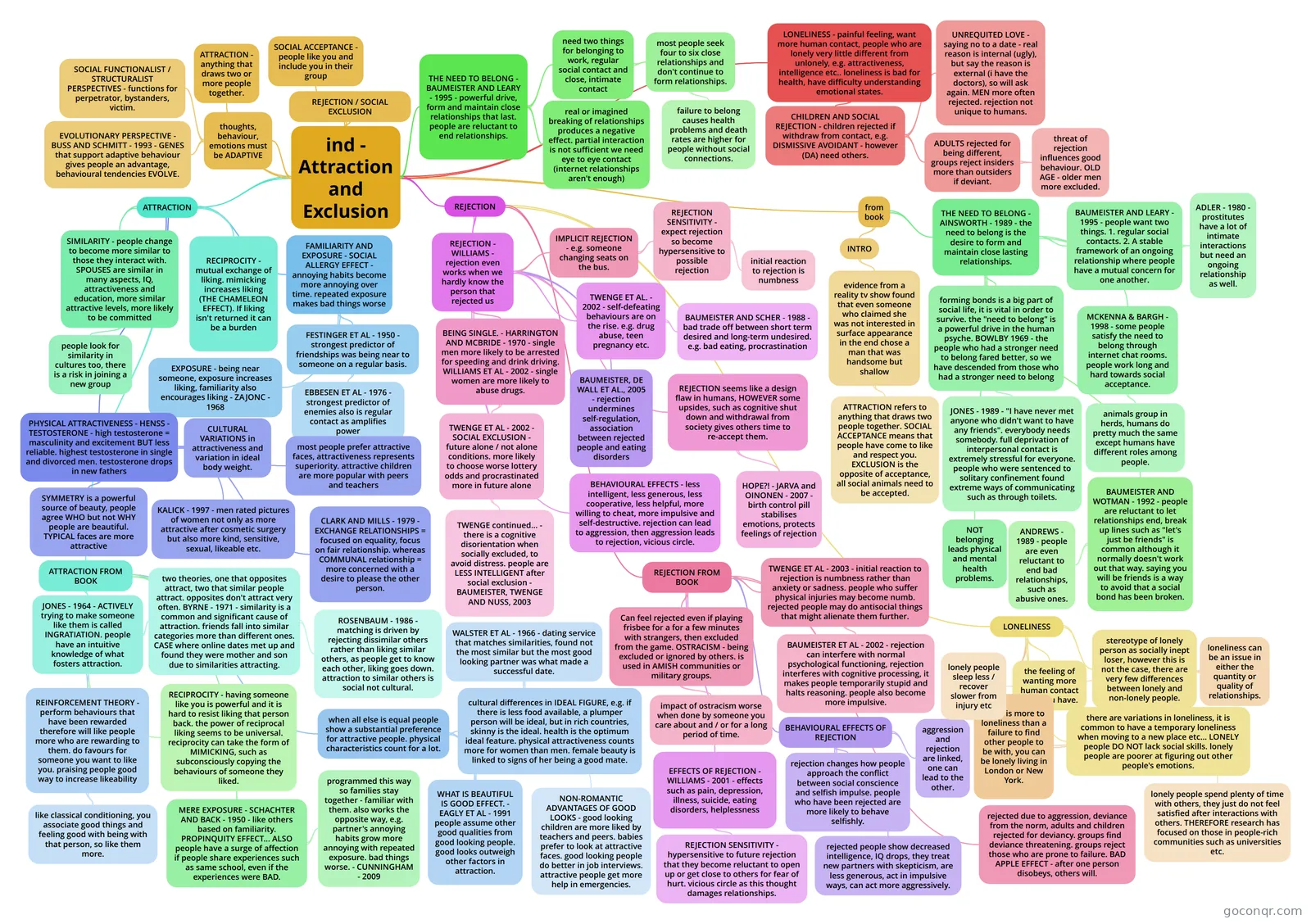
Mind map: Attraction and exclusion psychology
Contenido del mapa
ind - Attraction and Exclusion
ATTRACTION - anything that draws two or more people together.
SOCIAL ACCEPTANCE - people like you and include you in their group
REJECTION / SOCIAL EXCLUSION
THE NEED TO BELONG - BAUMEISTER AND LEARY - 1995 - powerful drive, form and maintain close relationships that last. people are reluctant to end relationships.
- need two things for belonging to work, regular social contact and close, intimate contact
- most people seek four to six close relationships and don't continue to form relationships.
- failure to belong causes health problems and death rates are higher for people without social connections.
- most people seek four to six close relationships and don't continue to form relationships.
- real or imagined breaking of relationships produces a negative effect. partial interaction is not sufficient we need eye to eye contact (internet relationships aren't enough)
- need two things for belonging to work, regular social contact and close, intimate contact
ATTRACTION
- SIMILARITY - people change to become more similar to those they interact with. SPOUSES are similar in many aspects, IQ, attractiveness and education, more similar attractive levels, more likely to be committed
- people look for similarity in cultures too, there is a risk in joining a new group
- RECIPROCITY - mutual exchange of liking. mimicking increases liking (THE CHAMELEON EFFECT). If liking isn't returned it can be a burden
- FAMILIARITY AND EXPOSURE - SOCIAL ALLERGY EFFECT - annoying habits become more annoying over time. repeated exposure makes bad things worse
- EXPOSURE - being near someone, exposure increases liking, familiarity also encourages liking - ZAJONC - 1968
- FESTINGER ET AL - 1950 - strongest predictor of friendships was being near to someone on a regular basis.
- EBBESEN ET AL - 1976 - strongest predictor of enemies also is regular contact as amplifies power
- PHYSICAL ATTRACTIVENESS - HENSS - TESTOSTERONE - high testosterone = masculinity and excitement BUT less reliable. highest testosterone in single and divorced men. testosterone drops in new fathers
- most people prefer attractive faces, attractiveness represents superiority. attractive children are more popular with peers and teachers
- CULTURAL VARIATIONS in attractiveness and variation in ideal body weight.
- KALICK - 1997 - men rated pictures of women not only as more attractive after cosmetic surgery but also more kind, sensitive, sexual, likeable etc.
- SYMMETRY is a powerful source of beauty, people agree WHO but not WHY people are beautiful. TYPICAL faces are more attractive
- CLARK AND MILLS - 1979 - EXCHANGE RELATIONSHIPS = focused on equality, focus on fair relationship. whereas COMMUNAL relationship = more concerned with a desire to please the other person.
- ATTRACTION FROM BOOK
- JONES - 1964 - ACTIVELY trying to make someone like them is called INGRATIATION. people have an intuitive knowledge of what fosters attraction.
- two theories, one that opposites attract, two that similar people attract. opposites don't attract very often. BYRNE - 1971 - similarity is a common and significant cause of attraction. friends fall into similar categories more than different ones. CASE where online dates met up and found they were mother and son due to similarities attracting.
- ROSENBAUM - 1986 - matching is driven by rejecting dissimilar others rather than liking similar others, as people get to know each other, liking goes down. attraction to similar others is social not cultural.
- REINFORCEMENT THEORY - perform behaviours that have been rewarded therefore will like people more who are rewarding to them. do favours for someone you want to like you. praising people good way to increase likeability
- like classical conditioning, you associate good things and feeling good with being with that person, so like them more.
- RECIPROCITY - having someone like you is powerful and it is hard to resist liking that person back. the power of reciprocal liking seems to be universal. reciprocity can take the form of MIMICKING, such as subconsciously copying the behaviours of someone they liked.
- two theories, one that opposites attract, two that similar people attract. opposites don't attract very often. BYRNE - 1971 - similarity is a common and significant cause of attraction. friends fall into similar categories more than different ones. CASE where online dates met up and found they were mother and son due to similarities attracting.
- MERE EXPOSURE - SCHACHTER AND BACK - 1950 - like others based on familiarity. PROPINQUITY EFFECT... ALSO people have a surge of affection if people share experiences such as same school, even if the experiences were BAD.
- programmed this way so families stay together - familiar with them. also works the opposite way, e.g. partner's annoying habits grow more annoying with repeated exposure. bad things worse. - CUNNINGHAM - 2009
- when all else is equal people show a substantial preference for attractive people. physical characteristics count for a lot.
- WHAT IS BEAUTIFUL IS GOOD EFFECT. - EAGLY ET AL - 1991 people assume other good qualities from good looking people. good looks outweigh other factors in attraction.
- WALSTER ET AL - 1966 - dating service that matches similarities, found not the most similar but the most good looking partner was what made a successful date.
- NON-ROMANTIC ADVANTAGES OF GOOD LOOKS - good looking children are more liked by teachers and peers. babies prefer to look at attractive faces. good looking people do better in job interviews. attractive people get more help in emergencies.
- WALSTER ET AL - 1966 - dating service that matches similarities, found not the most similar but the most good looking partner was what made a successful date.
- cultural differences in IDEAL FIGURE, e.g. if there is less food available, a plumper person will be ideal, but in rich countries, skinny is the ideal. health is the optimum ideal feature. physical attractiveness counts more for women than men. female beauty is linked to signs of her being a good mate.
- WHAT IS BEAUTIFUL IS GOOD EFFECT. - EAGLY ET AL - 1991 people assume other good qualities from good looking people. good looks outweigh other factors in attraction.
- JONES - 1964 - ACTIVELY trying to make someone like them is called INGRATIATION. people have an intuitive knowledge of what fosters attraction.
- SIMILARITY - people change to become more similar to those they interact with. SPOUSES are similar in many aspects, IQ, attractiveness and education, more similar attractive levels, more likely to be committed
thoughts, behaviour, emotions must be ADAPTIVE
- SOCIAL FUNCTIONALIST / STRUCTURALIST PERSPECTIVES - functions for perpetrator, bystanders, victim.
- EVOLUTIONARY PERSPECTIVE - BUSS AND SCHMITT - 1993 - GENES that support adaptive behaviour gives people an advantage, behavioural tendencies EVOLVE.
LONELINESS - painful feeling, want more human contact, people who are lonely very little different from unlonely, e.g. attractiveness, intelligence etc.. loneliness is bad for health, have difficulty understanding emotional states.
- CHILDREN AND SOCIAL REJECTION - children rejected if withdraw from contact, e.g. DISMISSIVE AVOIDANT - however (DA) need others.
- ADULTS rejected for being different, groups reject insiders more than outsiders if deviant.
- threat of rejection influences good behaviour. OLD AGE - older men more excluded.
- UNREQUITED LOVE - saying no to a date - real reason is internal (ugly), but say the reason is external (i have the doctors), so will ask again. MEN more often rejected. rejection not unique to humans.
- ADULTS rejected for being different, groups reject insiders more than outsiders if deviant.
- CHILDREN AND SOCIAL REJECTION - children rejected if withdraw from contact, e.g. DISMISSIVE AVOIDANT - however (DA) need others.
REJECTION
- REJECTION - WILLIAMS - rejection even works when we hardly know the person that rejected us
- TWENGE ET AL. - 2002 - self-defeating behaviours are on the rise. e.g. drug abuse, teen pregnancy etc.
- BAUMEISTER AND SCHER - 1988 - bad trade off between short term desired and long-term undesired. e.g. bad eating, procrastination
- BEING SINGLE. - HARRINGTON AND MCBRIDE - 1970 - single men more likely to be arrested for speeding and drink driving. WILLIAMS ET AL - 2002 - single women are more likely to abuse drugs.
- TWENGE ET AL - 2002 - SOCIAL EXCLUSION - future alone / not alone conditions. more likely to choose worse lottery odds and procrastinated more in future alone
- TWENGE continued... - there is a cognitive disorientation when socially excluded, to avoid distress. people are LESS INTELLIGENT after social exclusion - BAUMEISTER, TWENGE AND NUSS, 2003
- TWENGE ET AL - 2002 - SOCIAL EXCLUSION - future alone / not alone conditions. more likely to choose worse lottery odds and procrastinated more in future alone
- IMPLICIT REJECTION - e.g. someone changing seats on the bus.
- REJECTION SENSITIVITY - expect rejection so become hypersensitive to possible rejection
- initial reaction to rejection is numbness
- REJECTION SENSITIVITY - expect rejection so become hypersensitive to possible rejection
- BAUMEISTER, DE WALL ET AL., 2005 - rejection undermines self-regulation, association between rejected people and eating disorders
- BEHAVIOURAL EFFECTS - less intelligent, less generous, less cooperative, less helpful, more willing to cheat, more impulsive and self-destructive. rejection can lead to aggression, then aggression leads to rejection, vicious circle.
- REJECTION seems like a design flaw in humans, HOWEVER some upsides, such as cognitive shut down and withdrawal from society gives others time to re-accept them.
- HOPE?! - JARVA and OINONEN - 2007 - birth control pill stabilises emotions, protects feelings of rejection
- TWENGE ET AL. - 2002 - self-defeating behaviours are on the rise. e.g. drug abuse, teen pregnancy etc.
- REJECTION FROM BOOK
- Can feel rejected even if playing frisbee for a for a few minutes with strangers, then excluded from the game. OSTRACISM - being excluded or ignored by others. is used in AMISH communities or military groups.
- impact of ostracism worse when done by someone you care about and / or for a long period of time.
- EFFECTS OF REJECTION - WILLIAMS - 2001 - effects such as pain, depression, illness, suicide, eating disorders, helplessness
- REJECTION SENSITIVITY - hypersensitive to future rejection that they become reluctant to open up or get close to others for fear of hurt. vicious circle as this thought damages relationships.
- TWENGE ET AL - 2003 - initial reaction to rejection is numbness rather than anxiety or sadness. people who suffer physical injuries may become numb. rejected people may do antisocial things that might alienate them further.
- BAUMEISTER ET AL - 2002 - rejection can interfere with normal psychological functioning, rejection interferes with cognitive processing, it makes people temporarily stupid and halts reasoning. people also become more impulsive.
- BEHAVIOURAL EFFECTS OF REJECTION
- rejection changes how people approach the conflict between social conscience and selfish impulse. people who have been rejected are more likely to behave selfishly.
- rejected people show decreased intelligence, IQ drops, they treat new partners with skepticism, are less generous, act in impulsive ways, can act more aggressively.
- aggression and rejection are linked, one can lead to the other.
- rejected due to aggression, deviance from the norm, adults and children rejected for deviancy. groups find deviance threatening. groups reject those who are prone to failure. BAD APPLE EFFECT - after one person disobeys, others will.
- Can feel rejected even if playing frisbee for a for a few minutes with strangers, then excluded from the game. OSTRACISM - being excluded or ignored by others. is used in AMISH communities or military groups.
- LONELINESS
- the feeling of wanting more human contact than you have.
- stereotype of lonely person as socially inept loser, however this is not the case, there are very few differences between lonely and non-lonely people.
- there are variations in loneliness, it is common to have a temporary loneliness when moving to a new place etc... LONELY people DO NOT lack social skills. lonely people are poorer at figuring out other people's emotions.
- there is more to loneliness than a failure to find other people to be with, you can be lonely living in London or New York.
- loneliness can be an issue in either the quantity or quality of relationships.
- lonely people spend plenty of time with others, they just do not feel satisfied after interactions with others. THEREFORE research has focused on those in people-rich communities such as universities etc.
- lonely people sleep less / recover slower from injury etc
- loneliness can be an issue in either the quantity or quality of relationships.
- REJECTION - WILLIAMS - rejection even works when we hardly know the person that rejected us
from book
- INTRO
- evidence from a reality tv show found that even someone who claimed she was not interested in surface appearance in the end chose a man that was handsome but shallow
- ATTRACTION refers to anything that draws two people together. SOCIAL ACCEPTANCE means that people have come to like and respect you. EXCLUSION is the opposite of acceptance, all social animals need to be accepted.
- evidence from a reality tv show found that even someone who claimed she was not interested in surface appearance in the end chose a man that was handsome but shallow
- THE NEED TO BELONG - AINSWORTH - 1989 - the need to belong is the desire to form and maintain close lasting relationships.
- forming bonds is a big part of social life, it is vital in order to survive. the "need to belong" is a powerful drive in the human psyche. BOWLBY 1969 - the people who had a stronger need to belong fared better, so we have descended from those who had a stronger need to belong
- JONES - 1989 - "I have never met anyone who didn't want to have any friends". everybody needs somebody. full deprivation of interpersonal contact is extremely stressful for everyone. people who were sentenced to solitary confinement found extreme ways of communicating such as through toilets.
- MCKENNA & BARGH - 1998 - some people satisfy the need to belong through internet chat rooms. people work long and hard towards social acceptance.
- animals group in herds, humans do pretty much the same except humans have different roles among people.
- BAUMEISTER AND WOTMAN - 1992 - people are reluctant to let relationships end, break up lines such as "let's just be friends" is common although it normally doesn't work out that way. saying you will be friends is a way to avoid that a social bond has been broken.
- ANDREWS - 1989 - people are even reluctant to end bad relationships, such as abusive ones.
- BAUMEISTER AND LEARY - 1995 - people want two things. 1. regular social contacts. 2. A stable framework of an ongoing relationship where people have a mutual concern for one another.
- ADLER - 1980 - prostitutes have a lot of intimate interactions but need an ongoing relationship as well.
- NOT belonging leads physical and mental health problems.
- forming bonds is a big part of social life, it is vital in order to survive. the "need to belong" is a powerful drive in the human psyche. BOWLBY 1969 - the people who had a stronger need to belong fared better, so we have descended from those who had a stronger need to belong
- INTRO
Información
- Descripción
- Social of Individual Mapa Mental sobre ind - Attraction and Exclusion, creado por becky.waine el 16/06/2013.
- Creado por
- becky.waine
- Visitas
- 138
- Etiquetas
- Valoración