
Mapa mental
STRUCTURE OF WORKING MEMORY
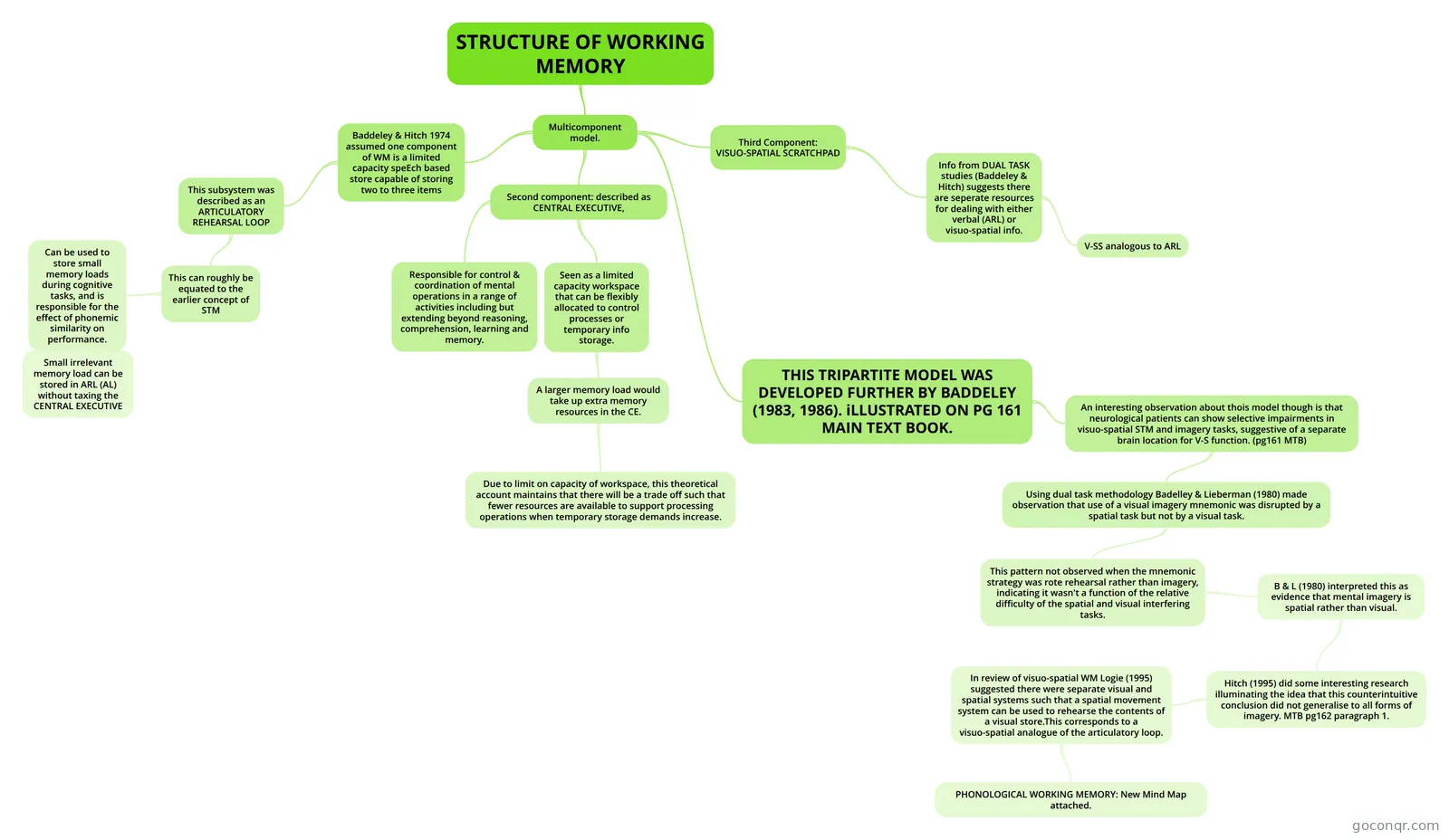
Mind map: structure of working memory
Contenido del mapa
STRUCTURE OF WORKING MEMORY
Multicomponent model.
- Baddeley & Hitch 1974 assumed one component of WM is a limited capacity speEch based store capable of storing two to three items
- This subsystem was described as an ARTICULATORY REHEARSAL LOOP
- This can roughly be equated to the earlier concept of STM
- Can be used to store small memory loads during cognitive tasks, and is responsible for the effect of phonemic similarity on performance.
- Small irrelevant memory load can be stored in ARL (AL) without taxing the CENTRAL EXECUTIVE
- Can be used to store small memory loads during cognitive tasks, and is responsible for the effect of phonemic similarity on performance.
- This can roughly be equated to the earlier concept of STM
- This subsystem was described as an ARTICULATORY REHEARSAL LOOP
- Second component: described as CENTRAL EXECUTIVE,
- Responsible for control & coordination of mental operations in a range of activities including but extending beyond reasoning, comprehension, learning and memory.
- Seen as a limited capacity workspace that can be flexibly allocated to control processes or temporary info storage.
- A larger memory load would take up extra memory resources in the CE.
- Due to limit on capacity of workspace, this theoretical account maintains that there will be a trade off such that fewer resources are available to support processing operations when temporary storage demands increase.
- A larger memory load would take up extra memory resources in the CE.
- Third Component: VISUO-SPATIAL SCRATCHPAD
- Info from DUAL TASK studies (Baddeley & Hitch) suggests there are seperate resources for dealing with either verbal (ARL) or visuo-spatial info.
- V-SS analogous to ARL
- Info from DUAL TASK studies (Baddeley & Hitch) suggests there are seperate resources for dealing with either verbal (ARL) or visuo-spatial info.
- THIS TRIPARTITE MODEL WAS DEVELOPED FURTHER BY BADDELEY (1983, 1986). iLLUSTRATED ON PG 161 MAIN TEXT BOOK.
- An interesting observation about thois model though is that neurological patients can show selective impairments in visuo-spatial STM and imagery tasks, suggestive of a separate brain location for V-S function. (pg161 MTB)
- Using dual task methodology Badelley & Lieberman (1980) made observation that use of a visual imagery mnemonic was disrupted by a spatial task but not by a visual task.
- This pattern not observed when the mnemonic strategy was rote rehearsal rather than imagery, indicating it wasn't a function of the relative difficulty of the spatial and visual interfering tasks.
- B & L (1980) interpreted this as evidence that mental imagery is spatial rather than visual.
- Hitch (1995) did some interesting research illuminating the idea that this counterintuitive conclusion did not generalise to all forms of imagery. MTB pg162 paragraph 1.
- In review of visuo-spatial WM Logie (1995) suggested there were separate visual and spatial systems such that a spatial movement system can be used to rehearse the contents of a visual store.This corresponds to a visuo-spatial analogue of the articulatory loop.
- PHONOLOGICAL WORKING MEMORY: New Mind Map attached.
- In review of visuo-spatial WM Logie (1995) suggested there were separate visual and spatial systems such that a spatial movement system can be used to rehearse the contents of a visual store.This corresponds to a visuo-spatial analogue of the articulatory loop.
- Hitch (1995) did some interesting research illuminating the idea that this counterintuitive conclusion did not generalise to all forms of imagery. MTB pg162 paragraph 1.
- B & L (1980) interpreted this as evidence that mental imagery is spatial rather than visual.
- This pattern not observed when the mnemonic strategy was rote rehearsal rather than imagery, indicating it wasn't a function of the relative difficulty of the spatial and visual interfering tasks.
- Using dual task methodology Badelley & Lieberman (1980) made observation that use of a visual imagery mnemonic was disrupted by a spatial task but not by a visual task.
- An interesting observation about thois model though is that neurological patients can show selective impairments in visuo-spatial STM and imagery tasks, suggestive of a separate brain location for V-S function. (pg161 MTB)
- Baddeley & Hitch 1974 assumed one component of WM is a limited capacity speEch based store capable of storing two to three items
Información
- Descripción
- level 3 ou Memory Mapa Mental sobre STRUCTURE OF WORKING MEMORY, creado por jamesbaily el 02/07/2013.
- Creado por
- jamesbaily
- Visitas
- 179
- Etiquetas
- Valoración