
Mapa mental
LOCALISATION OF FUNCTIONS
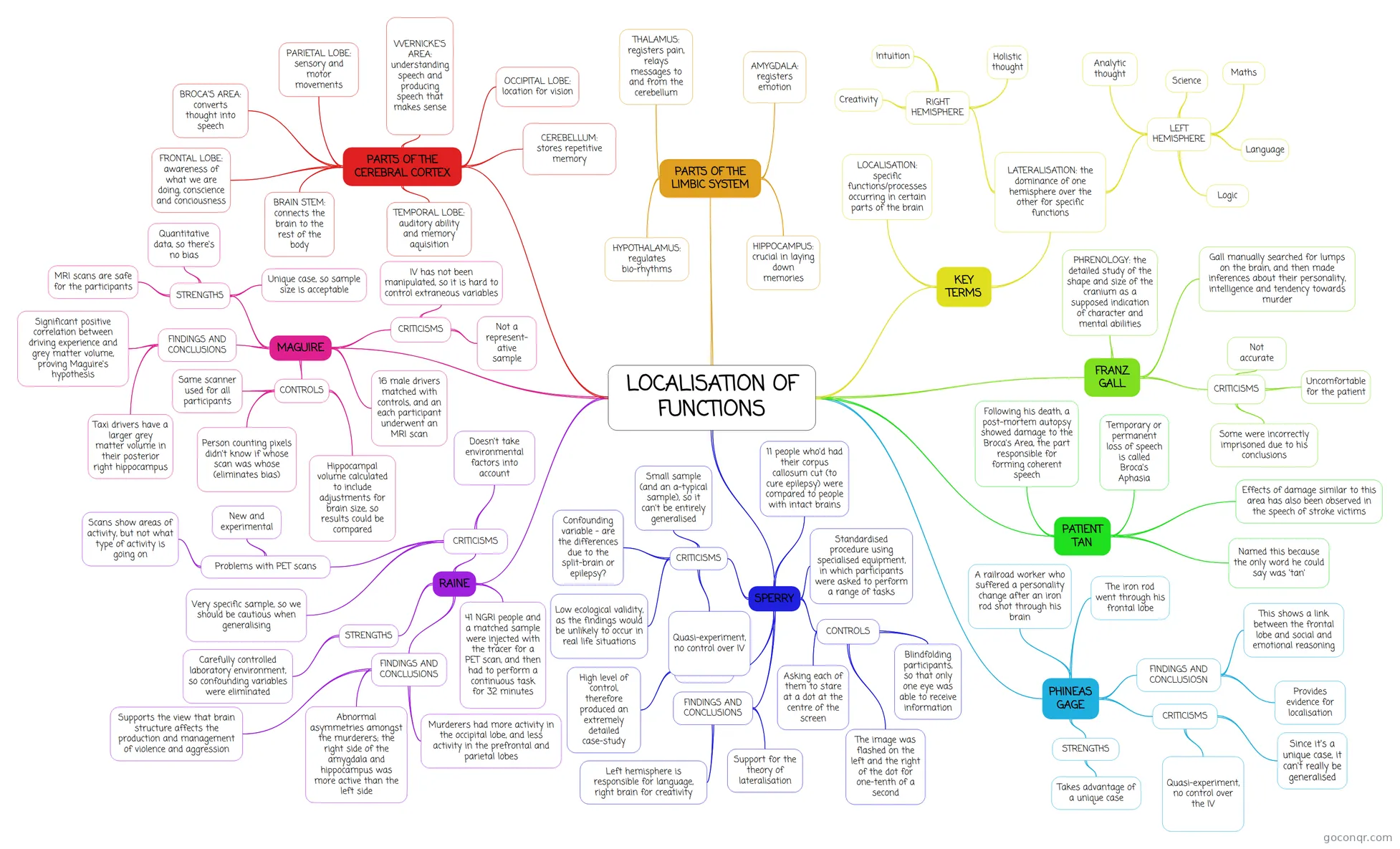
Mind map: localisation of functions in the brain
Contenido del mapa
LOCALISATION OF FUNCTIONS
PARTS OF THE CEREBRAL CORTEX
- FRONTAL LOBE: awareness of what we are doing, conscience and conciousness
- BROCA'S AREA: converts thought into speech
- PARIETAL LOBE: sensory and motor movements
- WERNICKE'S AREA: understanding speech and producing speech that makes sense
- OCCIPITAL LOBE: location for vision
- CEREBELLUM: stores repetitive memory
- BRAIN STEM: connects the brain to the rest of the body
- TEMPORAL LOBE: auditory ability and memory aquisition
PARTS OF THE LIMBIC SYSTEM
- HYPOTHALAMUS: regulates bio-rhythms
- THALAMUS: registers pain, relays messages to and from the cerebellum
- AMYGDALA: registers emotion
- HIPPOCAMPUS: crucial in laying down memories
KEY TERMS
- LOCALISATION: specific functions/processes occurring in certain parts of the brain
- LATERALISATION: the dominance of one hemisphere over the other for specific functions
- LEFT HEMISPHERE
- Logic
- Language
- Science
- Maths
- Analytic thought
- RiGHT HEMISPHERE
- Holistic thought
- Intuition
- Creativity
- LEFT HEMISPHERE
FRANZ GALL
- PHRENOLOGY: the detailed study of the shape and size of the cranium as a supposed indication of character and mental abilities
- Gall manually searched for lumps on the brain, and then made inferences about their personality, intelligence and tendency towards murder
- CRITICISMS
- Not accurate
- Uncomfortable for the patient
- Some were incorrectly imprisoned due to his conclusions
PATIENT TAN
- Named this because the only word he could say was 'tan'
- Following his death, a post-mortem autopsy showed damage to the Broca's Area, the part responsible for forming coherent speech
- Effects of damage similar to this area has also been observed in the speech of stroke victims
- Temporary or permanent loss of speech is called Broca's Aphasia
PHINEAS GAGE
- A railroad worker who suffered a personality change after an iron rod shot through his brain
- The iron rod went through his frontal lobe
- FINDINGS AND CONCLUSIOSN
- This shows a link between the frontal lobe and social and emotional reasoning
- Provides evidence for localisation
- CRITICISMS
- Since it's a unique case, it can't really be generalised
- Quasi-experiment, no control over the IV
- STRENGTHS
- Takes advantage of a unique case
SPERRY
- 11 people who'd had their corpus callosum cut (to cure epilepsy) were compared to people with intact brains
- Standardised procedure using specialised equipment, in which participants were asked to perform a range of tasks
- CONTROLS
- Blindfolding participants, so that only one eye was able to receive information
- Asking each of them to stare at a dot at the centre of the screen
- The image was flashed on the left and the right of the dot for one-tenth of a second
- FINDINGS AND CONCLUSIONS
- Support for the theory of lateralisation
- Left hemisphere is responsible for language, right brain for creativity
- STRENGTHS
- High level of control, therefore produced an extremely detailed case-study
- CRITICISMS
- Small sample (and an a-typical sample), so it can't be entirely generalised
- Confounding variable - are the differences due to the split-brain or epilepsy?
- Low ecological validity, as the findings would be unlikely to occur in real life situations
- Quasi-experiment, no control over IV
RAINE
- 41 NGRI people and a matched sample were injected with the tracer for a PET scan, and then had to perform a continuous task for 32 minutes
- FINDINGS AND CONCLUSIONS
- Murderers had more activity in the occipital lobe, and less activity in the prefrontal and parietal lobes
- Abnormal asymmetries amongst the murderers; the right side of the amygdala and hippocampus was more active than the left side
- Supports the view that brain structure affects the production and management of violence and aggression
- STRENGTHS
- Carefully controlled laboratory environment, so confounding variables were eliminated
- CRITICISMS
- Problems with PET scans
- New and experimental
- Scans show areas of activity, but not what type of activity is going on
- Doesn't take environmental factors into account
- Very specific sample, so we should be cautious when generalising
- Problems with PET scans
MAGUIRE
- 16 male drivers matched with controls, and an each participant underwent an MRI scan
- CONTROLS
- Same scanner used for all participants
- Person counting pixels didn't know if whose scan was whose (eliminates bias)
- Hippocampal volume calculated to include adjustments for brain size, so results could be compared
- FINDINGS AND CONCLUSIONS
- Taxi drivers have a larger grey matter volume in their posterior right hippocampus
- Significant positive correlation between driving experience and grey matter volume, proving Maguire's hypothesis
- STRENGTHS
- MRI scans are safe for the participants
- Quantitative data, so there's no bias
- Unique case, so sample size is acceptable
- CRITICISMS
- Not a represent- ative sample
- IV has not been manipulated, so it is hard to control extraneous variables
Información
- Descripción
- Mapa Mental sobre LOCALISATION OF FUNCTIONS, creado por Emily-Kcrayg el 10/10/2014.
- Creado por
- Emily-Kcrayg
- Visitas
- 113
- Etiquetas
- Valoración
Más sobre Localisation of Brain Function