
Mapa mental
Memory
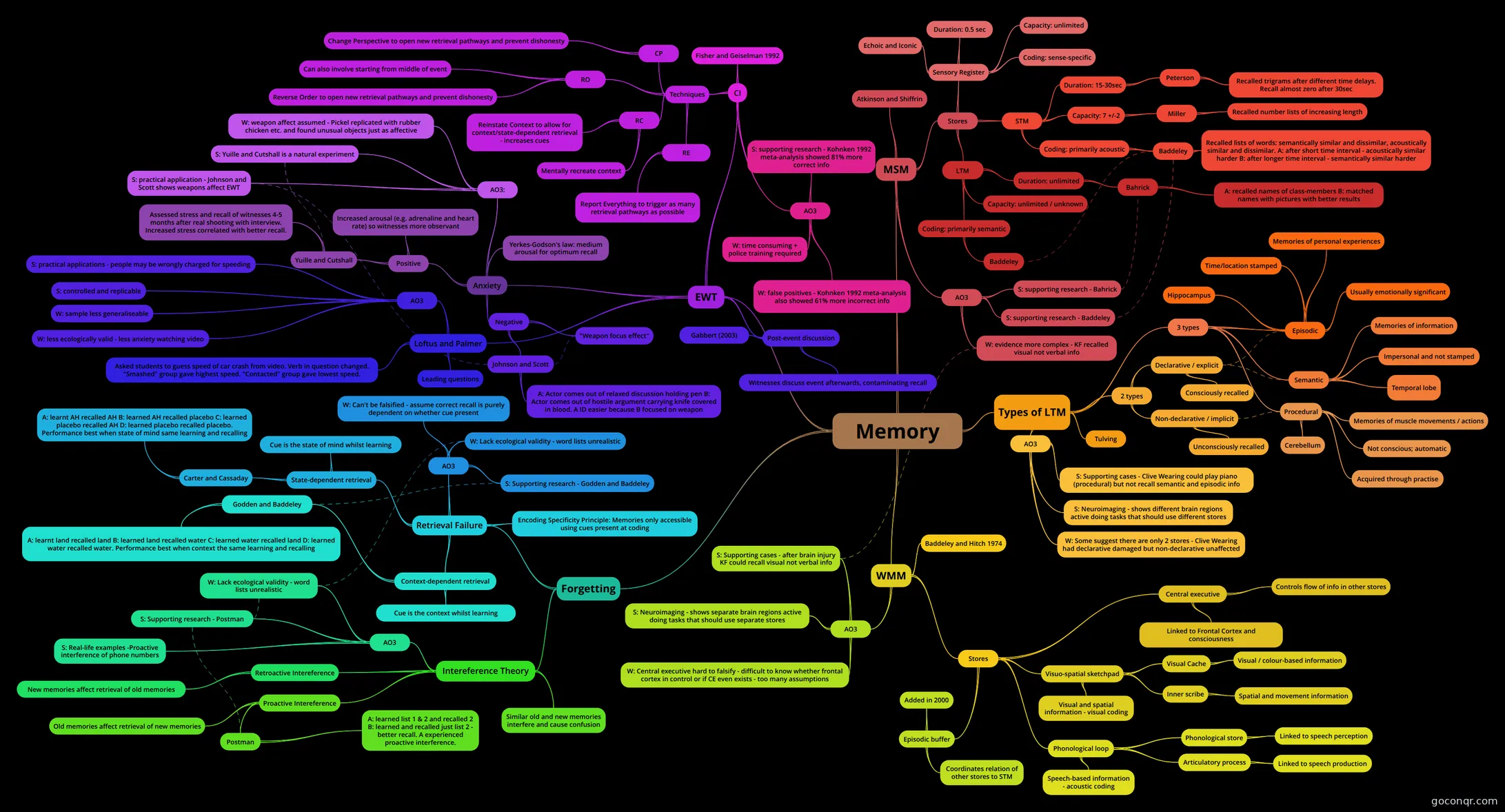
Mind map: Memory
Contenido del mapa
Memory
MSM
- Atkinson and Shiffrin
- Stores
- Sensory Register
- Duration: 0.5 sec
- Capacity: unlimited
- Coding: sense-specific
- Echoic and Iconic
- STM
- Capacity: 7 +/-2
- Miller
- Recalled number lists of increasing length
- Miller
- Duration: 15-30sec
- Peterson
- Recalled trigrams after different time delays. Recall almost zero after 30sec
- Peterson
- Coding: primarily acoustic
- Baddeley
- Recalled lists of words: semantically similar and dissimilar, acoustically similar and dissimilar. A: after short time interval - acoustically similar harder B: after longer time interval - semantically similar harder
- Baddeley
- Capacity: 7 +/-2
- LTM
- Duration: unlimited
- Bahrick
- A: recalled names of class-members B: matched names with pictures with better results
- Bahrick
- Capacity: unlimited / unknown
- Coding: primarily semantic
- Baddeley
- LTM
- Duration: unlimited
- Sensory Register
- AO3
- S: supporting research - Bahrick
- S: supporting research - Baddeley
- W: evidence more complex - KF recalled visual not verbal info
Types of LTM
- 3 types
- Episodic
- Time/location stamped
- Memories of personal experiences
- Usually emotionally significant
- Hippocampus
- Semantic
- Memories of information
- Impersonal and not stamped
- Temporal lobe
- Procedural
- Memories of muscle movements / actions
- Not conscious; automatic
- Acquired through practise
- Cerebellum
- Episodic
- 2 types
- Declarative / explicit
- Consciously recalled
- Non-declarative / implicit
- Unconsciously recalled
- Declarative / explicit
- AO3
- S: Supporting cases - Clive Wearing could play piano (procedural) but not recall semantic and episodic info
- S: Neuroimaging - shows different brain regions active doing tasks that should use different stores
- W: Some suggest there are only 2 stores - Clive Wearing had declarative damaged but non-declarative unaffected
- Tulving
- 3 types
WMM
- Stores
- Phonological loop
- Speech-based information - acoustic coding
- Articulatory process
- Linked to speech production
- Phonological store
- Linked to speech perception
- Visuo-spatial sketchpad
- Visual and spatial information - visual coding
- Visual Cache
- Visual / colour-based information
- Inner scribe
- Spatial and movement information
- Central executive
- Controls flow of info in other stores
- Linked to Frontal Cortex and consciousness
- Episodic buffer
- Added in 2000
- Coordinates relation of other stores to STM
- Phonological loop
- Baddeley and Hitch 1974
- AO3
- S: Supporting cases - after brain injury KF could recall visual not verbal info
- S: Neuroimaging - shows separate brain regions active doing tasks that should use separate stores
- W: Central executive hard to falsify - difficult to know whether frontal cortex in control or if CE even exists - too many assumptions
- Stores
Forgetting
- Intereference Theory
- Proactive Intereference
- Old memories affect retrieval of new memories
- Postman
- A: learned list 1 & 2 and recalled 2 B: learned and recalled just list 2 - better recall. A experienced proactive interference.
- Retroactive Intereference
- New memories affect retrieval of old memories
- Similar old and new memories interfere and cause confusion
- AO3
- S: Supporting research - Postman
- S: Real-life examples -Proactive interference of phone numbers
- W: Lack ecological validity - word lists unrealistic
- Proactive Intereference
- Retrieval Failure
- Encoding Specificity Principle: Memories only accessible using cues present at coding
- Context-dependent retrieval
- Cue is the context whilst learning
- Godden and Baddeley
- A: learnt land recalled land B: learned land recalled water C: learned water recalled land D: learned water recalled water. Performance best when context the same learning and recalling
- State-dependent retrieval
- Cue is the state of mind whilst learning
- Carter and Cassaday
- A: learnt AH recalled AH B: learned AH recalled placebo C: learned placebo recalled AH D: learned placebo recalled placebo. Performance best when state of mind same learning and recalling
- AO3
- S: Supporting research - Godden and Baddeley
- W: Lack ecological validity - word lists unrealistic
- W: Can't be falsified - assume correct recall is purely dependent on whether cue present
- Intereference Theory
EWT
- Loftus and Palmer
- Asked students to guess speed of car crash from video. Verb in question changed. "Smashed" group gave highest speed. "Contacted" group gave lowest speed.
- Leading questions
- AO3
- S: practical applications - people may be wrongly charged for speeding
- S: controlled and replicable
- W: less ecologically valid - less anxiety watching video
- W: sample less generaliseable
- Anxiety
- Negative
- Johnson and Scott
- A: Actor comes out of relaxed discussion holding pen B: Actor comes out of hostile argument carrying knife covered in blood. A ID easier because B focused on weapon
- "Weapon focus effect"
- Johnson and Scott
- Positive
- Increased arousal (e.g. adrenaline and heart rate) so witnesses more observant
- Yuille and Cutshall
- Assessed stress and recall of witnesses 4-5 months after real shooting with interview. Increased stress correlated with better recall.
- Yerkes-Godson's law: medium arousal for optimum recall
- AO3:
- S: practical application - Johnson and Scott shows weapons affect EWT
- S: Yuille and Cutshall is a natural experiment
- W: weapon affect assumed - Pickel replicated with rubber chicken etc. and found unusual objects just as affective
- Negative
- CI
- Techniques
- RE
- Report Everything to trigger as many retrieval pathways as possible
- RC
- Reinstate Context to allow for context/state-dependent retrieval - increases cues
- Mentally recreate context
- RO
- Reverse Order to open new retrieval pathways and prevent dishonesty
- Can also involve starting from middle of event
- CP
- Change Perspective to open new retrieval pathways and prevent dishonesty
- RE
- Fisher and Geiselman 1992
- AO3
- S: supporting research - Kohnken 1992 meta-analysis showed 81% more correct info
- W: false positives - Kohnken 1992 meta-analysis also showed 61% more incorrect info
- W: time consuming + police training required
- Techniques
- Post-event discussion
- Witnesses discuss event afterwards, contaminating recall
- Gabbert (2003)
- Loftus and Palmer
Información
- Descripción
- A level Psychology Mapa Mental sobre Memory, creado por James Warne el 15/03/2020.
- Creado por
- James Warne
- Visitas
- 1
- Valoración