
Mapa mental
Grammatical Development 2
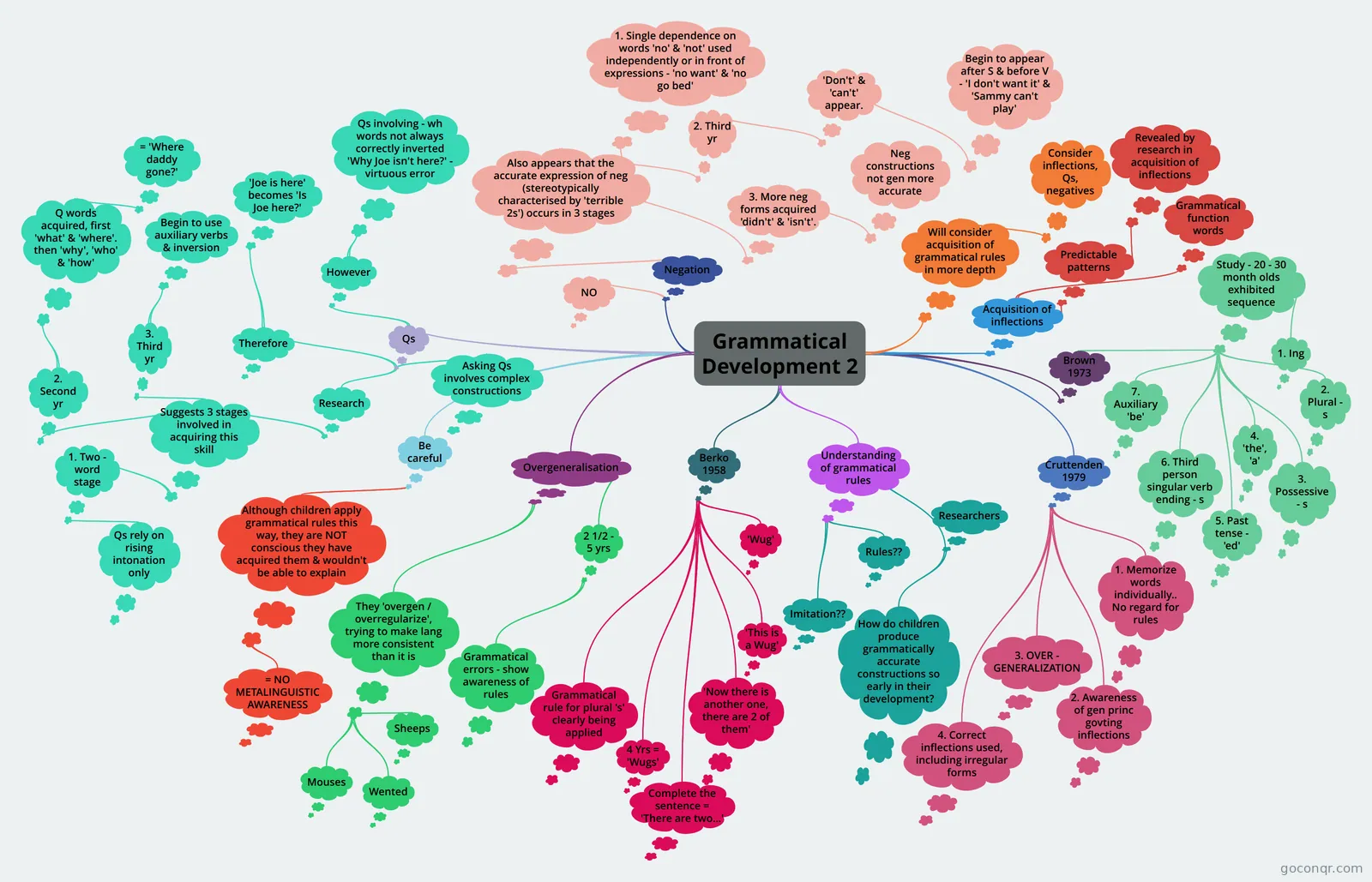
Mind map: Grammatical development
Contenido del mapa
Grammatical Development 2
Will consider acquisition of grammatical rules in more depth
- Consider inflections, Qs, negatives
Acquisition of inflections
- Predictable patterns
- Revealed by research in acquisition of inflections
- Grammatical function words
- Predictable patterns
Brown 1973
- Study - 20 - 30 month olds exhibited sequence
- 1. Ing
- 2. Plural - s
- 3. Possessive - s
- 4. 'the', 'a'
- 5. Past tense - 'ed'
- 6. Third person singular verb ending - s
- 7. Auxiliary 'be'
- Study - 20 - 30 month olds exhibited sequence
Cruttenden 1979
- 1. Memorize words individually.. No regard for rules
- 2. Awareness of gen princ govting inflections
- 3. OVER - GENERALIZATION
- 4. Correct inflections used, including irregular forms
Understanding of grammatical rules
- Researchers
- How do children produce grammatically accurate constructions so early in their development?
- Rules??
- Imitation??
- Researchers
Berko 1958
- 'Wug'
- 'This is a Wug'
- 'Now there is another one, there are 2 of them'
- Complete the sentence = 'There are two...'
- 4 Yrs = 'Wugs'
- Grammatical rule for plural 's' clearly being applied
Overgeneralisation
- 2 1/2 - 5 yrs
- Grammatical errors - show awareness of rules
- They 'overgen / overregularize', trying to make lang more consistent than it is
- Sheeps
- Wented
- Mouses
- 2 1/2 - 5 yrs
Be careful
- Although children apply grammatical rules this way, they are NOT conscious they have acquired them & wouldn't be able to explain
- = NO METALINGUISTIC AWARENESS
- Although children apply grammatical rules this way, they are NOT conscious they have acquired them & wouldn't be able to explain
Qs
- Asking Qs involves complex constructions
- Research
- Suggests 3 stages involved in acquiring this skill
- 1. Two - word stage
- Qs rely on rising intonation only
- 2. Second yr
- Q words acquired, first 'what' & 'where'. then 'why', 'who' & 'how'
- = 'Where daddy gone?'
- Q words acquired, first 'what' & 'where'. then 'why', 'who' & 'how'
- 3. Third yr
- Begin to use auxiliary verbs & inversion
- 1. Two - word stage
- Suggests 3 stages involved in acquiring this skill
- Therefore
- 'Joe is here' becomes 'Is Joe here?'
- However
- Qs involving - wh words not always correctly inverted 'Why Joe isn't here?' - virtuous error
Negation
- NO
- Also appears that the accurate expression of neg (stereotypically characterised by 'terrible 2s') occurs in 3 stages
- 1. Single dependence on words 'no' & 'not' used independently or in front of expressions - 'no want' & 'no go bed'
- 2. Third yr
- 'Don't' & 'can't' appear.
- Begin to appear after S & before V - 'I don't want it' & 'Sammy can't play'
- 'Don't' & 'can't' appear.
- 3. More neg forms acquired 'didn't' & 'isn't'.
- Neg constructions not gen more accurate
Información
- Descripción
- Child Language acquisition mind map about early development of lang
- Creado por
- megan langdon
- Visitas
- 95
- Etiquetas
- Valoración