
Mapa mental
Cell division
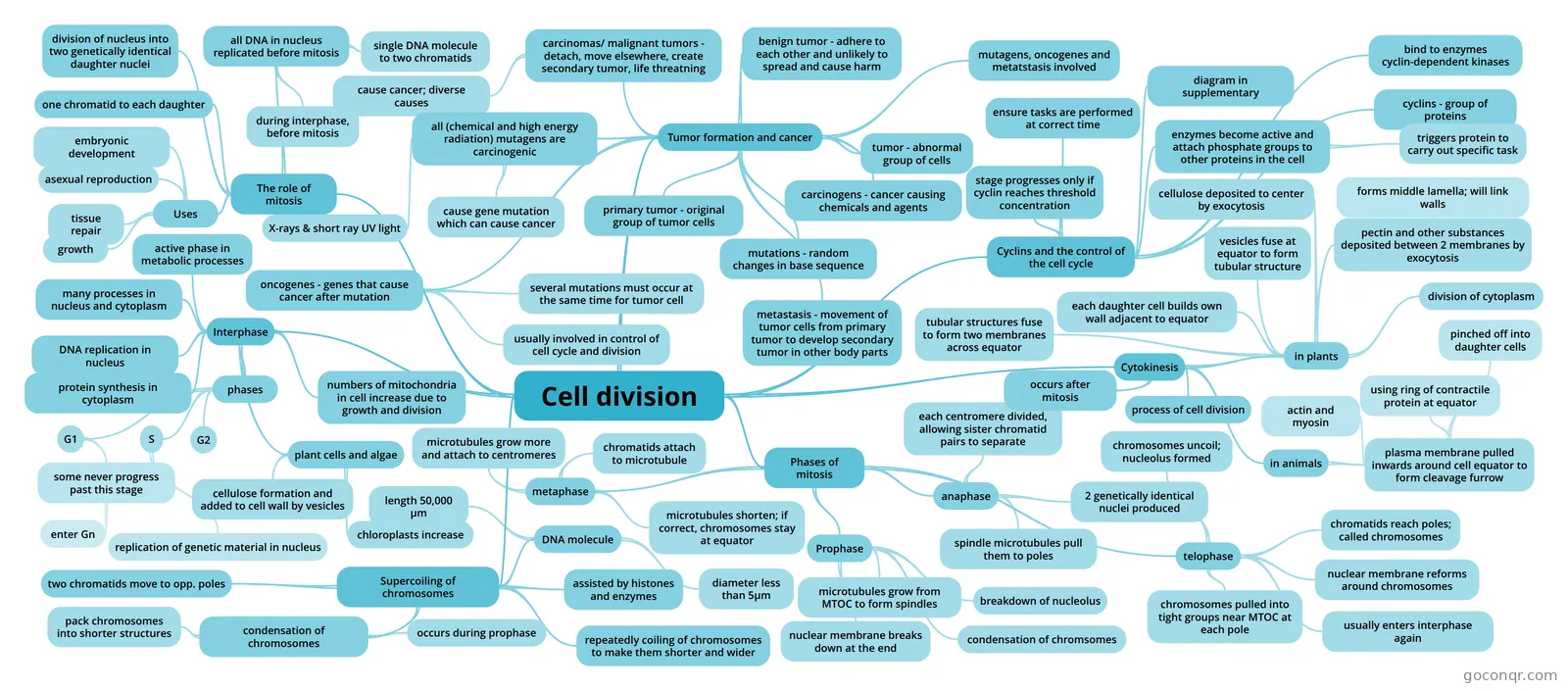
Mind map: Cell division
Contenido del mapa
Cell division
The role of mitosis
- division of nucleus into two genetically identical daughter nuclei
- all DNA in nucleus replicated before mitosis
- during interphase, before mitosis
- single DNA molecule to two chromatids
- one chromatid to each daughter
- Uses
- embryonic development
- growth
- tissue repair
- asexual reproduction
Interphase
- active phase in metabolic processes
- many processes in nucleus and cytoplasm
- DNA replication in nucleus
- protein synthesis in cytoplasm
- numbers of mitochondria in cell increase due to growth and division
- plant cells and algae
- chloroplasts increase
- cellulose formation and added to cell wall by vesicles
- phases
- G1
- some never progress past this stage
- enter Gn
- some never progress past this stage
- S
- replication of genetic material in nucleus
- G2
- G1
Supercoiling of chromosomes
- condensation of chromosomes
- pack chromosomes into shorter structures
- occurs during prophase
- two chromatids move to opp. poles
- DNA molecule
- diameter less than 5µm
- length 50,000 µm
- repeatedly coiling of chromosomes to make them shorter and wider
- assisted by histones and enzymes
- condensation of chromosomes
Phases of mitosis
- Prophase
- condensation of chromsomes
- breakdown of nucleolus
- microtubules grow from MTOC to form spindles
- nuclear membrane breaks down at the end
- metaphase
- microtubules grow more and attach to centromeres
- chromatids attach to microtubule
- microtubules shorten; if correct, chromosomes stay at equator
- anaphase
- each centromere divided, allowing sister chromatid pairs to separate
- spindle microtubules pull them to poles
- 2 genetically identical nuclei produced
- telophase
- chromatids reach poles; called chromosomes
- chromosomes pulled into tight groups near MTOC at each pole
- nuclear membrane reforms around chromosomes
- chromosomes uncoil; nucleolus formed
- usually enters interphase again
- Prophase
Cytokinesis
- occurs after mitosis
- in plants
- vesicles fuse at equator to form tubular structure
- tubular structures fuse to form two membranes across equator
- division of cytoplasm
- pectin and other substances deposited between 2 membranes by exocytosis
- forms middle lamella; will link walls
- cellulose deposited to center by exocytosis
- each daughter cell builds own wall adjacent to equator
- in animals
- plasma membrane pulled inwards around cell equator to form cleavage furrow
- using ring of contractile protein at equator
- actin and myosin
- pinched off into daughter cells
- plasma membrane pulled inwards around cell equator to form cleavage furrow
- process of cell division
Cyclins and the control of the cell cycle
- cyclins - group of proteins
- ensure tasks are performed at correct time
- bind to enzymes cyclin-dependent kinases
- enzymes become active and attach phosphate groups to other proteins in the cell
- triggers protein to carry out specific task
- stage progresses only if cyclin reaches threshold concentration
- diagram in supplementary
Tumor formation and cancer
- mutagens, oncogenes and metatstasis involved
- tumor - abnormal group of cells
- benign tumor - adhere to each other and unlikely to spread and cause harm
- carcinomas/ malignant tumors - detach, move elsewhere, create secondary tumor, life threatning
- cause cancer; diverse causes
- carcinogens - cancer causing chemicals and agents
- all (chemical and high energy radiation) mutagens are carcinogenic
- cause gene mutation which can cause cancer
- X-rays & short ray UV light
- mutations - random changes in base sequence
- oncogenes - genes that cause cancer after mutation
- usually involved in control of cell cycle and division
- several mutations must occur at the same time for tumor cell
- metastasis - movement of tumor cells from primary tumor to develop secondary tumor in other body parts
- primary tumor - original group of tumor cells
Información
- Descripción
- Mind Map of Topic 1.1 Cell Division of IB Biology Chapter 1 Cell Biology
- Creado por
- tiasabs
- Visitas
- 159
- Etiquetas
- Valoración