
Mapa mental
Plato
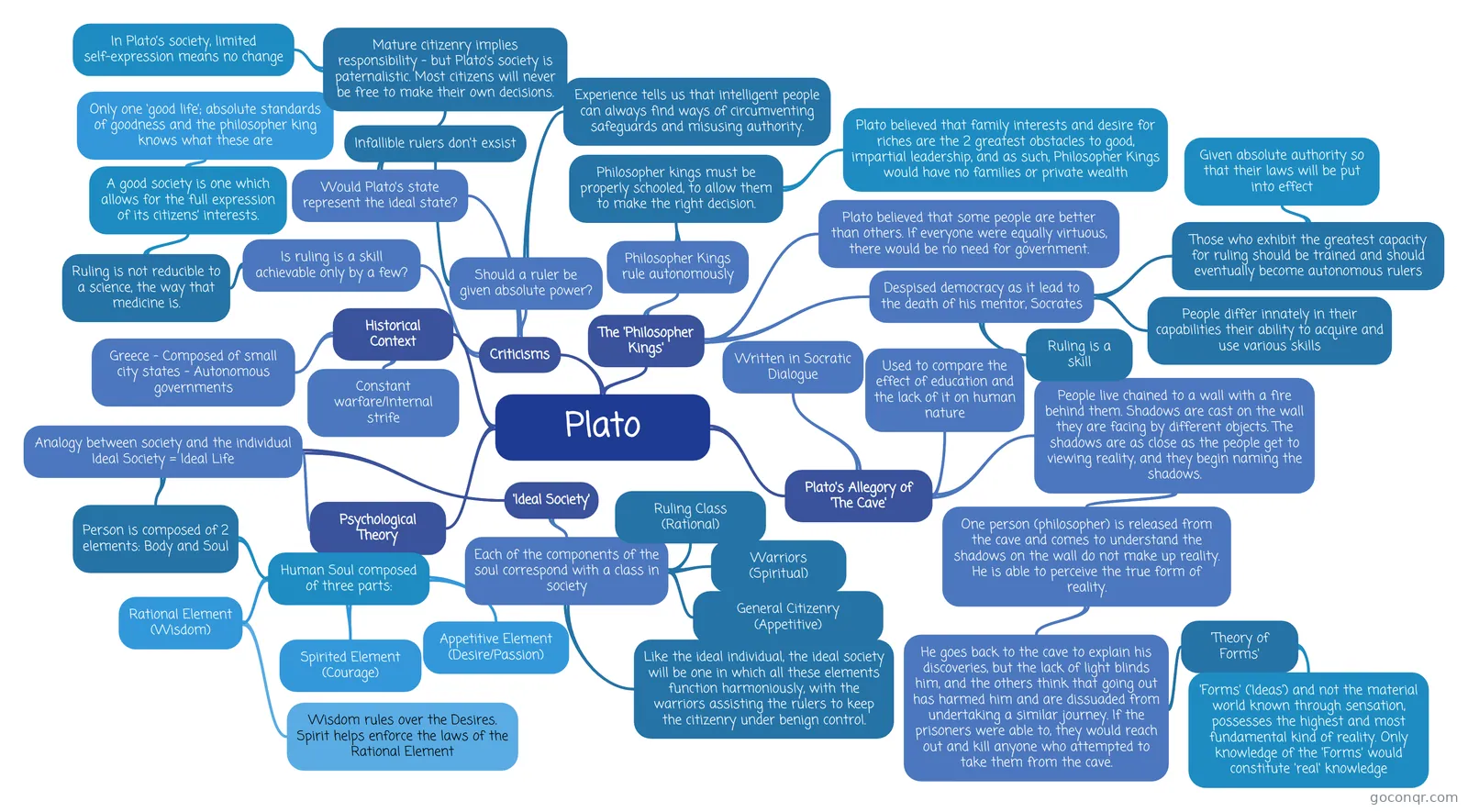
Mind map: Plato's Allegory of the Cave
Contenido del mapa
Plato
Plato's Allegory of 'The Cave'
- Written in Socratic Dialogue
- People live chained to a wall with a fire behind them. Shadows are cast on the wall they are facing by different objects. The shadows are as close as the people get to viewing reality, and they begin naming the shadows.
- One person (philosopher) is released from the cave and comes to understand the shadows on the wall do not make up reality. He is able to perceive the true form of reality.
- He goes back to the cave to explain his discoveries, but the lack of light blinds him, and the others think that going out has harmed him and are dissuaded from undertaking a similar journey. If the prisoners were able to, they would reach out and kill anyone who attempted to take them from the cave.
- 'Theory of Forms'
- 'Forms' ('Ideas') and not the material world known through sensation, possesses the highest and most fundamental kind of reality. Only knowledge of the 'Forms' would constitute 'real' knowledge
- 'Theory of Forms'
- He goes back to the cave to explain his discoveries, but the lack of light blinds him, and the others think that going out has harmed him and are dissuaded from undertaking a similar journey. If the prisoners were able to, they would reach out and kill anyone who attempted to take them from the cave.
- One person (philosopher) is released from the cave and comes to understand the shadows on the wall do not make up reality. He is able to perceive the true form of reality.
- Used to compare the effect of education and the lack of it on human nature
Historical Context
- Greece - Composed of small city states - Autonomous governments
- Constant warfare/Internal strife
Psychological Theory
- Analogy between society and the individual Ideal Society = Ideal Life
- Person is composed of 2 elements: Body and Soul
- Human Soul composed of three parts:
- Rational Element (Wisdom)
- Wisdom rules over the Desires. Spirit helps enforce the laws of the Rational Element
- Spirited Element (Courage)
- Appetitive Element (Desire/Passion)
- Rational Element (Wisdom)
- Human Soul composed of three parts:
- 'Ideal Society'
- Each of the components of the soul correspond with a class in society
- Ruling Class (Rational)
- Warriors (Spiritual)
- General Citizenry (Appetitive)
- Like the ideal individual, the ideal society will be one in which all these elements function harmoniously, with the warriors assisting the rulers to keep the citizenry under benign control.
- Each of the components of the soul correspond with a class in society
- Person is composed of 2 elements: Body and Soul
- Analogy between society and the individual Ideal Society = Ideal Life
The 'Philosopher Kings'
- Plato believed that some people are better than others. If everyone were equally virtuous, there would be no need for government.
- Philosopher Kings rule autonomously
- Philosopher kings must be properly schooled, to allow them to make the right decision.
- Plato believed that family interests and desire for riches are the 2 greatest obstacles to good, impartial leadership, and as such, Philosopher Kings would have no families or private wealth
- Philosopher kings must be properly schooled, to allow them to make the right decision.
- Despised democracy as it lead to the death of his mentor, Socrates
- Ruling is a skill
- People differ innately in their capabilities their ability to acquire and use various skills
- Those who exhibit the greatest capacity for ruling should be trained and should eventually become autonomous rulers
- Given absolute authority so that their laws will be put into effect
Criticisms
- Is ruling is a skill achievable only by a few?
- Ruling is not reducible to a science, the way that medicine is.
- A good society is one which allows for the full expression of its citizens’ interests.
- Only one ‘good life’; absolute standards of goodness and the philosopher king knows what these are
- A good society is one which allows for the full expression of its citizens’ interests.
- Ruling is not reducible to a science, the way that medicine is.
- Should a ruler be given absolute power?
- Experience tells us that intelligent people can always find ways of circumventing safeguards and misusing authority.
- Infallible rulers don't exsist
- Would Plato’s state represent the ideal state?
- Mature citizenry implies responsibility – but Plato’s society is paternalistic. Most citizens will never be free to make their own decisions.
- In Plato’s society, limited self-expression means no change
- Mature citizenry implies responsibility – but Plato’s society is paternalistic. Most citizens will never be free to make their own decisions.
- Is ruling is a skill achievable only by a few?
Información
- Descripción
- High School Biology/Philosophy Mapa Mental sobre Plato, creado por Becky Guan el 06/08/2015.
- Creado por
- Becky Guan
- Visitas
- 25
- Valoración