
Mapa mental
Operant Conditioning
Contenido del mapa
Operant Conditioning
A form of learning when the learner is an active participant or important, or instrumental in receiving a reward of consequence for their behaviour
- Behaviour with desirable consequence will tend to be repeated and vice versa
Three Phase Model
- 1. Discriminative stimulus (antecedent)
- occurs before response
- 2. Response (R)
- Occurs due to SD and is voluntary
- 3. Consequence
- to the response
- 1. Discriminative stimulus (antecedent)
Research
- B.F skinner
- Skinner box
- Lever that delivers food when pressed
- wired to a recorder to mark each time a desired response is made
- equipped with lights, buzzers and sometimes electric shock flooring
- Lever that delivers food when pressed
- Method
- hungry rat placed in box and displayed random behaviours (trial and error learning
- Rat was rewarded with food whenever the level is pressed
- The rat eventually associated the lever pressing behaviour with food
- The rat displayed operant conditioning when it pressed the lever voluntarily
- The rat eventually associated the lever pressing behaviour with food
- Rat was rewarded with food whenever the level is pressed
- hungry rat placed in box and displayed random behaviours (trial and error learning
Key Elements
- Reinforcement
- Positive reinforcement
- A pleasant or desired stimulus is applied to increase the likelihood of the behaviour occurring again.
- Negative reinforcement
- A plesant or desired stimulus is removed to increase the likelihood of the behaviour occurring again
- Positive reinforcement
- Punishment
- Positive punishment
- Unpleasant or undesirable stimulus is applied to decrease the likelihood of the behaviour occurring again
- Response cost
- Unpleasant or undesirable stimulus is removed to decrease the likelihood of the behaviour occurring again
- Positive punishment
- Reinforcement
Key factors
- Order of presentation
- Most effective when reinforcement/punishment is presented after response
- Timing
- most effective when reinforcement/punishment is given immediately after response
- less effective when there is a delay
- But a delay may be unavoidable
- less effective when there is a delay
- most effective when reinforcement/punishment is given immediately after response
- Appropriateness
- reinforcer nees to be desirable to the learner
- punishment needs to be undesirable to learner
- Order of presentation
Schedules of reinforcement
- Continous reinforcement
- reinforcement is given after every correct response
- used during the early stages of conditioning as it is most rapid
- behaviour is quickly extinguished
- Partial reinforcement
- reinforcement is given after some correct responses, but not all
- used once a desired response consistently occurs to maintain, increase or strengthen the response
- responses will be stronger and less likely to weaken than those maintained by continuous
- harder to extinguish
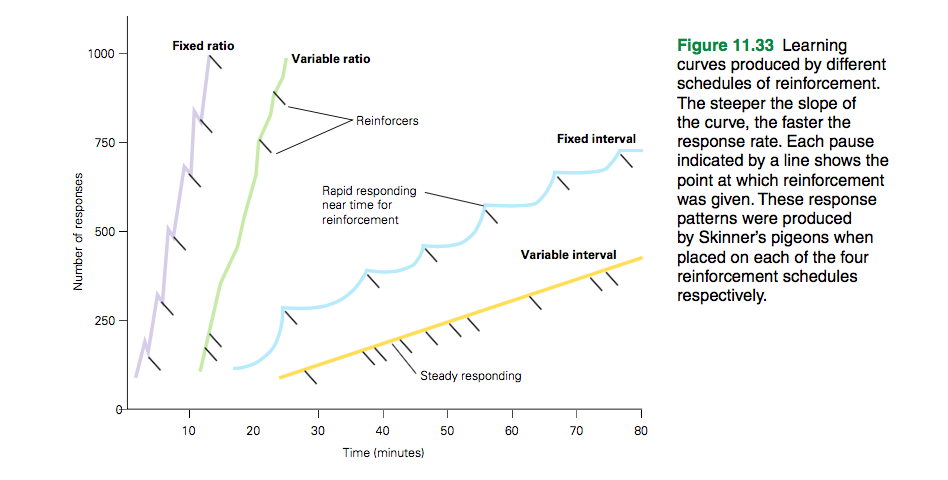
- fixed ratio
- reinforcement is given after a definite and unvarying number of desired responses
- Acquisition
- very effective because the reinforcer is predictable
- pattern of response
- very fast response rate
- extinction
- quick and easy
- Fixed interval
- reinforcement is given after a definite or predictable period of time has elapsed since the previous reinforcer and if the desired response has been made
- Acquisition
- moderate response rate but often erratic
- pattern of response
- once organism realises that time is the key factor, it stops responding for a while after last reinforcer but quickly responds as the time for the next reinforcer approaches
- extinction
- easy because of the predictable nature of the reinforcement
- Variable ratio
- reinforcement occurs after a varying or unpredictable number of correct responses
- acquisition
- very effective and fast
- pattern of response
- steady responses due to the unpredictable nature of the reinforcement
- extinction
- takes a long time
- hardest schedule to extinguish
- takes a long time
- variable Interval
- Reinforcement occurs at varying or unpredictable times, provided the correct response has been made.
- pattern of response
- slow and steady
- extinction
- very slow and gradually
- Continous reinforcement
Key processes
- acquisition
- the speed of learning depends on which schedule of reinforcement is used
- if behaviour is too complex to be performed completely shaping will be used
- Extinction
- the gradual decrease in the strength or rate of a conditioned response following consistent non-reinforcement of the response
- less likely to occur when partial reinforcement is used because the uncertainty leads to a greater tendency for the response to continue
- Spontaneous recovery
- after the apparent extinction of a conditioned response, spontaneous recovery can occur and the organism will once again show the response in the absence of any reinforcement
- response will be weaker and short lived
- stimulus generalisation
- occurs when the correct response is made to another stimulus that is similar to the stimulus that was present when the conditioned response was reinforced
- Stimulus discrimination
- occurs when the correct response is made to a stimulus and reinforced but not to any similar stimuli
- acquisition
Applications
- Shaping
- When a reinforcer is given for any response that successively approximates and ultimately leads to the final response or target behaviour
- method of successive approximations
- used for behaviours that have a low probability of occurring naturally
- this reinforcement increases the likelihood of the progressive steps being taken towards the final response
- Skinner used it with pigeons
- other examples
- leanring to write or swim
- other examples
- Token Economy
- A form of behaviour therapy where desired behaviours are reinforced with tokens which can be exchanged fora reward of the learners choice
- limitaions
- difficult to apply in practice because people feel manipulated and refuse to cooperate
- fail when the underlying cause of the behaviour is not altered
- Shaping
Imágenes y archivos del mapa
Información
- Descripción
- Mapa Mental sobre Operant Conditioning, creado por laurenjimmi el 14/08/2015.
- Creado por
- laurenjimmi
- Visitas
- 1
- Valoración