
Mapa mental
Group Therapy Counselling
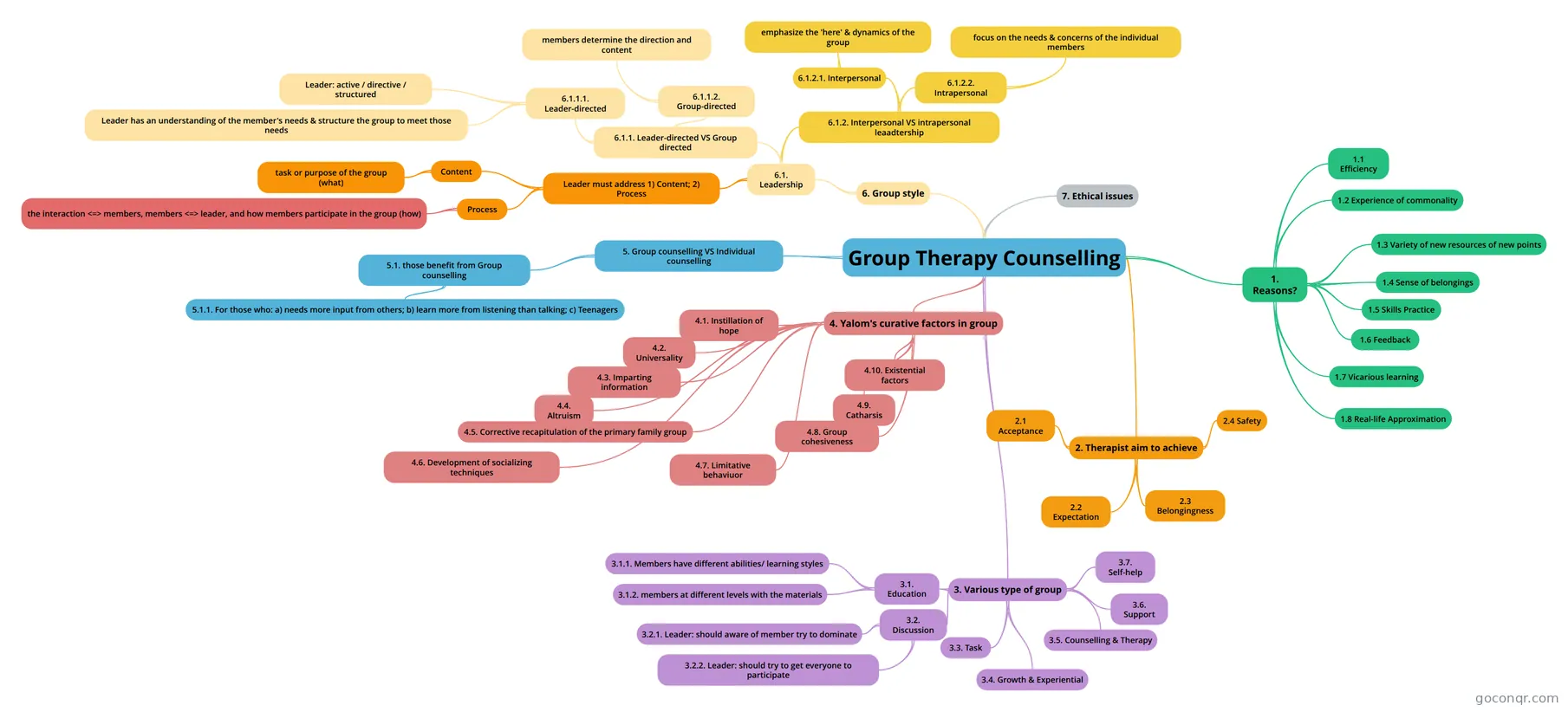
Mind map: Group therapy counselling
Contenido del mapa
Group Therapy Counselling
1. Reasons?
- 1.1 Efficiency
- 1.2 Experience of commonality
- 1.3 Variety of new resources of new points
- 1.4 Sense of belongings
- 1.5 Skills Practice
- 1.6 Feedback
- 1.7 Vicarious learning
- 1.8 Real-life Approximation
2. Therapist aim to achieve
- 2.1 Acceptance
- 2.2 Expectation
- 2.3 Belongingness
- 2.4 Safety
3. Various type of group
- 3.1. Education
- 3.1.1. Members have different abilities/ learning styles
- 3.1.2. members at different levels with the materials
- 3.2. Discussion
- 3.2.1. Leader: should aware of member try to dominate
- 3.2.2. Leader: should try to get everyone to participate
- 3.3. Task
- 3.4. Growth & Experiential
- 3.5. Counselling & Therapy
- 3.6. Support
- 3.7. Self-help
- 3.1. Education
4. Yalom's curative factors in group
- 4.1. Instillation of hope
- 4.2. Universality
- 4.3. Imparting information
- 4.4. Altruism
- 4.5. Corrective recapitulation of the primary family group
- 4.6. Development of socializing techniques
- 4.7. Limitative behaviuor
- 4.8. Group cohesiveness
- 4.9. Catharsis
- 4.10. Existential factors
5. Group counselling VS Individual counselling
- 5.1. those benefit from Group counselling
- 5.1.1. For those who: a) needs more input from others; b) learn more from listening than talking; c) Teenagers
- 5.1. those benefit from Group counselling
6. Group style
- 6.1. Leadership
- 6.1.1. Leader-directed VS Group directed
- 6.1.1.1. Leader-directed
- Leader: active / directive / structured
- Leader has an understanding of the member's needs & structure the group to meet those needs
- 6.1.1.2. Group-directed
- members determine the direction and content
- 6.1.1.1. Leader-directed
- 6.1.2. Interpersonal VS intrapersonal leaadtership
- 6.1.2.1. Interpersonal
- emphasize the 'here' & dynamics of the group
- 6.1.2.2. Intrapersonal
- focus on the needs & concerns of the individual members
- 6.1.2.1. Interpersonal
- Leader must address 1) Content; 2) Process
- Content
- task or purpose of the group (what)
- Process
- the interaction <=> members, members <=> leader, and how members participate in the group (how)
- Content
- 6.1.1. Leader-directed VS Group directed
- 6.1. Leadership
7. Ethical issues
Información
- Descripción
- Group Therapy Counselling
- Creado por
- Fi MSWpsychologist
- Visitas
- 262
- Etiquetas
- Valoración