
Mapa mental
Proteins
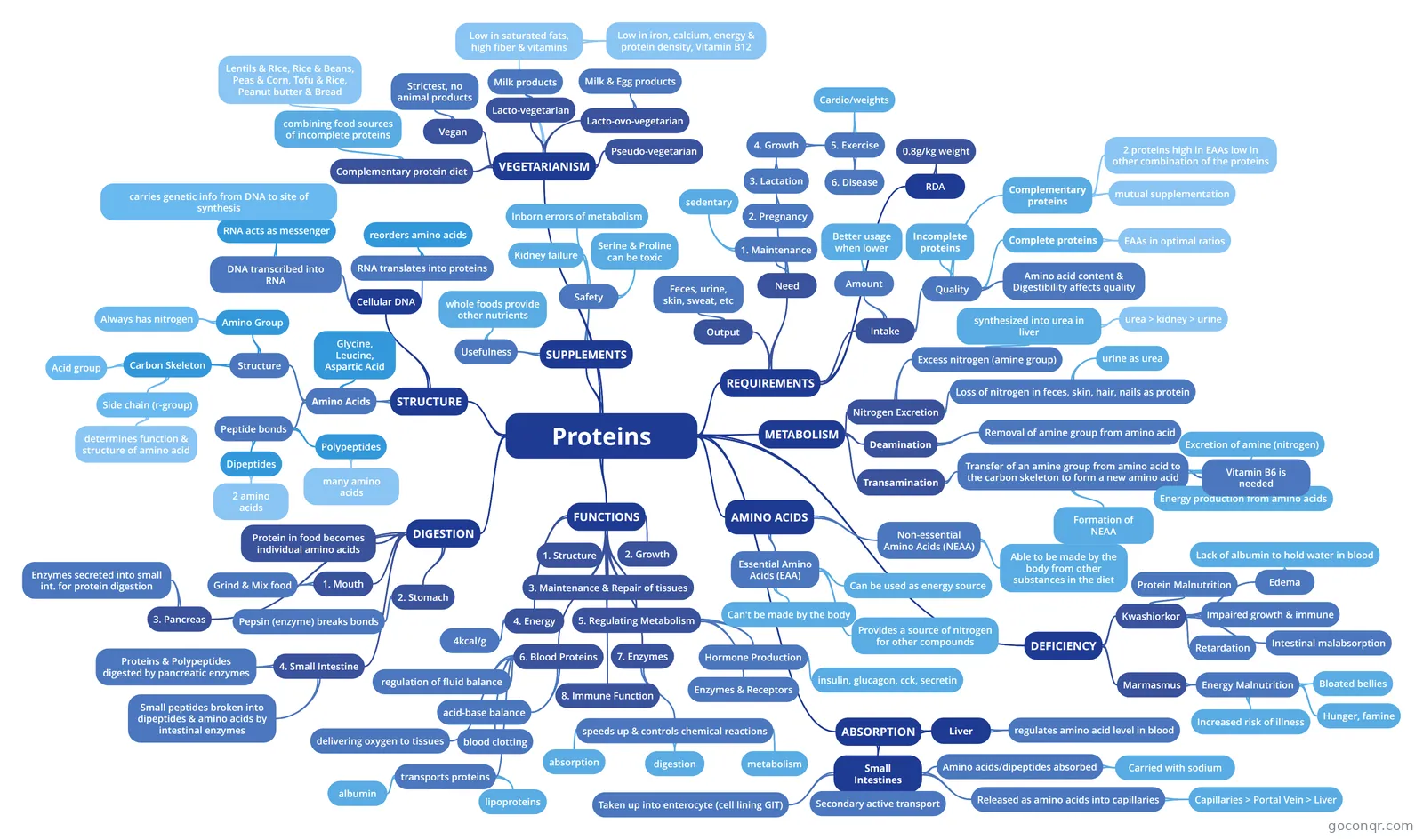
Mind map: Proteins
Contenido del mapa
Proteins
STRUCTURE
- Amino Acids
- Glycine, Leucine, Aspartic Acid
- Structure
- Amino Group
- Always has nitrogen
- Carbon Skeleton
- Acid group
- Side chain (r-group)
- determines function & structure of amino acid
- Amino Group
- Peptide bonds
- Dipeptides
- 2 amino acids
- Polypeptides
- many amino acids
- Dipeptides
- Cellular DNA
- DNA transcribed into RNA
- RNA acts as messenger
- carries genetic info from DNA to site of synthesis
- RNA acts as messenger
- RNA translates into proteins
- reorders amino acids
- DNA transcribed into RNA
- Amino Acids
AMINO ACIDS
- Essential Amino Acids (EAA)
- Can't be made by the body
- Can be used as energy source
- Provides a source of nitrogen for other compounds
- Non-essential Amino Acids (NEAA)
- Able to be made by the body from other substances in the diet
- Essential Amino Acids (EAA)
FUNCTIONS
- 1. Structure
- 2. Growth
- 3. Maintenance & Repair of tissues
- 4. Energy
- 4kcal/g
- 5. Regulating Metabolism
- Hormone Production
- insulin, glucagon, cck, secretin
- Enzymes & Receptors
- Hormone Production
- 6. Blood Proteins
- regulation of fluid balance
- acid-base balance
- blood clotting
- delivering oxygen to tissues
- transports proteins
- albumin
- lipoproteins
- 7. Enzymes
- speeds up & controls chemical reactions
- digestion
- absorption
- metabolism
- speeds up & controls chemical reactions
- 8. Immune Function
ABSORPTION
- Small Intestines
- Secondary active transport
- Amino acids/dipeptides absorbed
- Carried with sodium
- Taken up into enterocyte (cell lining GIT)
- Released as amino acids into capillaries
- Capillaries > Portal Vein > Liver
- Liver
- regulates amino acid level in blood
- Small Intestines
DIGESTION
- Protein in food becomes individual amino acids
- 1. Mouth
- Grind & Mix food
- 2. Stomach
- Pepsin (enzyme) breaks bonds
- 3. Pancreas
- Enzymes secreted into small int. for protein digestion
- 4. Small Intestine
- Proteins & Polypeptides digested by pancreatic enzymes
- Small peptides broken into dipeptides & amino acids by intestinal enzymes
METABOLISM
- Transamination
- Transfer of an amine group from amino acid to the carbon skeleton to form a new amino acid
- Formation of NEAA
- Excretion of amine (nitrogen)
- Energy production from amino acids
- Vitamin B6 is needed
- Transfer of an amine group from amino acid to the carbon skeleton to form a new amino acid
- Deamination
- Removal of amine group from amino acid
- Nitrogen Excretion
- Loss of nitrogen in feces, skin, hair, nails as protein
- urine as urea
- Excess nitrogen (amine group)
- synthesized into urea in liver
- urea > kidney > urine
- synthesized into urea in liver
- Loss of nitrogen in feces, skin, hair, nails as protein
- Transamination
REQUIREMENTS
- Intake
- Quality
- Amino acid content & Digestibility affects quality
- Complete proteins
- EAAs in optimal ratios
- Incomplete proteins
- Complementary proteins
- mutual supplementation
- 2 proteins high in EAAs low in other combination of the proteins
- Amount
- Better usage when lower
- Quality
- Output
- Feces, urine, skin, sweat, etc
- Need
- 1. Maintenance
- sedentary
- 2. Pregnancy
- 3. Lactation
- 4. Growth
- 5. Exercise
- 6. Disease
- Cardio/weights
- 5. Exercise
- 4. Growth
- 3. Lactation
- 1. Maintenance
- RDA
- 0.8g/kg weight
- Intake
VEGETARIANISM
- Vegan
- Strictest, no animal products
- Lacto-vegetarian
- Milk products
- Lacto-ovo-vegetarian
- Milk & Egg products
- Pseudo-vegetarian
- Complementary protein diet
- combining food sources of incomplete proteins
- Lentils & RIce, Rice & Beans, Peas & Corn, Tofu & Rice, Peanut butter & Bread
- combining food sources of incomplete proteins
- Low in saturated fats, high fiber & vitamins
- Low in iron, calcium, energy & protein density, Vitamin B12
- Vegan
DEFICIENCY
- Kwashiorkor
- Protein Malnutrition
- Impaired growth & immune
- Retardation
- Edema
- Lack of albumin to hold water in blood
- Intestinal malabsorption
- Marmasmus
- Energy Malnutrition
- Hunger, famine
- Bloated bellies
- Increased risk of illness
- Energy Malnutrition
- Kwashiorkor
SUPPLEMENTS
- Usefulness
- whole foods provide other nutrients
- Safety
- Serine & Proline can be toxic
- Kidney failure
- Inborn errors of metabolism
- Usefulness
Información
- Descripción
- Mapa Mental sobre Proteins, creado por Zaneta Chan el 18/03/2016.
- Creado por
- Zaneta Chan
- Visitas
- 5
- Valoración