
Mapa mental
coding capacity & duration of memory
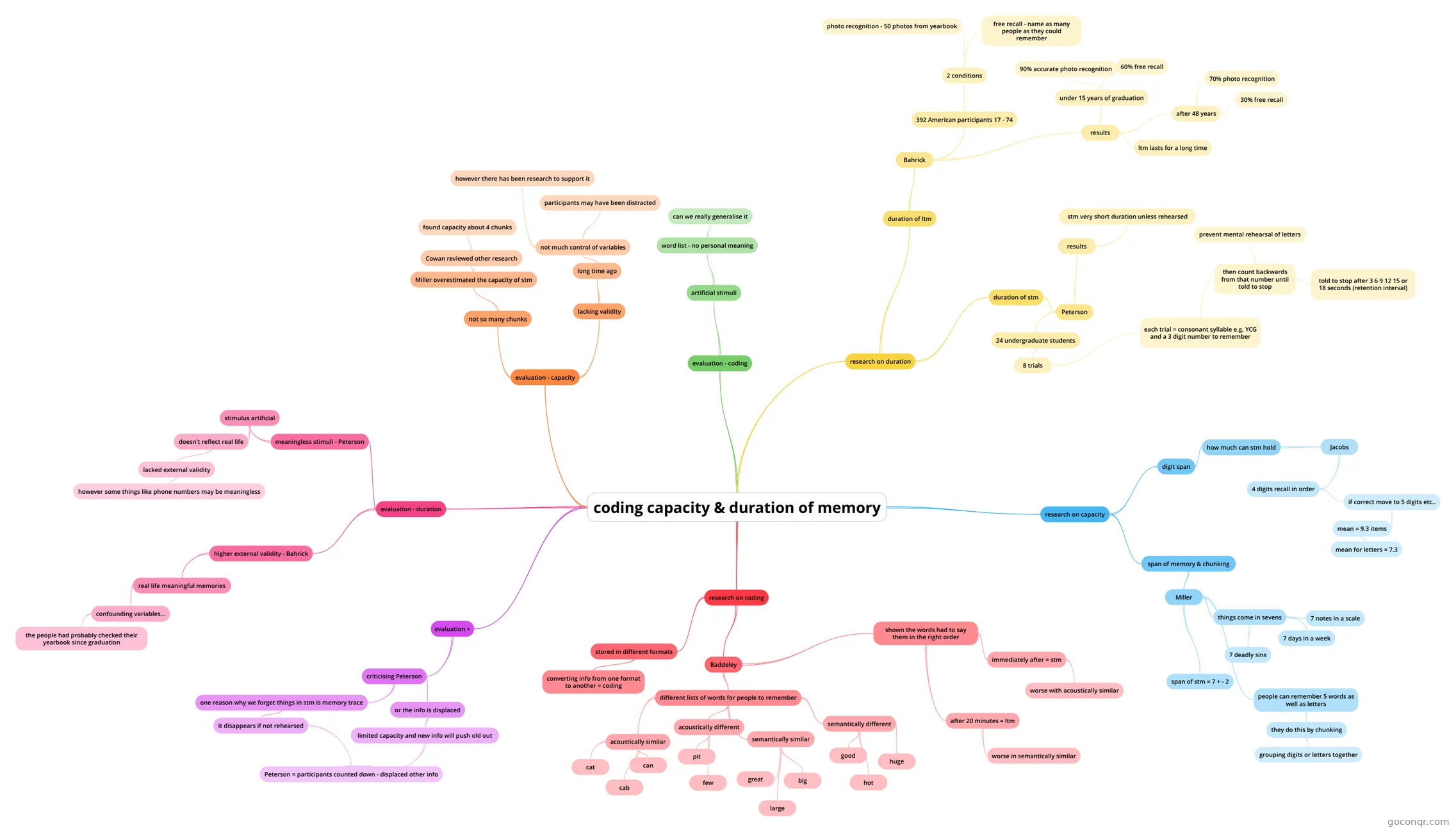
Mind map: coding capacity and duration of memory
Contenido del mapa
coding capacity & duration of memory
research on coding
- stored in different formats
- converting info from one format to another = coding
- Baddeley
- different lists of words for people to remember
- acoustically similar
- cat
- cab
- can
- acoustically different
- pit
- few
- semantically similar
- great
- big
- large
- semantically different
- good
- huge
- hot
- acoustically similar
- shown the words had to say them in the right order
- immediately after = stm
- worse with acoustically similar
- after 20 minutes = ltm
- worse in semantically similar
- immediately after = stm
- different lists of words for people to remember
- stored in different formats
research on capacity
- digit span
- how much can stm hold
- Jacobs
- 4 digits recall in order
- if correct move to 5 digits etc..
- mean = 9.3 items
- mean for letters = 7.3
- mean = 9.3 items
- if correct move to 5 digits etc..
- 4 digits recall in order
- Jacobs
- how much can stm hold
- span of memory & chunking
- Miller
- things come in sevens
- 7 notes in a scale
- 7 days in a week
- 7 deadly sins
- span of stm = 7 + - 2
- people can remember 5 words as well as letters
- they do this by chunking
- grouping digits or letters together
- they do this by chunking
- things come in sevens
- Miller
- digit span
research on duration
- duration of stm
- Peterson
- 24 undergraduate students
- 8 trials
- each trial = consonant syllable e.g. YCG and a 3 digit number to remember
- then count backwards from that number until told to stop
- prevent mental rehearsal of letters
- told to stop after 3 6 9 12 15 or 18 seconds (retention interval)
- then count backwards from that number until told to stop
- each trial = consonant syllable e.g. YCG and a 3 digit number to remember
- 8 trials
- results
- stm very short duration unless rehearsed
- 24 undergraduate students
- Peterson
- duration of ltm
- Bahrick
- 392 American participants 17 - 74
- 2 conditions
- photo recognition - 50 photos from yearbook
- free recall - name as many people as they could remember
- 2 conditions
- results
- under 15 years of graduation
- 90% accurate photo recognition
- 60% free recall
- after 48 years
- 70% photo recognition
- 30% free recall
- ltm lasts for a long time
- under 15 years of graduation
- 392 American participants 17 - 74
- Bahrick
- duration of stm
evaluation - coding
- artificial stimuli
- word list - no personal meaning
- can we really generalise it
- word list - no personal meaning
- artificial stimuli
evaluation - capacity
- lacking validity
- long time ago
- not much control of variables
- participants may have been distracted
- however there has been research to support it
- not much control of variables
- long time ago
- not so many chunks
- Miller overestimated the capacity of stm
- Cowan reviewed other research
- found capacity about 4 chunks
- Cowan reviewed other research
- Miller overestimated the capacity of stm
- lacking validity
evaluation - duration
- meaningless stimuli - Peterson
- stimulus artificial
- doesn't reflect real life
- lacked external validity
- however some things like phone numbers may be meaningless
- lacked external validity
- doesn't reflect real life
- stimulus artificial
- higher external validity - Bahrick
- real life meaningful memories
- confounding variables...
- the people had probably checked their yearbook since graduation
- confounding variables...
- real life meaningful memories
- meaningless stimuli - Peterson
evaluation +
- criticising Peterson
- one reason why we forget things in stm is memory trace
- it disappears if not rehearsed
- Peterson = participants counted down - displaced other info
- it disappears if not rehearsed
- or the info is displaced
- limited capacity and new info will push old out
- limited capacity and new info will push old out
- one reason why we forget things in stm is memory trace
- criticising Peterson
Información
- Descripción
- AS - Level (chapter 2 - memory ) psychology Mapa Mental sobre coding capacity & duration of memory, creado por Daisy U el 28/03/2016.
- Creado por
- Daisy U
- Visitas
- 28
- Valoración