
Mapa mental
Types of Attachment
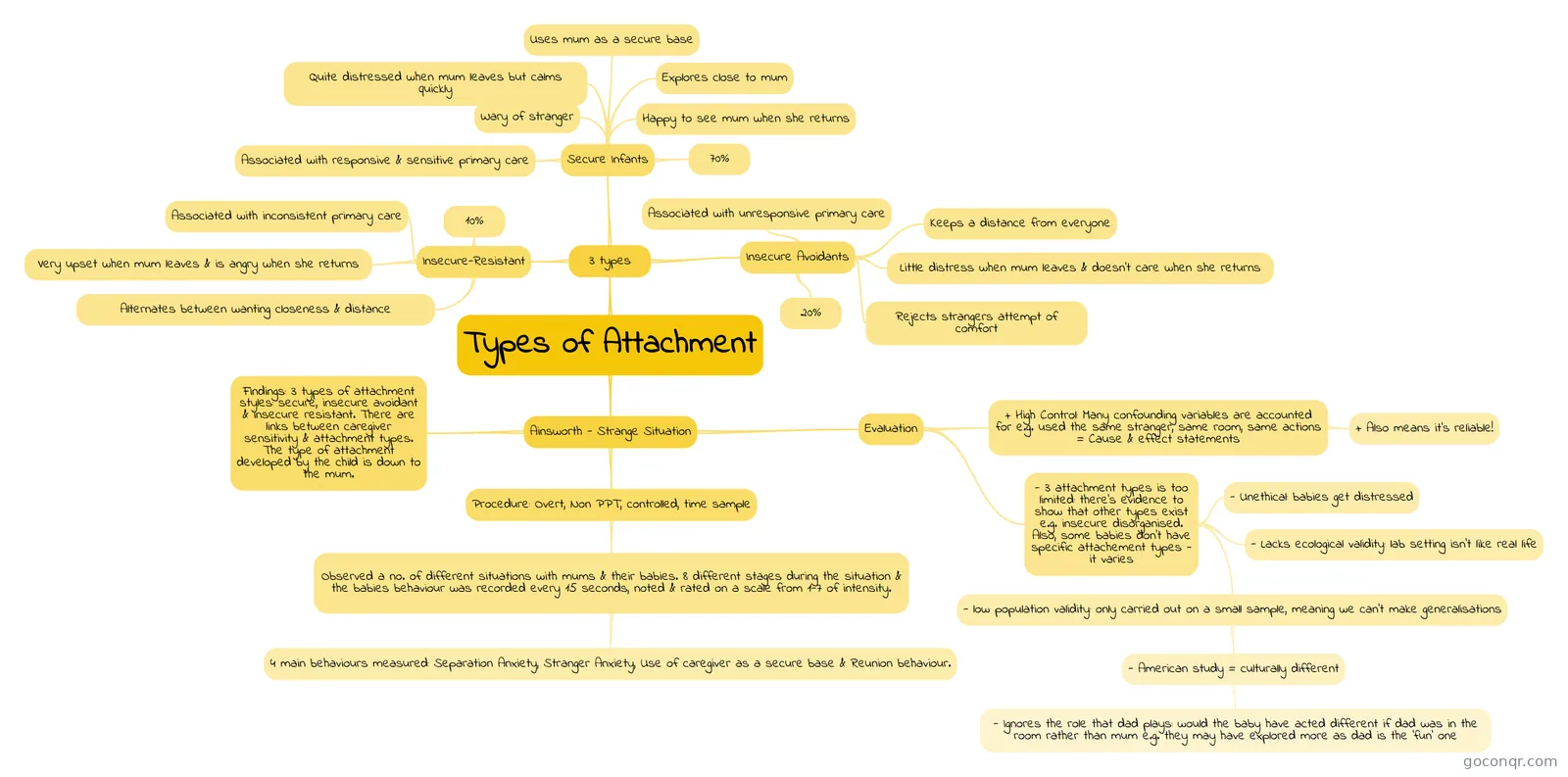
Mind map: Types of attachment
Contenido del mapa
Types of Attachment
Ainsworth - Strange Situation
- Procedure: Overt, Non PPT, controlled, time sample
- Observed a no. of different situations with mums & their babies. 8 different stages during the situation & the babies behaviour was recorded every 15 seconds, noted & rated on a scale from 1-7 of intensity.
- 4 main behaviours measured: Separation Anxiety, Stranger Anxiety, Use of caregiver as a secure base & Reunion behaviour.
- Observed a no. of different situations with mums & their babies. 8 different stages during the situation & the babies behaviour was recorded every 15 seconds, noted & rated on a scale from 1-7 of intensity.
- Findings: 3 types of attachment styles: secure, insecure avoidant & insecure resistant. There are links between caregiver sensitivity & attachment types. The type of attachment developed by the child is down to the mum.
- Evaluation
- + High Control: Many confounding variables are accounted for e.g. used the same stranger, same room, same actions = Cause & effect statements
- + Also means it's reliable!
- - 3 attachment types is too limited: there's evidence to show that other types exist e.g. insecure disorganised. Also, some babies don't have specific attachement types - it varies
- - low population validity: only carried out on a small sample, meaning we can't make generalisations
- - American study = culturally different
- - Ignores the role that dad plays: would the baby have acted different if dad was in the room rather than mum e.g. they may have explored more as dad is the 'fun' one
- - American study = culturally different
- - Unethical: babies get distressed
- - Lacks ecological validity: lab setting isn't like real life
- - low population validity: only carried out on a small sample, meaning we can't make generalisations
- + High Control: Many confounding variables are accounted for e.g. used the same stranger, same room, same actions = Cause & effect statements
- Procedure: Overt, Non PPT, controlled, time sample
3 types
- Secure Infants
- Uses mum as a secure base
- Explores close to mum
- Quite distressed when mum leaves but calms quickly
- Happy to see mum when she returns
- Wary of stranger
- 70%
- Associated with responsive & sensitive primary care
- Insecure Avoidants
- Little distress when mum leaves & doesn't care when she returns
- Rejects strangers attempt of comfort
- Keeps a distance from everyone
- 20%
- Associated with unresponsive primary care
- Insecure-Resistant
- Very upset when mum leaves & is angry when she returns
- Alternates between wanting closeness & distance
- 10%
- Associated with inconsistent primary care
- Secure Infants
Información
- Descripción
- AS - Level (Attachment) Psychology Mapa Mental sobre Types of Attachment, creado por Megan Bray4033 el 18/04/2016.
- Creado por
- Megan Bray4033
- Visitas
- 0
- Valoración