
Mapa mental
Production of Segmentals: Consonants and Vowels
Contenido del mapa
Production of Segmentals: Consonants and Vowels
Consonants and Vowels: The Syllable as a Unit
- Consonants and vowels may be defined by their role in speech production of syllables.
- Syllable
- The smallest phonetic unit. They are motor units composed of three parts. Syllables may also be open or closed.
- Vowels form the nucleus of syllables; consonants release and arrest syllables. Vowels may also stand alone to form syllables. For example, utterances such as ah, oh, and I are vowels and may also stand alone. Consonants may not stand alone; they function only with vowels.
- Onset
- The initial consonant or consonant cluster of the syllable, created by release of the syllable pulse through articulatory movements or action of the chest muscles.
- Nucleus
- A vowel oor diphthong in the middle of the syllable, created by vowel shaping movements of the vocal tract.
- Coda
- The consonant at the end of the syllable, created by arrest of the syllable pulse through articulatory movements, actions of the chest muscles, or both.
- Syllabics
- Another term for vowels because they carry syllables. A few consonants have a syllabic nature in that they also can form the nucleus of a syllable. These syllabic consonants are /l/, /n/, and /m/. The diacritical marker/, / is used to incite the syllabic nature of these consonants.
- Closed Syllables
- They end in consonants; cook, lip, and hiss are closed syllables.
- Open Syllables
- They end in vowels; my, hey, and ski are open syllables.
- Syllabification
- The skill involved in identifying the number of syllables in words. Speakers using syllabification would know, for example, that categorize has four syllables whereas dog has one syllable.
- Comparisons of Vowels and Consonants
- Vowels Always voicedMay stand alone Velum always elevated Vocal tract open Airflow continuous May be described by: distinctive features tongue and lip position tension vs. laxness
- Consonants May be voiced or voiceless Always combined with vowel Velum elevated or lowered Vocal tract modified or constricted Airflow modified or stopped May be described by: distinctive features place-voice-manner
Classification Systems
- Distinctive feature analysis and place-manner-voice analysis are two systems for classifying speech sounds
- Distinctive Feature Analysis
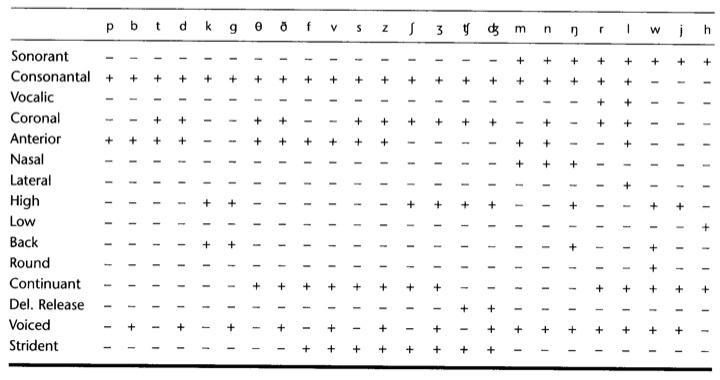
- This approach to classification was created by linguists to describe the languages of the world. The basic concept of the distinctive feature approach is that each phoneme is a collection of independent features.
- A distinctive feature is a unique characteristic of a phoneme that distinguishes one phoneme from another, although many phonemes share certain common features.
- Each phoneme (consonant or vowel) is described according to a cluster of features that are either present or absent in that phoneme. It's a binary system in which the presence of a feature is noted by a plus (+) mark and the absence of a feature is noted by a minus (-) symbol.
- Place-Voice-Manner Analysis
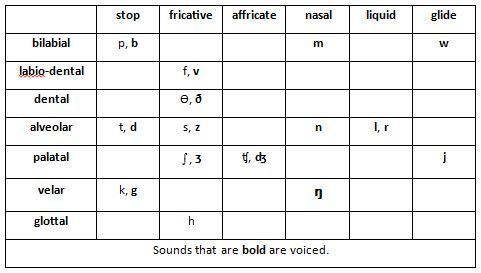
- Categorizes consonants in terms of three parameters: place, voice, and manner of production.
- Place of Articulation
- Refers to the location of the sound's production, indicating the primary articulators that shape the sounds. For example, /p/ is termed a bilabial because it is produced by putting the lips together.
- Voicing
- Refers to vocal fold vibration during production of sounds. Voiced sounds are those produced while the vocal folds are vibrating. Voiceless sounds are those produced while the vocal folds are not vibrating. The /p/ is a voiceless sound.
- Manner of Articulation
- Refers to the degree or type of constriction of the vocal tract during consonant production. For example, /p/ is termed a stop because it is produced by putting the lips together band completely stopping the airflow.
Consonants
- Speech sounds produced by movement of articulatory muscles. These movements modify the airstream in some manner by interrupting it, stopping it, or creating a narrow opening through which it must pass. Consonants may be voiced or voiceless.
- They're described according to distinctive features and their place, voice, and manner of production.
- Distinctive Feature Analysis of Consonants
- When a person produces /ǝ/, the tongue is neutral and at rest. For production of many consonants, the tongue moves to a different position. In the distinctive feature system, many sounds are described according to where and how the tongue moves away from the neutral resting position /ǝ/.
- Vocalic Sounds
- All vowels and the consonants /r/ and /l/. They have little constriction and are associated with spontaneous voicing.
- Consonantal Sounds
- Includes /m/, /b/, /p/, /ŋ/, /dƷ/, /t∫/, /Ʒ/, /∫/, /r/, /l/, /n/, /s/, /z/, /d/, /t/, /Ò/, /ø/, /v/, /f/. These sounds have marked constriction along the midline regions of the vocal tract.
- Lateral Sounds
- Includes /l/ only. /l/ is produced by placing the front of the tongue against the alveolar ridge (midline closure) and lowering the midsection of the tongue bilaterally (lateral opening).
- Voiced Sounds
- Includes /m/, /n/, /ŋ/, /b/, /g/, /l/, /r/, /z/, /d/, /v/, /w/, /dƷ/, /j /, /Ʒ/, /ò/. When these sounds are produced, the vocal folds vibrate.
- Back Sounds
- Include (+) back consonants /k/, /g/, /ŋ/. These sounds are produced with the tongue retracted from the neutral position.
- Low Sounds
- Includes only (+) low /h/. The tongue is lowered from the neutral schwa position.
- Continuant Sounds
- Includes /h/, /r/, /l/, /s/, /z/, /f/, /v/, /w/, /j /, /Ʒ/, /∫/, /Ò/, /Ø/. Thes sounds are produced with an incomplete point of constriction. For this reason, the airflow is not entirely stopped at any time, and the sounds may be produced continuously until the person runs out of breath.
- Nasal Sounds
- Includes /m/, /n/, /ŋ /. These sounds are produced by lowering the velum so that there is coupling of the oral and nasal cavities and sounds are resinated in the oral cavity.
- Anterior Sounds
- Includes /m/, /p/, /b/, /l/, /n/, /s/, /z/, /t/, /d/, /v/, /f/, /w/, /ò/, /ɵ/. These sounds are produced with a point of constriction located more anteriorly than that of /∫/. The production of /∫/ defines the boundary between anterior and nonanterior sounds.
- Coronal Sounds
- Includes /r/, /l/, /n/, /s/, /z/, /t/, /d/, /dƷ/, /t∫/. These sounds are produced with the tongue blade raised above the neutral schwa position.
- Round Sounds
- Includes /r/ and /w/. These sounds are produced with the lips protruded or rounded.
- Tense Sounds
- Includes /l/, /s/, /f/, /k/, /t/, /p/, /∫/, /Ò/, /Ɵ/, /dƷ/, /t∫/. All these consonants are voiceless except /dƷ/ and /l/. These sounds are produced with a relatively greater degree of contraction or muscle tension at the root of the tongue.
- HIgh Sounds
- Includes (+) high consonants /k/, /g/, /ŋ /, /∫/, /Ʒ/, /j /, /t∫/, /dƷ/. Thes sounds are produced with the tongue elevated above the neutral schwa position.
- Strident Sounds
- Includes /t∫/, /dƷ/, /Ʒ/, /∫/, /s/, /z/, /f/, /v/. These sounds are produced by forcing the airstream through a small, constricted opening. The result is strident or intense noise.
- Sonorant Sounds
- Includes /n/ /m/ /ŋ /, /l/, /r/, /w/, /j /. These sounds are produced by allowing the airstream to pass relatively uninterrupted through the nasal or oral cavity. There is no stoppage or point of constriction.
- Interrupted Sounds
- Includes /t∫/, /dƷ/, /t/, /d/, /k/, /g/, /p/, /b/. Thes sounds may be thought of as the opposites of sonorants because the interrupted sounds are produced by complete blockage of the airstream at the point of constriction.
- Syllabics
- Includes liquids /r/, /l/ and nasals /m/, /n/, /ŋ/. All vowels are syllabics, but most consonants are not. Syllabics serve as the nucleus for a syllable.
- Obstruents
- Includes affricates /t∫/, /dƷ/, fricatives /f/ /v/, /ò/, /ɵ/, /s/, /z/, /h/, /∫/, /Ʒ/, and stops /p/, /b/, /t/, /d/, /k/, /g/. They are made with a notable amount of obstruction in the vocal tract. Obstruents are made with a narrow constriction or complete closure of the oral cavity, so a friction noise is produced or the airstream is stopped completely.
- Sibilants
- Includes affricates /t∫/ and /dƷ/ and fricatives /s/, /z/, /∫/, /Ʒ/. Sibilants are high frequency sounds that have longer duration and more stridency than most other consonants.
- Approximants
- Includes glides /w/ and /j /, and liquids /r/ and /l/. They're called approximants because of the approximating nature of the contact between the two articulators that help form them. That is, the degree of contact is approximate, not nearly as firm or closed as it is for fricatives, affricates, and stops.
- Rhotic
- Term sometimes used to describe /r/ and its allophonic variations.
- Place--Voice-Manner Analysis of Consonants
- Place of Articulation
- Linguavelars
- Are produced when the dorsum of the tongue contacts the velum. They are /g/, /j /, /ŋ /.
- Linguapalatals
- Are produced when the tongue blade is pressed against the hard palate. to form the point of constriction just posterior to the alveolar ridge. They are /j /, /r/, /dƷ/, /t∫/, /Ʒ/, /∫/.
- Lingua-alveolars
- Are produced by contact of the tip of the tongue with the alveolar ridge. They are /s/, /z/, /n/, /l/, /t/, /d/.
- Linguadentals
- Produced by protruding the tongue tip slightly between the cutting edge of the lower and upper front teeth, forming a narrow constriction, and contact between the tongue and teeth is light. They are /Ò/ and /Ɵ/.
- Bilabials
- Produced by mutual contact of the upper and lower lips. They are /w/, /m/, /p/, /b/.
- Labiodentals
- Produced by placing the lower edge of the upper central incisors on the upper portion of the lower lip. A narrow point of constriction is formed from this light contact of the incisors and lip. They are /f/ and /v/.
- Glottals
- Produced at the level of the glottis. Vocal folds are open, and the air passes through them. Only glottal in American Englidh is /h/.
- Linguavelars
- Voicing
- Refers to whether the vocal folds are vibrating when a consonant is produced. Sounds such as /r/, /g/, /z/ are voiced. Sounds such as /k/, /t/, /s/ are voiceless.
- Cognate pairs
- Sounds that are identical in every way except voicing. Place and manner of production are the same, but the feature of voicing is different. For example, /p-b/ and /k-g/ are cognate pairs.
- Manner of Articulation
- Nasals
- Includes /m/, /n/, /ŋ /.
- They are produced by lowering the velum to keep the velopharyngeal port open. The open velopharyngeal port allows the sound produced by the vibrating vocal folds to pass through the nasal cavity.
- The vocal tract is lengthened, and there is an overall increase in the area for resonance. Thus, the resonance characteristic is changed by low-frequency components being added to the sounds.
- /n/
- place= lingua-alveolar voice= voiced manner= nasal distinctive features= +voiced, +consonantal, +anterior, +coronal, +nasal
- /m/
- place= bilabial voice= voiced manner=nasal distinctive features= +voiced, +consonantal, +anterior, +nasal
- /ŋ/
- place= linguavelar voice= voiced manner= nasal distinctive features= +voiced, +consonantal, +high, +back, +nasal
- Fricatives
- They derive their name from the friction-a hissing type quality-that results from the continuous forcing of air through a narrow constriction.
- Two closely approximating articulators form a constriction through which a continuous airstream must pass. The constrictions in the vocal tract generate aperiodic noise as the airflow passes through them. The constrictions must be narrow enough and the airflow strong enough to create a turbulent airflow. This turbulent airflow creates noisy random vibrations, or friction, Firm velopharyngeal closure is necessary.
- /Ʒ-∫/
- place= linguapalatal voice= /Ʒ/ voiced, /∫/ voiceless manner= fricative distinctive features= +consonantal, +coronal, +continuant, +high, +strident
- /f-v/
- place= labiodental voice= /f/ voiceless, /v/ voiced manner= fricative distinctive features= +consonantal, +anterior, +continuant, +strident
- /s-z/
- place= lingua-alveolar voice= /s/ voiceless, /z/ voiced manner= fricative distinctive features= +consonantal, +anterior, +coronal, +continuant, +strident
- /ò-Ɵ/
- place= linguadental voice= /Ò/ voiced, /Ɵ/ voiceless manner= fricative distinctive features= +consonantal, +coronal, + anterior, +continuant
- /h/
- place= glottal voice= voiceless manner= fricative distinctive features= +continuant, +low
- Affricates
- Affricates /t∫/ and /dƷ/ have both a fricative and a stop component. These sounds begin as stops and are released as fricatives. The speaker makes alveolar closure for /d/ or /t/; when the closure is released, the tongue is retracted and shaped for production of /t∫/ or /dƷ/.
- Usually, the lips are slightly rounded as the fricative portion of the affricate sound is produced.
- /t∫-dƷ/
- place= lingua-alveolar voice= /t∫/ voiceless, /dƷ/ voiced manner= affricate distinctive features= +consonantal, +coronal, +strident
- Stops
- Produced by complete constriction or closure of the vocal tract at some point, so tha]e airstream is totally stopped. Stops are formed at three basic places: alveolar (closure between the tip of the tongue and the alveolar ridge), velar (closure between the tongue blade and roof of the mouth), and labial (closure of the lips).
- When airflow is completely stopped, pressure builds up behind the point of contact; when the built-up air is released, there is a short audible burst of noise. Consequently, stops may also be called stop-plosives.
- /t-d/
- place= lingua-alveolar voice= /t/ voiceless, /d/ voiced manner= stop distinctive features= +consonantal, +anterior, +coronal
- /p-b/
- place=bilabial voice= /p/ voiceless, /b/ voiced manner= stop distinctive features= +consonantal, +anterior
- /k-g/
- place= linguavelar voice= /k/ voiceless, /g/ voiced manner= stop distinctive features= +consonantal, +high, +back
- Glides
- Also called semivowels and sonorants, are produced by a quick transition of the articulators as they move from a partially constricted state to a more open state for the vowels that follow them. The term on glide is used tom describe this movement. In comparison to stops, fricatives, and affricates, glides are formed by a relatively transitory and unrestricted point of constriction.
- /w/
- place= bilabial voice= voiced manner= Glide distinctive features= +anterior, +continuant
- /j/
- place= linguapalatal voice= voiced manner= glide distinctive features= +continuant, +high
- Liquids
- Produced with the least oral cavity restriction of all the consonants. The vocal tract is obstructed only slightly more than vowels.
- /r/
- The /r/ is also called a rhotic, and is commonly produced in two ways. One way is as a retroflex, made with the tongue tip retracted and approximating the hard palate; a second way is as a bunched /r/, where the dorsum of the tongue is "bunched" or retracted and elevated toward the hard palate.
- place= linguapalatal voice= voiced manner= liquid distinctive features= +consonantal, +coronal, +continuant, +vocalic
- /l/
- Also called a lateral because when the /l/ is produced, the midsection portion of the tongue is relaxed and open, and thus air is directed through the sides of the tongue.
- place= lingua-alveolar voice= voiced manner= liquid distinctive features= +consonantal, +anterior, +coronal, +continuant, +vocalic
- Nasals
- Place of Articulation
- Consonant Clusters
- Whlile many consonants are produced alone or adjacent to vowels, others are produced adjacent to some consonants. These are also known as blends and may occur in the initial, medial, or final position of words.
- Most consonant clusters in American English consist of two consonants. However, some three consonant clusters also occur. Examples of two consonant clusters are mosquito, bless, silk. Examples of three consonant clusters are burst, straw, burnt.
Vowels
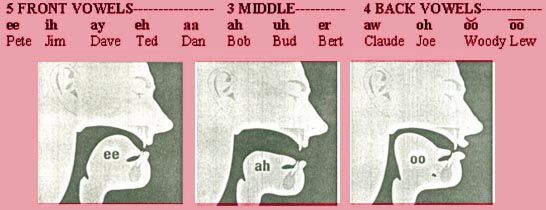
- Unlike consonants, which are mostly produced with some constriction of the vocal tract, vowels are produced with an open vocal tract. The vocal tract is open from the vocal folds to the lips, with no point of constriction.
- Because all vowels are voiced, the sound source for vowels is the vocal folds. Resonance patterns for the vowels are shaped by the vocal tract. The distinctive resonance features for each vowel sound are produced by changing the size and shape of the oral cavity.
- Distinctive Feature Analysis
- Vocalics
- Includes all vowels. These sounds are produced without a marked constriction of he vocal tract.
- Sonorants
- Includes all vowels. Are produced by an airstream that passes unconstricted through the oral or nasal cavity.
- Voiced
- Includes all vowels. All vowels are produced with vocal fold vibration.
- Rounded
- Are /o/, /u/, /Ʊ/, /ɔ/. These sounds are produced with the lips protruded or rounded.
- Tense
- Are /e/, /I/, /∧/, /ǯ/, /o/, /u/. These sounds are produced with muscle contraction or tension at the root of the tongue.
- Front
- Are /I/, /i/, /e/ /Ƹ/, /ie/. The tongue is in a position anterior to the neutral schwa position.
- Back
- Are /
- High
- Includes /i/, /I/, /Ʊ/, /u/. These sounds are made with the tongue elevated above the neutral schwa position.
- Low
- Includes /æ/, /
- Rhotic
- Rhotic refers to sounds made with an /r/ collaring. These sounds include mid-central vowels /Ər/, /Ʒr/.
- Vocalics
- Vowel Position Characteristics
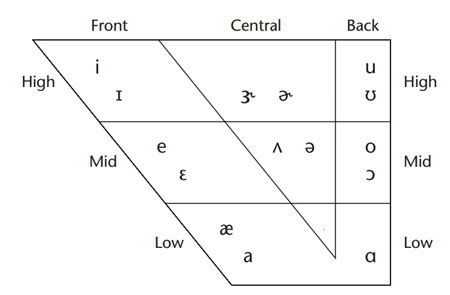
- While it is helpful to describe a vowel according to their distinctive features, it is also useful to describe vowel production from a position of physiologic rest- that is, what amount of mandibular, tongue, and lip movement, away from physiologic rest is necessary for production of each vowel. Vowels are characterized according to four dimensions.
- Tongue Forwardness/Retraction
- Causes vowels to be categorized as front, central, or back in terms of production within the oral cavity.
- Tongue Height
- Causes vowels to be categorized as high, mid, or low in terms of production within the oral cavity
- Lip Position
- Causes vowels to be characterized as rounded or unrounded For rounded vowels, the lips are protruded. For unrounded vowels, the lips are in a neutral or slightly retracted position.
- Tense/Lax
- Tense vowels have a longer duration and are produced with increased tension, while lax vowels are of shorter duration and are produced with relatively less muscular tension.
- Front Vowels
- Mid Front Vowels /e/ and /Ƹ/
- /e/: tense, unround; compared to production of /I/, /e/ involves keeping the tongue lower and slightly more retracted. Key words are make, later, fate.
- /Ƹ/: lax, unround; the /Ƹ/ vowel is produced slightly lower than /e/. Key words are let, ten, sent.
- Low From Vowel /æ/
- /æ/: lax, unround; one of the lowest vowels in English. /æ/ is produced with the tongue lower and more retracted than required for production of /Ƹ/. Key words are tan, matter, sat.
- High Front Vowels /I/ and /i/
- /I/: lax, unround; tongue is slightly lower and more posterior than for /i/. Key words are bit, sick, rim.
- /i/: tense, unround: tongue is in a high and forward position. Key words are heat, meeting, see.
- Central Vowels
- The place of production varies for each of the central vowels, also called mid central vowels.
- /Ʒr/ and /Ər/
- /Ʒr/: tense, half-round, retroflexed; the tongue blade is bunched and elevated toward the hard palate. The tongue is retracted toward /o/, and tongue height is approximately equivalent to /I/ and /e/. The /Ʒr/ is transcribed to represent /r/ production in syllables receiving primary stress (e.g. curtain). Key words include curtain, hurt, dirty.
- /Ər/: lax, half-round, and retroflexed. The /Ər/, called schwar, is produced in the same manner as /Ʒr/. However, schwa is transcribed to represent /r/ production in unstressed syllables such as that in butter. Key words include letter, color, ladder.
- /Ə/ and /∧/
- /Ə/: lax, unround; the tongue blades lowered in relation to /Ʒr/. The unstressed /Ə/ occurs in unstressed syllables such as that in above. Key words include attempt, ahead, pizza.
- /∧/; lax, unround; the /∧/ vowel is produced in a manner similar to that for /Ə/, but the tongue is slightly more retracted toward /
- Back vowels
- High Back Vowels /u/ and /Ʊ/
- /u/: tense, round; the tongue is in the highest, most retracted position when a speaker is producing /Ʊ/. Key words are spoon, fruit, bruise.
- /Ʊ/: lax, round; the /Ʊ/ vowel is produced in a slightly lower and more forward manner than /u/. Key words are took, put, foot.
- Mid Back Vowels /o/ and /ɔ/
- /ɔ/: lax, round; the /ɔ/ vowel is produced a little lower than /u/. Key words are fought, caught, shawl.
- /o/: tense, round; in comparison to /u/, /o/ is produced slightly lower in the oral cavity. Key words are coat, lower, soapy.
- Low Back Vowel /
- /
- Dipththongs
- Produced as a slow gliding movement from one vowel (the on glide) to the adjacent vowel (the off glide). For example, in the diphthong /
- They're represented phonetically by digraph symbols that highlight the initial and final segments.
- Phonemic Diphthongs
- /aI/, /ɔi/, and /aƱ/ cannot be reduced to pure vowels without changing word meaning. For example /taIp/ and /t
- /aI/
- Example include pipe, my, might, rite
- /aƱ/
- Examples include cow, house, town, pout.
- /ɔi/
- Examples include toil, boy, moist, loiter
- Nonphonemic Diphthongs
- /oƱ/ and /ɔI/ don't change word meanings. For example, the listener perceives /soƱp/ and /sop/ as the same words.
- /eI/
- Examples include vacation, take, face
- /
- Examples include loan, throne, phone
- High Back Vowels /u/ and /Ʊ/
- Mid Front Vowels /e/ and /Ƹ/
Imágenes y archivos del mapa
Información
- Descripción
- Professional (Chapter 2) Speech language pathology Mapa Mental sobre Production of Segmentals: Consonants and Vowels, creado por Steven Hesse el 04/08/2016.
- Creado por
- Steven Hesse
- Visitas
- 86
- Valoración