
Mapa mental
Levine et al
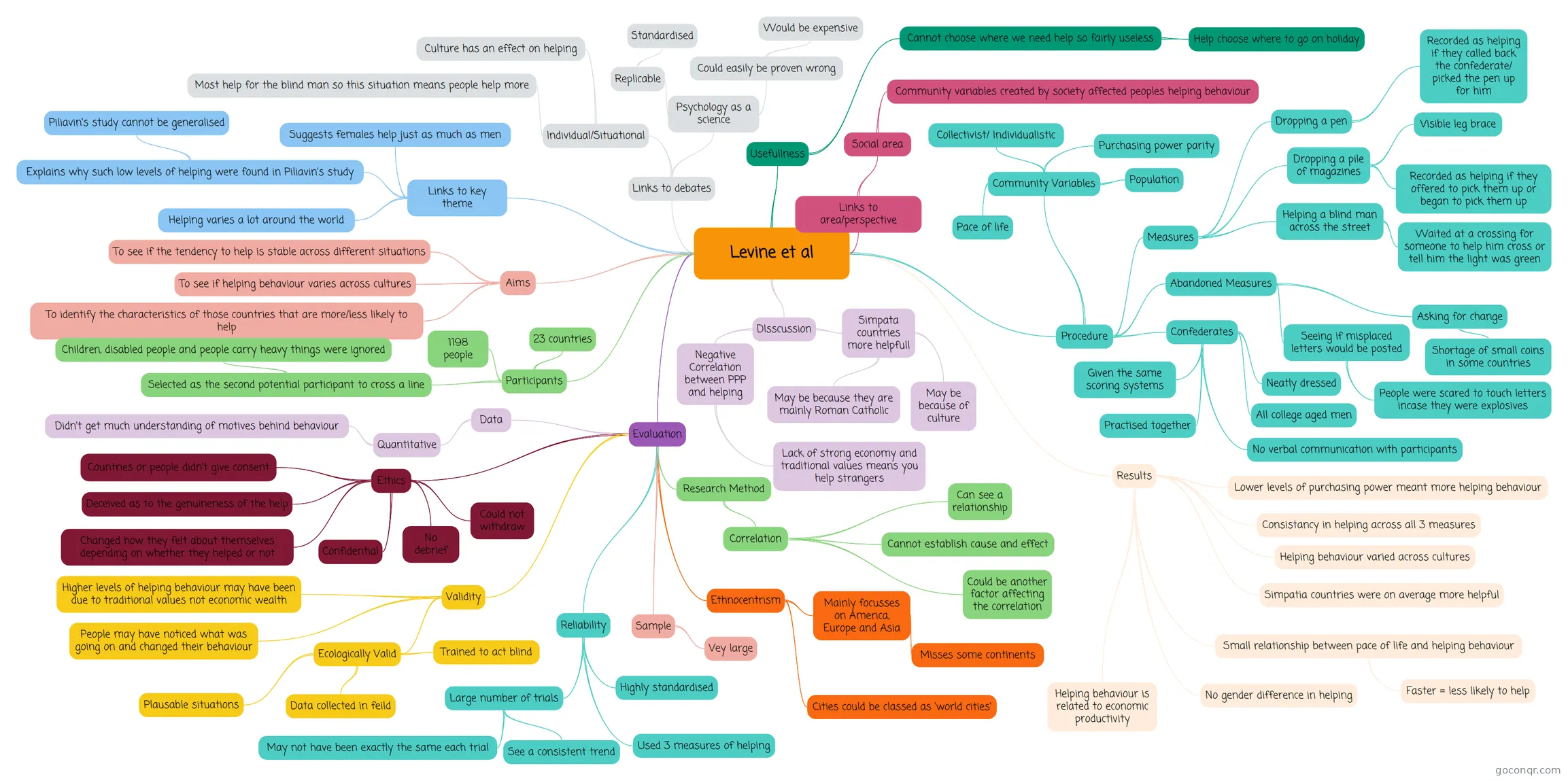
Mind map: Levine et al study
Contenido del mapa
Levine et al
Participants
- 23 countries
- 1198 people
- Selected as the second potential participant to cross a line
- Children, disabled people and people carry heavy things were ignored
Procedure
- Measures
- Dropping a pen
- Recorded as helping if they called back the confederate/ picked the pen up for him
- Dropping a pile of magazines
- Visible leg brace
- Recorded as helping if they offered to pick them up or began to pick them up
- Helping a blind man across the street
- Waited at a crossing for someone to help him cross or tell him the light was green
- Dropping a pen
- Abandoned Measures
- Asking for change
- Shortage of small coins in some countries
- Seeing if misplaced letters would be posted
- People were scared to touch letters incase they were explosives
- Asking for change
- Confederates
- All college aged men
- Neatly dressed
- Given the same scoring systems
- No verbal communication with participants
- Practised together
- Community Variables
- Population
- Purchasing power parity
- Collectivist/ Individualistic
- Pace of life
- Measures
Results
- Consistancy in helping across all 3 measures
- Helping behaviour varied across cultures
- No gender difference in helping
- Lower levels of purchasing power meant more helping behaviour
- Simpatia countries were on average more helpful
- Small relationship between pace of life and helping behaviour
- Faster = less likely to help
- Helping behaviour is related to economic productivity
DIsscussion
- Simpata countries more helpfull
- May be because of culture
- May be because they are mainly Roman Catholic
- Negative Correlation between PPP and helping
- Lack of strong economy and traditional values means you help strangers
- Simpata countries more helpfull
Evaluation
- Validity
- Higher levels of helping behaviour may have been due to traditional values not economic wealth
- People may have noticed what was going on and changed their behaviour
- Ecologically Valid
- Plausable situations
- Data collected in feild
- Trained to act blind
- Reliability
- Highly standardised
- Used 3 measures of helping
- Large number of trials
- May not have been exactly the same each trial
- See a consistent trend
- Ethics
- Countries or people didn't give consent
- Deceived as to the genuineness of the help
- Could not withdraw
- No debrief
- Changed how they felt about themselves depending on whether they helped or not
- Confidential
- Data
- Quantitative
- Didn't get much understanding of motives behind behaviour
- Quantitative
- Sample
- Vey large
- Ethnocentrism
- Mainly focusses on America, Europe and Asia
- Misses some continents
- Cities could be classed as 'world cities'
- Mainly focusses on America, Europe and Asia
- Research Method
- Correlation
- Cannot establish cause and effect
- Could be another factor affecting the correlation
- Can see a relationship
- Correlation
- Validity
Links to key theme
- Helping varies a lot around the world
- Explains why such low levels of helping were found in Piliavin's study
- Piliavin's study cannot be generalised
- Suggests females help just as much as men
Links to debates
- Individual/Situational
- Culture has an effect on helping
- Most help for the blind man so this situation means people help more
- Psychology as a science
- Replicable
- Standardised
- Could easily be proven wrong
- Would be expensive
- Replicable
- Individual/Situational
Links to area/perspective
- Social area
- Community variables created by society affected peoples helping behaviour
- Social area
Aims
- To see if the tendency to help is stable across different situations
- To see if helping behaviour varies across cultures
- To identify the characteristics of those countries that are more/less likely to help
Usefullness
- Cannot choose where we need help so fairly useless
- Help choose where to go on holiday
- Cannot choose where we need help so fairly useless
Información
- Descripción
- A-Level (The Social Area) Psychology Mapa Mental sobre Levine et al, creado por Bethany Pass el 15/09/2016.
- Creado por
- Bethany Pass
- Visitas
- 43
- Historial
-
- Creado por Bethany Pass · 2 feb 2016
- Copiado por Bethany Pass · 2 feb 2016
- Copiado por Bethany Pass · 2 feb 2016
- Copiado por Bethany Pass · 7 sep 2016
- Copiado por Bethany Pass · 15 sep 2016
- Valoración