
Mapa mental
CHAPTER 6 LEARNING
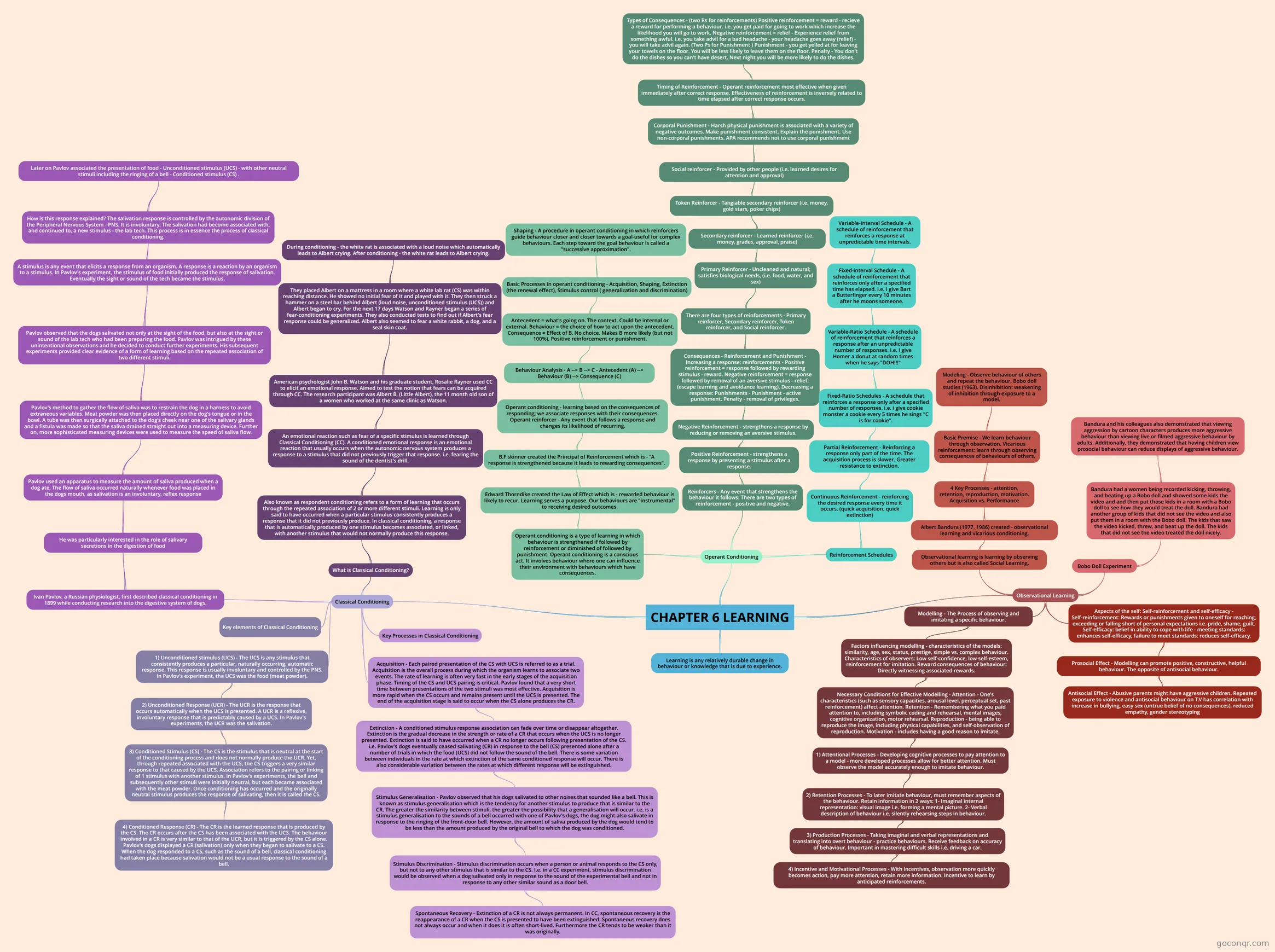
Mind map: Chapter 6 learning
Contenido del mapa
CHAPTER 6 LEARNING
Classical Conditioning
- Ivan Pavlov, a Russian physiologist, first described classical conditioning in 1899 while conducting research into the digestive system of dogs.
- He was particularly interested in the role of salivary secretions in the digestion of food
- Pavlov used an apparatus to measure the amount of saliva produced when a dog ate. The flow of saliva occurred naturally whenever food was placed in the dogs mouth, as salivation is an involuntary, reflex response
- Pavlov's method to gather the flow of saliva was to restrain the dog in a harness to avoid extraneous variables. Meat powder was then placed directly on the dog's tongue or in the bowl. A tube was then surgically attached to the dog's cheek near one of the salivary glands and a fistula was made so that the saliva drained straight out into a measuring device. Further on, more sophisticated measuring devices were used to measure the speed of saliva flow.
- Pavlov observed that the dogs salivated not only at the sight of the food, but also at the sight or sound of the lab tech who had been preparing the food. Pavlov was intrigued by these unintentional observations and he decided to conduct further experiments. His subsequent experiments provided clear evidence of a form of learning based on the repeated association of two different stimuli.
- A stimulus is any event that elicits a response from an organism. A response is a reaction by an organism to a stimulus. In Pavlov's experiment, the stimulus of food initially produced the response of salivation. Eventually the sight or sound of the tech became the stimulus.
- How is this response explained? The salivation response is controlled by the autonomic division of the Peripheral Nervous System - PNS. It is involuntary. The salivation had become associated with, and continued to, a new stimulus - the lab tech. This process is in essence the process of classical conditioning.
- Later on Pavlov associated the presentation of food - Unconditioned stimulus (UCS) - with other neutral stimuli including the ringing of a bell - Conditioned stimulus (CS) .
- How is this response explained? The salivation response is controlled by the autonomic division of the Peripheral Nervous System - PNS. It is involuntary. The salivation had become associated with, and continued to, a new stimulus - the lab tech. This process is in essence the process of classical conditioning.
- A stimulus is any event that elicits a response from an organism. A response is a reaction by an organism to a stimulus. In Pavlov's experiment, the stimulus of food initially produced the response of salivation. Eventually the sight or sound of the tech became the stimulus.
- Pavlov observed that the dogs salivated not only at the sight of the food, but also at the sight or sound of the lab tech who had been preparing the food. Pavlov was intrigued by these unintentional observations and he decided to conduct further experiments. His subsequent experiments provided clear evidence of a form of learning based on the repeated association of two different stimuli.
- Pavlov's method to gather the flow of saliva was to restrain the dog in a harness to avoid extraneous variables. Meat powder was then placed directly on the dog's tongue or in the bowl. A tube was then surgically attached to the dog's cheek near one of the salivary glands and a fistula was made so that the saliva drained straight out into a measuring device. Further on, more sophisticated measuring devices were used to measure the speed of saliva flow.
- Pavlov used an apparatus to measure the amount of saliva produced when a dog ate. The flow of saliva occurred naturally whenever food was placed in the dogs mouth, as salivation is an involuntary, reflex response
- He was particularly interested in the role of salivary secretions in the digestion of food
- Key elements of Classical Conditioning
- What is Classical Conditioning?
- Also known as respondent conditioning refers to a form of learning that occurs through the repeated association of 2 or more different stimuli. Learning is only said to have occurred when a particular stimulus consistently produces a response that it did not previously produce. In classical conditioning, a response that is automatically produced by one stimulus becomes associated, or linked, with another stimulus that would not normally produce this response.
- An emotional reaction such as fear of a specific stimulus is learned through Classical Conditioning (CC). A conditioned emotional response is an emotional reaction that usually occurs when the autonomic nervous system produces a response to a stimulus that did not previously trigger that response. i.e. fearing the sound of the dentist's drill.
- American psychologist John B. Watson and his graduate student, Rosalie Rayner used CC to elicit an emotional response. Aimed to test the notion that fears can be acquired through CC. The research participant was Albert B. (Little Albert), the 11 month old son of a women who worked at the same clinic as Watson.
- They placed Albert on a mattress in a room where a white lab rat (CS) was within reaching distance. He showed no initial fear of it and played with it. They then struck a hammer on a steel bar behind Albert (loud noise, unconditioned stimulus (UCS)) and Albert began to cry. For the next 17 days Watson and Rayner began a series of fear-conditioning experiments. They also conducted tests to find out if Albert's fear response could be generalized. Albert also seemed to fear a white rabbit, a dog, and a seal skin coat.
- During conditioning - the white rat is associated with a loud noise which automatically leads to Albert crying. After conditioning - the white rat leads to Albert crying.
- They placed Albert on a mattress in a room where a white lab rat (CS) was within reaching distance. He showed no initial fear of it and played with it. They then struck a hammer on a steel bar behind Albert (loud noise, unconditioned stimulus (UCS)) and Albert began to cry. For the next 17 days Watson and Rayner began a series of fear-conditioning experiments. They also conducted tests to find out if Albert's fear response could be generalized. Albert also seemed to fear a white rabbit, a dog, and a seal skin coat.
- American psychologist John B. Watson and his graduate student, Rosalie Rayner used CC to elicit an emotional response. Aimed to test the notion that fears can be acquired through CC. The research participant was Albert B. (Little Albert), the 11 month old son of a women who worked at the same clinic as Watson.
- An emotional reaction such as fear of a specific stimulus is learned through Classical Conditioning (CC). A conditioned emotional response is an emotional reaction that usually occurs when the autonomic nervous system produces a response to a stimulus that did not previously trigger that response. i.e. fearing the sound of the dentist's drill.
- Also known as respondent conditioning refers to a form of learning that occurs through the repeated association of 2 or more different stimuli. Learning is only said to have occurred when a particular stimulus consistently produces a response that it did not previously produce. In classical conditioning, a response that is automatically produced by one stimulus becomes associated, or linked, with another stimulus that would not normally produce this response.
- 1) Unconditioned stimulus (UCS) - The UCS is any stimulus that consistently produces a particular, naturally occurring, automatic response. This response is usually involuntary and controlled by the PNS. In Pavlov's experiment, the UCS was the food (meat powder).
- 2) Unconditioned Response (UCR) - The UCR is the response that occurs automatically when the UCS is presented. A UCR is a reflexive, involuntary response that is predictably caused by a UCS. In Pavlov's experiments, the UCR was the salivation.
- 3) Conditioned Stimulus (CS) - The CS is the stimulus that is neutral at the start of the conditioning process and does not normally produce the UCR. Yet, through repeated associated with the UCS, the CS triggers a very similar response to that caused by the UCS. Association refers to the pairing or linking of 1 stimulus with another stimulus. In Pavlov's experiments, the bell and subsequently other stimuli were initially neutral, but each became associated with the meat powder. Once conditioning has occurred and the originally neutral stimulus produces the response of salivating, then it is called the CS.
- 4) Conditioned Response (CR) - The CR is the learned response that is produced by the CS. The CR occurs after the CS has been associated with the UCS. The behaviour involved in a CR is very similar to that of the UCR, but it is triggered by the CS alone. Pavlov's dogs displayed a CR (salivation) only when they began to salivate to a CS. When the dog responded to a CS, such as the sound of a bell, classical conditioning had taken place because salivation would not be a usual response to the sound of a bell.
- 3) Conditioned Stimulus (CS) - The CS is the stimulus that is neutral at the start of the conditioning process and does not normally produce the UCR. Yet, through repeated associated with the UCS, the CS triggers a very similar response to that caused by the UCS. Association refers to the pairing or linking of 1 stimulus with another stimulus. In Pavlov's experiments, the bell and subsequently other stimuli were initially neutral, but each became associated with the meat powder. Once conditioning has occurred and the originally neutral stimulus produces the response of salivating, then it is called the CS.
- 2) Unconditioned Response (UCR) - The UCR is the response that occurs automatically when the UCS is presented. A UCR is a reflexive, involuntary response that is predictably caused by a UCS. In Pavlov's experiments, the UCR was the salivation.
- Key Processes in Classical Conditioning
- Acquisition - Each paired presentation of the CS with UCS is referred to as a trial. Acquisition is the overall process during which the organism learns to associate two events. The rate of learning is often very fast in the early stages of the acquisition phase. Timing of the CS and UCS pairing is critical. Pavlov found that a very short time between presentations of the two stimuli was most effective. Acquisition is more rapid when the CS occurs and remains present until the UCS is presented. The end of the acquisition stage is said to occur when the CS alone produces the CR.
- Extinction - A conditioned stimulus response association can fade over time or disappear altogether. Extinction is the gradual decrease in the strength or rate of a CR that occurs when the UCS is no longer presented. Extinction is said to have occurred when a CR no longer occurs following presentation of the CS. i.e. Pavlov's dogs eventually ceased salivating (CR) in response to the bell (CS) presented alone after a number of trials in which the food (UCS) did not follow the sound of the bell. There is some variation between individuals in the rate at which extinction of the same conditioned response will occur. There is also considerable variation between the rates at which different response will be extinguished.
- Stimulus Generalisation - Pavlov observed that his dogs salivated to other noises that sounded like a bell. This is known as stimulus generalisation which is the tendency for another stimulus to produce that is similar to the CR. The greater the similarity between stimuli, the greater the possibility that a generalisation will occur. i.e. is a stimulus generalisation to the sounds of a bell occurred with one of Pavlov's dogs, the dog might also salivate in response to the ringing of the front-door bell. However, the amount of saliva produced by the dog would tend to be less than the amount produced by the original bell to which the dog was conditioned.
- Stimulus Discrimination - Stimulus discrimination occurs when a person or animal responds to the CS only, but not to any other stimulus that is similar to the CS. I.e. in a CC experiment, stimulus discrimination would be observed when a dog salivated only in response to the sound of the experimental bell and not in response to any other similar sound as a door bell.
- Spontaneous Recovery - Extinction of a CR is not always permanent. In CC, spontaneous recovery is the reappearance of a CR when the CS is presented to have been extinguished. Spontaneous recovery does not always occur and when it does it is often short-lived. Furthermore the CR tends to be weaker than it was originally.
- Stimulus Discrimination - Stimulus discrimination occurs when a person or animal responds to the CS only, but not to any other stimulus that is similar to the CS. I.e. in a CC experiment, stimulus discrimination would be observed when a dog salivated only in response to the sound of the experimental bell and not in response to any other similar sound as a door bell.
- Stimulus Generalisation - Pavlov observed that his dogs salivated to other noises that sounded like a bell. This is known as stimulus generalisation which is the tendency for another stimulus to produce that is similar to the CR. The greater the similarity between stimuli, the greater the possibility that a generalisation will occur. i.e. is a stimulus generalisation to the sounds of a bell occurred with one of Pavlov's dogs, the dog might also salivate in response to the ringing of the front-door bell. However, the amount of saliva produced by the dog would tend to be less than the amount produced by the original bell to which the dog was conditioned.
- Extinction - A conditioned stimulus response association can fade over time or disappear altogether. Extinction is the gradual decrease in the strength or rate of a CR that occurs when the UCS is no longer presented. Extinction is said to have occurred when a CR no longer occurs following presentation of the CS. i.e. Pavlov's dogs eventually ceased salivating (CR) in response to the bell (CS) presented alone after a number of trials in which the food (UCS) did not follow the sound of the bell. There is some variation between individuals in the rate at which extinction of the same conditioned response will occur. There is also considerable variation between the rates at which different response will be extinguished.
- Ivan Pavlov, a Russian physiologist, first described classical conditioning in 1899 while conducting research into the digestive system of dogs.
Operant Conditioning
- Operant conditioning is a type of learning in which behaviour is strengthened if followed by reinforcement or diminished of followed by punishment. Operant conditioning is a conscious act. It involves behaviour where one can influence their environment with behaviours which have consequences.
- Edward Thorndike created the Law of Effect which is - rewarded behaviour is likely to recur. Learning serves a purpose. Our behaviours are "instrumental" to receiving desired outcomes.
- B.F skinner created the Principal of Reinforcement which is - "A response is strengthened because it leads to rewarding consequences".
- Operant conditioning - learning based on the consequences of responding; we associate responses with their consequences. Operant reinforcer - Any event that follows a response and changes its likelihood of recurring.
- Behaviour Analysis - A --> B --> C - Antecedent (A) --> Behaviour (B) --> Consequence (C)
- Antecedent = what's going on. The context. Could be internal or external. Behaviour = the choice of how to act upon the antecedent. Consequence = Effect of B. No choice. Makes B more likely (but not 100%). Positive reinforcement or punishment.
- Basic Processes in operant conditioning - Acquisition, Shaping, Extinction (the renewal effect), Stimulus control ( generalization and discrimination)
- Shaping - A procedure in operant conditioning in which reinforcers guide behaviour closer and closer towards a goal-useful for complex behaviours. Each step toward the goal behaviour is called a "successive approximation".
- Basic Processes in operant conditioning - Acquisition, Shaping, Extinction (the renewal effect), Stimulus control ( generalization and discrimination)
- Antecedent = what's going on. The context. Could be internal or external. Behaviour = the choice of how to act upon the antecedent. Consequence = Effect of B. No choice. Makes B more likely (but not 100%). Positive reinforcement or punishment.
- Behaviour Analysis - A --> B --> C - Antecedent (A) --> Behaviour (B) --> Consequence (C)
- Operant conditioning - learning based on the consequences of responding; we associate responses with their consequences. Operant reinforcer - Any event that follows a response and changes its likelihood of recurring.
- B.F skinner created the Principal of Reinforcement which is - "A response is strengthened because it leads to rewarding consequences".
- Edward Thorndike created the Law of Effect which is - rewarded behaviour is likely to recur. Learning serves a purpose. Our behaviours are "instrumental" to receiving desired outcomes.
- Reinforcers - Any event that strengthens the behaviour it follows. There are two types of reinforcement - positive and negative.
- Positive Reinforcement - strengthens a response by presenting a stimulus after a response.
- Negative Reinforcement - strengthens a response by reducing or removing an aversive stimulus.
- Consequences - Reinforcement and Punishment - Increasing a response: reinforcements - Positive reinforcement = response followed by rewarding stimulus - reward. Negative reinforcement = response followed by removal of an aversive stimulus - relief. (escape learning and avoidance learning). Decreasing a response: Punishments - Punishment - active punishment. Penalty - removal of privileges.
- There are four types of reinforcements - Primary reinforcer, Secondary reinforcer, Token reinforcer, and Social reinforcer.
- Primary Reinforcer - Uncleaned and natural; satisfies biological needs, (i.e. food, water, and sex)
- Secondary reinforcer - Learned reinforcer (i.e. money, grades, approval, praise)
- Token Reinforcer - Tangiable secondary reinforcer (i.e. money, gold stars, poker chips)
- Social reinforcer - Provided by other people (i.e. learned desires for attention and approval)
- Corporal Punishment - Harsh physical punishment is associated with a variety of negative outcomes. Make punishment consistent. Explain the punishment. Use non-corporal punishments. APA recommends not to use corporal punishment
- Timing of Reinforcement - Operant reinforcement most effective when given immediately after correct response. Effectiveness of reinforcement is inversely related to time elapsed after correct response occurs.
- Types of Consequences - (two Rs for reinforcements) Positive reinforcement = reward - recieve a reward for performing a behaviour. i.e. you get paid for going to work which increase the likelihood you will go to work. Negative reinforcement = relief - Experience relief from something awful. i.e. you take advil for a bad headache - your headache goes away (relief) - you will take advil again. (Two Ps for Punishment ) Punishment - you get yelled at for leaving your towels on the floor. You will be less likely to leave them on the floor. Penalty - You don't do the dishes so you can't have desert. Next night you will be more likely to do the dishes.
- Timing of Reinforcement - Operant reinforcement most effective when given immediately after correct response. Effectiveness of reinforcement is inversely related to time elapsed after correct response occurs.
- Corporal Punishment - Harsh physical punishment is associated with a variety of negative outcomes. Make punishment consistent. Explain the punishment. Use non-corporal punishments. APA recommends not to use corporal punishment
- Social reinforcer - Provided by other people (i.e. learned desires for attention and approval)
- Token Reinforcer - Tangiable secondary reinforcer (i.e. money, gold stars, poker chips)
- Secondary reinforcer - Learned reinforcer (i.e. money, grades, approval, praise)
- Primary Reinforcer - Uncleaned and natural; satisfies biological needs, (i.e. food, water, and sex)
- There are four types of reinforcements - Primary reinforcer, Secondary reinforcer, Token reinforcer, and Social reinforcer.
- Consequences - Reinforcement and Punishment - Increasing a response: reinforcements - Positive reinforcement = response followed by rewarding stimulus - reward. Negative reinforcement = response followed by removal of an aversive stimulus - relief. (escape learning and avoidance learning). Decreasing a response: Punishments - Punishment - active punishment. Penalty - removal of privileges.
- Negative Reinforcement - strengthens a response by reducing or removing an aversive stimulus.
- Positive Reinforcement - strengthens a response by presenting a stimulus after a response.
- Reinforcement Schedules
- Continuous Reinforcement - reinforcing the desired response every time it occurs. (quick acquisition. quick extinction)
- Partial Reinforcement - Reinforcing a response only part of the time. The acquisition process is slower. Greater resistance to extinction.
- Fixed-Ratio Schedules - A schedule that reinforces a response only after a specified number of responses. i.e. i give cookie monster a cookie every 5 times he sings "C is for cookie".
- Variable-Ratio Schedule - A schedule of reinforcement that reinforces a response after an unpredictable number of responses. i.e. I give Homer a donut at random times when he says "DOH!!!"
- Fixed-interval Schedule - A schedule of reinforcement that reinforces only after a specified time has elapsed. i.e. I give Bart a Butterfinger every 10 minutes after he moons someone.
- Variable-Interval Schedule - A schedule of reinforcement that reinforces a response at unpredictable time intervals.
- Fixed-interval Schedule - A schedule of reinforcement that reinforces only after a specified time has elapsed. i.e. I give Bart a Butterfinger every 10 minutes after he moons someone.
- Variable-Ratio Schedule - A schedule of reinforcement that reinforces a response after an unpredictable number of responses. i.e. I give Homer a donut at random times when he says "DOH!!!"
- Fixed-Ratio Schedules - A schedule that reinforces a response only after a specified number of responses. i.e. i give cookie monster a cookie every 5 times he sings "C is for cookie".
- Partial Reinforcement - Reinforcing a response only part of the time. The acquisition process is slower. Greater resistance to extinction.
- Continuous Reinforcement - reinforcing the desired response every time it occurs. (quick acquisition. quick extinction)
- Operant conditioning is a type of learning in which behaviour is strengthened if followed by reinforcement or diminished of followed by punishment. Operant conditioning is a conscious act. It involves behaviour where one can influence their environment with behaviours which have consequences.
Observational Learning
- Observational learning is learning by observing others but is also called Social Learning.
- Albert Bandura (1977, 1986) created - observational learning and vicarious conditioning.
- 4 Key Processes - attention, retention, reproduction, motivation. Acquisition vs. Performance
- Basic Premise - We learn behaviour through observation. Vicarious reinforcement: learn through observing consequences of behaviours of others.
- Modeling - Observe behaviour of others and repeat the behaviour. Bobo doll studies (1963). Disinhibition: weakening of inhibition through exposure to a model.
- Basic Premise - We learn behaviour through observation. Vicarious reinforcement: learn through observing consequences of behaviours of others.
- 4 Key Processes - attention, retention, reproduction, motivation. Acquisition vs. Performance
- Albert Bandura (1977, 1986) created - observational learning and vicarious conditioning.
- Bobo Doll Experiment
- Bandura had a women being recorded kicking, throwing, and beating up a Bobo doll and showed some kids the video and and then put those kids in a room with a Bobo doll to see how they would treat the doll. Bandura had another group of kids that did not see the video and also put them in a room with the Bobo doll. The kids that saw the video kicked, threw, and beat up the doll. The kids that did not see the video treated the doll nicely.
- Bandura and his colleagues also demonstrated that viewing aggression by cartoon characters produces more aggressive behaviour than viewing live or filmed aggressive behaviour by adults. Additionally, they demonstrated that having children view prosocial behaviour can reduce displays of aggressive behaviour.
- Bandura had a women being recorded kicking, throwing, and beating up a Bobo doll and showed some kids the video and and then put those kids in a room with a Bobo doll to see how they would treat the doll. Bandura had another group of kids that did not see the video and also put them in a room with the Bobo doll. The kids that saw the video kicked, threw, and beat up the doll. The kids that did not see the video treated the doll nicely.
- Modelling - The Process of observing and imitating a specific behaviour.
- Factors influencing modelling - characteristics of the models: similarity, age, sex, status, prestige, simple vs. complex behaviour. Characteristics of observers: Low self-confidence, low self-esteem, reinforcement for imitation. Reward consequences of behaviour: Directly witnessing associated rewards.
- Necessary Conditions for Effective Modelling - Attention - One's characteristics (such as sensory capacities, arousal level, perceptual set, past reinforcement) affect attention. Retention - Remembering what you paid attention to, including symbolic coding and rehearsal, mental images, cognitive organization, motor rehearsal. Reproduction - being able to reproduce the image, including physical capabilities, and self-observation of reproduction. Motivation - includes having a good reason to imitate.
- 1) Attentional Processes - Developing cognitive processes to pay attention to a model - more developed processes allow for better attention. Must observe the model accurately enough to imitate behaviour.
- 2) Retention Processes - To later imitate behaviour, must remember aspects of the behaviour. Retain information in 2 ways: 1- Imaginal internal representation: visual image i.e. forming a mental picture. 2- Verbal description of behaviour i.e. silently rehearsing steps in behaviour.
- 3) Production Processes - Taking imaginal and verbal representations and translating into overt behaviour - practice behaviours. Receive feedback on accuracy of behaviour. Important in mastering difficult skills i.e. driving a car.
- 4) Incentive and Motivational Processes - With incentives, observation more quickly becomes action, pay more attention, retain more information. Incentive to learn by anticipated reinforcements.
- 3) Production Processes - Taking imaginal and verbal representations and translating into overt behaviour - practice behaviours. Receive feedback on accuracy of behaviour. Important in mastering difficult skills i.e. driving a car.
- 2) Retention Processes - To later imitate behaviour, must remember aspects of the behaviour. Retain information in 2 ways: 1- Imaginal internal representation: visual image i.e. forming a mental picture. 2- Verbal description of behaviour i.e. silently rehearsing steps in behaviour.
- 1) Attentional Processes - Developing cognitive processes to pay attention to a model - more developed processes allow for better attention. Must observe the model accurately enough to imitate behaviour.
- Necessary Conditions for Effective Modelling - Attention - One's characteristics (such as sensory capacities, arousal level, perceptual set, past reinforcement) affect attention. Retention - Remembering what you paid attention to, including symbolic coding and rehearsal, mental images, cognitive organization, motor rehearsal. Reproduction - being able to reproduce the image, including physical capabilities, and self-observation of reproduction. Motivation - includes having a good reason to imitate.
- Factors influencing modelling - characteristics of the models: similarity, age, sex, status, prestige, simple vs. complex behaviour. Characteristics of observers: Low self-confidence, low self-esteem, reinforcement for imitation. Reward consequences of behaviour: Directly witnessing associated rewards.
- Aspects of the self: Self-reinforcement and self-efficacy - Self-reinforcement: Rewards or punishments given to oneself for reaching, exceeding or falling short of personal expectations i.e. pride, shame, guilt. Self-efficacy: belief in ability to cope with life - meeting standards: enhances self-efficacy, failure to meet standards: reduces self-efficacy.
- Prosocial Effect - Modelling can promote positive, constructive, helpful behaviour. The opposite of antisocial behaviour.
- Antisocial Effect - Abusive parents might have aggressive children. Repeated exposure to violence and antisocial behaviour on T.V has correlation with increase in bullying, easy sex (untrue belief of no consequences), reduced empathy, gender stereotyping
- Prosocial Effect - Modelling can promote positive, constructive, helpful behaviour. The opposite of antisocial behaviour.
- Observational learning is learning by observing others but is also called Social Learning.
Learning is any relatively durable change in behaviour or knowledge that is due to experience.
Información
- Descripción
- SEC I psychology Mapa Mental sobre CHAPTER 6 LEARNING, creado por jayna miller el 18/11/2016.
- Creado por
- jayna miller
- Visitas
- 2
- Valoración