
Apuntes
Lecture 1
Contenido del apunte (9)
Página 1
Basic Definitions
Anatomy- the study of the structure of the body
Physiology- the study of the functional processes of the body
Microscopic Anatomy-the study of the structure of cells, tissues, and organs of the body as seen with a microscope.
Cytology- the study of cell structure and function
Histology- the study of microscopic structures of tissue and organs
Developmental Anatomy- The study of the structural changes of an individual from fertilization to adulthood.
Gross anatomy-the branch of anatomy that deals with the structure of organs and tissues that are visible to the naked eye.
Regional Anatomy- an approach to anatomic study based on regions, parts, or divisions of the body (the foot or the inguinal region), emphasizing the relationships of various systemic structures (muscles, nerves, and arteries) within that area
Surface Anatomy- deals with anatomical features that can be studied by sight, without dissection.
Systemic Anatomy-an approach to anatomic study organized by organ systems, the cardiovascular system, emphasizing an overview of the system throughout the body
Página 2
Homeostasis
Homeostasis- The ability of the body to maintain relatively stable internal conditions even though the outside world changes; indicates a dynamic
state of equilibrium
Homeostasis is a state of dynamic consistency. Homeostasis does not require variable to be constant at all times.
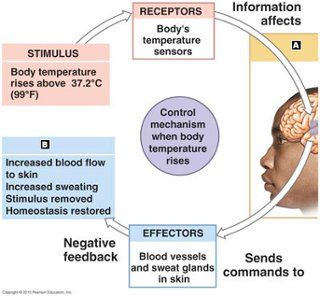
The compensating mechanisms that mediate responses are called homeostatic control systems.
Receptor- detects environmental change
Control Center- integrating center - the brain
Effector- the response of the system
Set point- the point in which homeostasis is set and which things are determined as in euilibrium
Página 3
Communication
Signals travel from the receptor and the integration center through an afferent pathway-afferent means to carry to
The output of the integration center to the effector travels through the efferent pathway-efferent as in exit
Effectors can be hormones -chemical messengers, neurons-electrical messengers, or neuroendocrine-combination of the two
There is the endocrine system, nervous system, and the neuroendocrine system- signaling is crucial for appropriate functioning of all systems.
Paracrine substances are chemical messengers involved in local communication between cells
Autocrine substances are chemical messengers secreted into the extracellular fluid and effects the cell that excreted the chemical.
Página 4
Feedback Loops
Negative feedback loop
Most systems act in this way
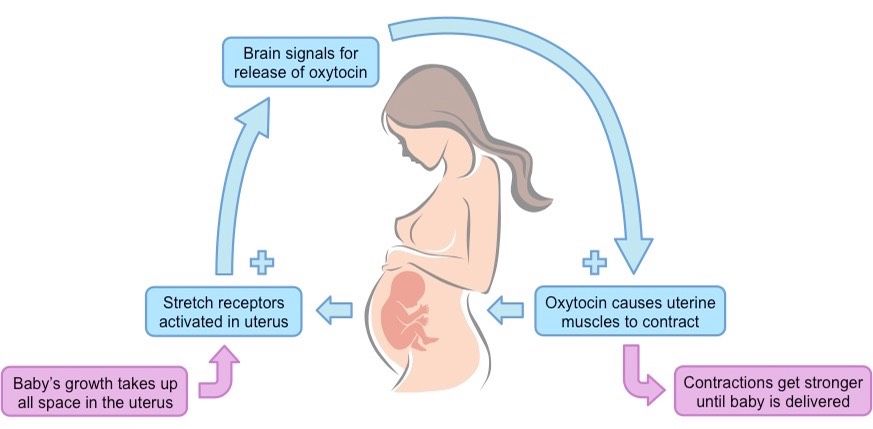
Positive feedback
Also known as partition
Most common example is birth
Página 5
Overcoming the Cell Barrier
Permeability determines what moves in and out of a cell
nutrients must get in
products and waste must get out
Selective permeability restricts materials based on
size
electrical charge
molecular shape
lipid solubility
molecules that are soluble in lipids travel quickly into and out of cells
3 Categories of Transport
Diffusion and Osmosis
Diffusion can be simple or channel mediated but it always requires a concentration gradient
Channel mediated diffusion- materials pass through the transmembrane protein channels
they are water soluable compounds
they are ions
Passage depends on
size
charge
interaction with the channel
Osmosis
Osmosis is diffusion of water across the cell membrane
The more solute molecules the lower the concentration of water
The membrane must be freely permeable to water and selectively permeable to solutes
Osmotic pressure- Is the force of a concentration gradient of water
osmosis can be prevented by resisting the change in volume and applying hydrostatic pressure equal to the of the osmotic pressure in the opposite direction
Tonicity
the osmotic effect of a solute on a cell
2 fluids may have equal osmolarity but different tonicity
Isotonic- same tonicity
Hypotonic-less than
Hypertonic-higher than
Carrier-mediated transport
transports ions and organic substrated
Facilitated diffusion
passive- goes down a concentration gradient
carrier mediated- carrier proteins transport molecules too large to fit through channel proteins- glucose and amino acids
Active transport
Active transport proteins move substrates against their concentration gradients- it requires energy like ATP
sodium potassium exchange pump
Secondary active transport
Sodium concentration gradient drives glucose transport
ATP energy pumps sodium back out
Contrasport
Counterrtransport
Characteristics of carrier mediated transport
specificity- only specific substances for specific carriers
saturation limits
regulation-
Vesicular transport
Página 6
Organic Molecules
Always contain carbon and hydrogen
Many contain large chains of covalently linked carbon
Many are water soluble
Four major classes
Carbohydrates
Lipids
Protein
Nucleic Acids
Carbohydrates
Contain a carbon, hydrogen, and oxygen
provide a ready and easily used source of cellular fuel
classes
monosaccharides
Disaccarides
Polysaccharides
Lipids
Contain a carbon, hydrogen, and oxygen
Purpose
insulate
energy storage
shock absorption
chemical messenger
steroid
Account for 10-12% of ur total body weight
5 classes
Fatty Acids
saturated and unsaturated
Eicosanoids
prostaglandins
leukotrines
Glycerides
neutral fats
Steroids
cholesterol
estrogen and testosterone
corticosteroids and calctrol
Bile salts
Phospholipids and Glycolipids
Where do lipids enter the metabolic pathway?
Protein
1000000 of kinds and 10-30% of total body weight
Most are macromolecules
Protein functions
support
movement
transport
buffering
metabolic regulation
coordination and control
defense
Structure of proteins
consist of long chains of amino acids joined by peptide bonds
Primary structure- polypeptide
Secondary structure- hydrogen bonds form spirals or pleats
Tertiary structure- secondary structure folds into a unique shape
Quaternary structure- proteins final shape
Specific types of protein
Fibrous
Globular
compact spherical proteins that have at least a tertiary structure
Water soluable
include chaperone and enzymes
Protein Combination
Glycoproteins- large protein with a small carbohydrate
Proteoglycans-large polysaccharides and polypeptides
Where do proteins enter the metabolic pathway?
Nucleotides
Long chains of nucleotides form RNA and DNA
DNA in the cell nucleus contains the information needed to construct all of the protein in the body
Nucleotides
Purines
Adenine
Guanine
Pyrdines
Cytosine
Thymine
Uracil (RNA only)
Forms of RNA
messenger RNA
transfer RNA
ribosomal RNA
Página 7
Metabolism
Aerobic
Anaerobic
ADP and ATP
Página 8
Phosphorylation
adding a phosphate group to ADP with a high energy bond to form the high energy compound ATP
ATPase- the enzyme that catalyzes phsphorylation
ATP- chemical energy stored in phosphate bonds