
Test
MO30 Phase 1 Drug Metabolism
Este test tiene tipos de pregunta que se abren en el reproductor de siempre.
Preguntas del test (12)
1Identify the major and minor products of aliphatic oxidation of pentobarbital.

- Amajor product
- Bminor product
2Label the compounds by their active groups, and also label the chemical vs enzymatic pathways.
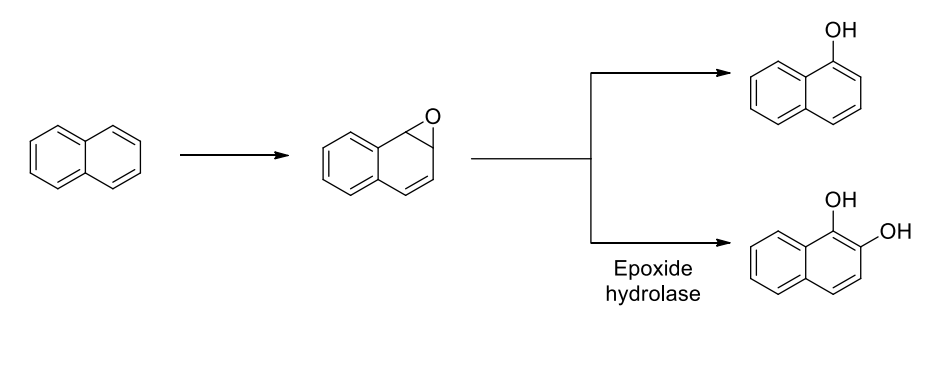
- Aepoxide
- Bphenol
- Cdiol (catechol)
- DEnzymatic
- EChemical
3Reactivity in Aromatic Oxidation mechanism is analogous to electrophilic aromatic substitution reactions
in organic chemistry:
• electron-donating substituents [blank_start]enhance[blank_end] metabolic oxidation
• electron-withdrawing substituents [blank_start]reduce or prevent[blank_end] oxidation
• oxidation occurs at the [blank_start]least[blank_end] hindered position
• if two rings are present [blank_start]only one is[blank_end] usually oxidised- Aenhance
- Breduce or prevent
- Cleast
- Dmost
- Eonly one is
- Fboth are
4Dealkylation is loss of alkyl groups attached to [blank_start]O, N or S[blank_end] atoms.
The mechanism is [blank_start]hydroxylation[blank_end] of the nearest aliphatic/alpha [blank_start]carbon[blank_end], followed by hydrolytic cleavage to give the corresponding [blank_start]phenols, amines and thiols[blank_end]. Forms an [blank_start]ether[blank_end] as well.
There must be an alpha [blank_start]hydrogen[blank_end] present, i.e. Aromatic ring—X—CR3 would be resistant (X = O, N or S).- AO, N or S
- Bhydroxylation
- Ccarbon
- Dphenols, amines and thiols
- Eether
- Fhydrogen
5In O-deakylation, the hemiacetal intermediate is unstable and dissociates to form an aldehyde or ketone.
- AVerdadero
- BFalso
6Choose the incorrect statement.
- AIn O-deakylation, the hemiacetal intermediate is unstable and dissociates to form an aldehyde or ketone.
- BN-dealkylation proceeds via a carbinolamine which is unstable and dissociates to form an amine and an aldehyde.
- CS-dealkylation is rather uncommon because sulfur containing drugs are uncommon and the S atom is more susceptible to oxidation than the adjacent C-H bond.
7Primary aliphatic amines with no alpha-H like are oxidised to [blank_start]hydroxylamines[blank_end]. [blank_start]Secondary[blank_end] amines are also oxidised to hydroxylamines. Tertiary amines are oxidised to [blank_start]N-oxides[blank_end]. These N-oxidations are catalysed by either [blank_start]CYP450s[blank_end] or flavin-containing monooxygenases ([blank_start]FMOs[blank_end]).
- Ahydroxylamines
- BN-oxides
- CSecondary
- DCYP450s
- EFMOs
8Label the amines and product amine groups.
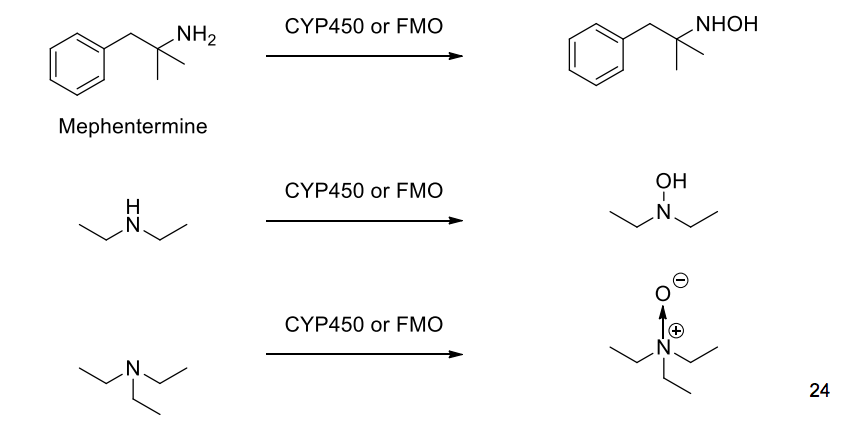
- APrimary amine
- BSecondary amine
- CTertiary amine
- DPrimary amine
- ESecondary amine
- FTertiary amine
- GPrimary amine
- HSecondary amine
- ITertiary amine
- JHydroxylamine
- KN-oxide
- LHydroxylamine
- MN-oxide
- NHydroxylamine
- ON-oxide
9S-oxidation is catalysed by the enzyme flavin-containing monoxygenase.
- AVerdadero
- BFalso
10Deamination occurs when the [blank_start]C-N[blank_end] bond linking the amino group to the bulk of the molecule is cleaved. Oxidative deamination converts primary aliphatic amines to [blank_start]aldehydes/ketones[blank_end]. Most deamination is via [blank_start]monoamine oxidase (MAO)[blank_end] which degrades endogenous catecholamines, but some still occur via [blank_start]CYP450s[blank_end].
- AC-N
- Baldehydes/ketones
- Cmonoamine oxidase (MAO)
- DCYP450s
11Oxidative dehalogenation is a common metabolic pathway for many halogenated hydrocarbons. The reaction catalysed by CYP450 (mainly [blank_start]CYP2E1[blank_end]) requires the presence of a halogen atom and a hydrogen on the same carbon. The hydrogen is made into a [blank_start]hydroxide[blank_end], and then a [blank_start]carbonyl[blank_end] group. The hydroxide's [blank_start]H[blank_end] leaves with the [blank_start]halogen[blank_end] to form X-H.
The rate increases with [blank_start]decreasing[blank_end] electronegativity (X = I > F) and [blank_start]increasing[blank_end] X (e.g. di-iodo, di-fluoro, etc.) on the same carbon.- ACYP2E1
- Bhydroxide
- Ccarbonyl
- DH
- Ehalogen
- Fdecreasing
- Gincreasing
12Choose the incorrect statement.
- AAzo (-N=N-) and nitro (-NO2) groups are reduced to primary amines by reductases plus NADPH and O2.
- BMost important hydrolysis reactions are those of esters, amides and thioesters.
- CAll hydrolysis reactions occur in the cytosol.
Información
- Descripción
- (Molecules) PHCY211 Test sobre MO30 Phase 1 Drug Metabolism, creado por Mer Scott el 15/04/2018.
- Autor
- Mer Scott
- Idioma
- English
- Visitas
- 9
- Etiquetas
- Valoración
- Aún sin valoraciones Valora este test