
Flashcards
Speciation Flashcards
Cards in this deck (59)
- 1Define SpeciationFormation
Different species
Common ancestor/ancestral species
As result of reproductive isolation - 2Define EvolutionChange in allele frequency
In population
Over time - 3Define MutationsPermanent change
In base sequence of DNA - 4Define PolyploidyOrganism
> 2 homologous sets of chromosomes
Somatic cells (
Occurs by non-disjunction
For plants NOT ANIMALS
Form of Sympatric Speciation - 5Describe Non-DisjunctionChromosomes unsuccessfully pulled apart
During meiosis - 6Explain Hybrid Infertility (Sterility) for PolyploidyND event
Not enough chromosomes from either parent
- inherit only 1 set from each parent
- homologous pairs cannot form
- contain odd no. chromosomes
May lead to a diploid (2n) somatic cell + one with no chromosomes in cell
Produce infertile offspring with another diploid
Polyploid organism + non-poly --> hybrid
- one gametic cell from diploid
- one from tetraploid (4n)
- make triploid that is sterile - uneven chromosomes
Cannot fuse in meiosis ( as no homologous pairs) - 7Explain Hybrid Fertility after Sterility for PolyploidyMust go through self-fertilisation or non-disjunction
Polyploid organism can reproduce with another poly organism - creates fertile offspring, even set of chromosomes
Chromosomes able to pair up - 8Explain how Polyploidy can result in Sympatric SpeciationPolyploid may result in post-zygotic RIM of hybrid sterility
If try to reproduce with original species
Instant speciation
Different phenotypes with survival advantages
Occupy diff niches
Lead to ecological isolation from original species
No gene flow between two species
Differences develop independently
Different selection pressures acting in different niches
Polyploid not able to produce fertile offspring with original organism
Become separate species in the same geographical area
No prior geographical isolation
Sympatric speciation - 9Explain how Polyploidy results in Instant SpeciationAre separate species - cannot produce fertile offspring between polyploid organism and original species
Polyploidy acting as a RIM - prevents successful reproduction between polyploid and original species
Leads to instant speciation
No prior separation is required for a polyploid to form
Can happen in one generation - 10Advantages of PolyploidyDifferent phenotypes in polyploid due to extra sets of chromosomes - growing larger and faster
Increased vigour - survival advantage, increase reproductive success, better with extreme conditions
Outcompete other plants for space and light
Reach maturity faster - reproduce sooner
Occupy different niche compared to original species - reduce competition, lead to speciation (ecological isolation) - 11Give a brief description of how Polyploidy occursformation of polyploid due to nd events or self-fertilisation
impacts of polyploid being formed → hybrid vigour → polyploids tend to produce more seeds, grow taller, occup diff ecological niches → more alleles → outcompete non-polyploid organisms
(niche differentiation) → polyploid’s selection pressures that allow them to exploit non-polyploid individual to outcompete it (hybrid vigour) - 12Define AllopolyploidySets of chromosomes
Originate from 2 or more ancestral species - 13Define AutopolyploidyAll sets of chromosomes
Same ancestral species - 14Define Gene FlowMovement of alleles
Between gene pools
When individuals migrate
Between populations - 15Define Natural SelectionEnvironmental factors
Select phenotypes
With increased fitness
Individuals more likely to reproduce
Pass on favourable alleles
Favourable alleles increase in frequency
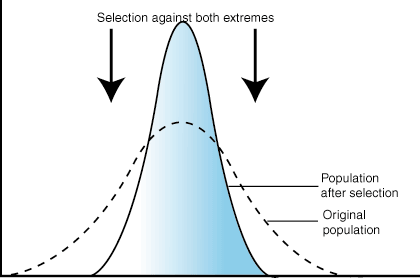
Within the population - 16Explain Stabilising SelectionOccurs in population
Intermediate phenotypes - highest fitness
Selected for
Two or more extreme phenotypes
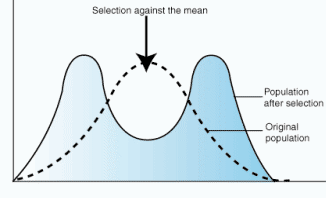
Selected against - 17Explain Disruptive SelectionOccurs in population
Two more phenotypes - highest fitness
Selected for
Intermediate phenotype
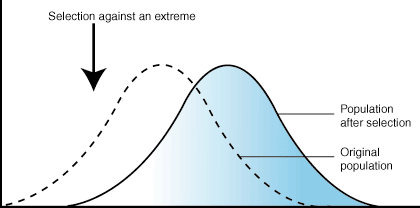
Selected against - 18Explain Directional SelectionPhenotype towards one end
Favoured over other phenotypes
Allele frequency shift to that phenotype
Over time - 19Name this SelectionDisruptive Selection
- 20Name this SelectionDirectional Selection
- 21Name this SelectionStabilising Selection
- 22Define Allopatric SpeciationFormation
New species
A result of physical separation
Common ancestral species
Over time - reproductively isolated
Diverge into different species - 23Define Sympatric SpeciationFormation
New species
Same geographical area
Due to differences in niche/behaviour
As a result of ecological isolation from - 24Define Sympatric SpeciesSpecies
Previously diverged from a common ancestor
By allopatric speciation
Exist in the same area
Remain reproductively isolated - 25What causes Allopatric Speciation to occur?Due to geographical isolation
- a geogrpahical barrier seperates
- common origicnal ancestors
- >2 geograpically isolated populations - 26Explain how Allopatric Speciation leads to Speciation1. Ancestral population occupies same geo area
2. Geographical barrier forms - separates original population >2 smaller
3. No contact between populations - prevents gene flow
4. Separated gene pools change independently - become different due to different selection pressures
5. Have different phenotypes - increase in gen variation between groups
6. Geographical barrier removed - another RIM developed, can't interbreed to produce fertile offspring
7. Become different species - 27Discuss the Southern Alps for Allopatric SpeciationGeographical RIM
Geographical changes with uplift of SAlps
- increase in habitat diversity, alpine niches
Uplift produced upland and lowland environments - formed forest, shrubland, grasslands, wet, dry habitats, mountainous topography
Divide between common ancestral species - 28Discuss Glacial Activity for Allopatric SpeciationGeographical RIM
Mountainious topograohy and rain-shadow zones in both islands - sustain diverse habitats throhg glacial peiods
Land bridges formed between North and South Island
Formed seaway - Cook Strait
- geographically young event
- prevented gene flow between each island during lowered sea levels, glacial movement
Caused isolated pockets of suitable habitat - different selection pressures in each location
Diverse habitats throughout glacial/interglacial periods
During lowered sea levels during major glaciations - 29What causes Sympatric Speciation to occur?Due to ecological isolation
Due to polyploidy - instant speciation - 30Explain how Ecological Isolation results in Sympatric Speciation?1. Ancestral population live in same geographical area
- group of individuals in that pop occupy separate ecological niches in the same area
- rarely come into contact, no reproduce, no gene flow to reduce competition
2. Groups change independently of each other
- become different over time due to different selection pressures
3. Separate groups have different phenotypes - increases genetic variation between groups
4. Diff RIM develops
- prevents groups from interbreeding to produce fertile offspring
- became separate species without geographical isolation - 31Discuss Uplift of Zealandia for Sympatric SpeciationEcological RIM
Accelerated uplift - led to speciation via adaptive raditon
Species colonised area, rapdily divsersifies to fill avaliable niches
Evolved specialised feeding habits - exploit diversity of diff foraging and deitray niches available
Evolution of physical morphologies - different phenotypes due to no gene flow between ancestral population and species - 32Define Reproductive Isolating MechanismBarrier
Prevents 2 organisms from mating, producing fertile offspring
Prevents successful interbreeding, gene flow - 33Define Pre-Zygotic RIMFactors acting before zygote forms
- 34Define Post-Zyogtic RIMFactors acting after zygote forms
e.g Hybrid inviability - 35Describe Hybrid InviabilityHybrid embryos
Not viable
Genes of 2 species incompatible
Hybrid dies before birth - 36Describe Hybrid SterilityHybrid offspring
Survive birth
Reach sexual maturity
Sterile
Cannot produce viable gametes - 37Describe Hybrid BreakdownHybrids viable
Fertile - capable of offspring
Harbour genetic abnormalities
Reduced fitness and fertility - 38Describe Geographical IsolationPhysical barriers
Separate populations
Cannot come into contact
No reproduction
No gene flow - 39Describe Ecological IsolationIndividuals of species
Live in the same geographical area
Differences in habitat/niche
Rarely come into contact
No reproduction
No gene flow - 40Define SpeciesGroup of organisms
Interbreed
Produce fertile offspring - 41Define Allopatric SpeciesSimiliar species
Geographically separated - 42Define Divergent EvolutionCommon ancestral species
Evolve into >2 species
Specialised to occupy diff niches
Develop different phenotypes - 43Define Convergent Evolution>2 diff direct ancestors
Evolve similar phenotypes
In response to similiar niche requirements - 44Explain Divergent EvolutionSpecies closely related - shared common acnestor
Homolgous structures - look different, same origin
Different selective pressures
Different ecological niches
Natural selection favours diff phenotypes
Different species from common ancestor develop over time - 45Explain Homologous StructuresEvolved differently from common ancestor
Different forms and functions
Due to different selection pressures, different ecological niches
Same anatomical structure due to ancestral origin - 46Explain Convergent EvolutionSpecies not closely related
Analogous structures - similar look, different origin
Evolved independently
Similiar adaptations
Similiar environmental selection pressures - 47Explain Analogous StructuresSimilar function and form
Same selection pressures
Similar ecological niches
Anatomical differences due to ancestral origins - 48Define Co-EvolutionDifferent species
Exerted selection pressures on each other over time
Adaptations in one species
Lead to reciprocal adaptations in the other - 49Define Adaptive RadiationDiversification of related species
From single ancestor
Exploit unoccupied niches - 50Explain Adaptive RadiationAllopatric Speciation
Original ancestral species evolves
Large number of species
Short period of time
(Rapid selection into many different forms)
Due to availability of many new niches
Ancestral species moved into niches
Exposed to different selection pressures
Changed phenotypes - selected different adaptations - 51Define Punctuated EquilibriumRate of evolutionary change
Long periods of time - species stay the same
Little evolutionary change (stasis)
Intererupted by short bursts of evolution
With rapid divergence/speciation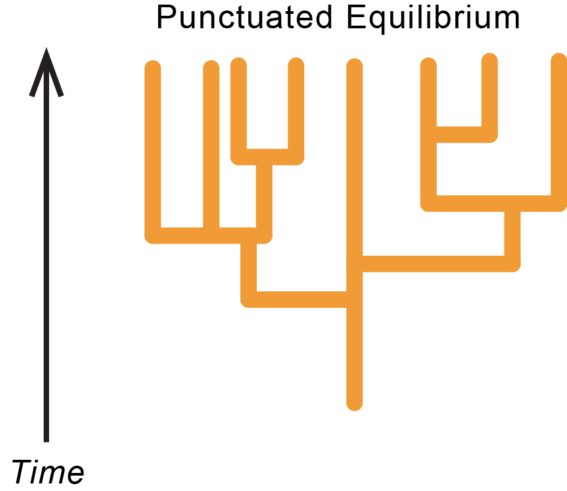
- 52Explain Punctuated EquilibriumSpecies stay unchanged for long periods time (stasis)
Rapid speciation occurs in short period time - involves adaptive radiation
Occurs due to environmental change
Geographical or Ecological RIM
New environmental conditions
Different ecological niches available to ancestral population - 53Define GradualismRate of evolutionary change
Evolutionary processes proceed slowly, continuously
Pop. of ancestral species slowly diverge
Acummulating adaptations
Different selection pressures
Accumulation of changes results in speciation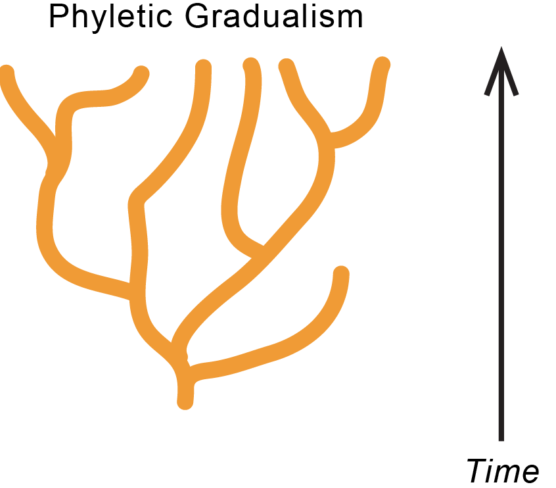
- 54Explain GradualismSpecies undergo slow adaptive change continuously
Due to constant action of evolutionary process
Changes in selection pressures acting on
New species appeare conitnually
Spread out over time interval
Takes a while for new species to evolve
In fossil records - 55Define Gene PoolAll the inheritable alleles
Present in a population - 56Define Allele FrequencyThe proportion of each allele
In a gene pool - 57Define Genetic DriftChange in frequency
Of existing alleles in a population
Due to random sampling of individuals
Through chance events - 58Explain Mutation's benefitsAdvantegous pehnotype
Increased fitness compared to less suited individuals
More likely to reproduce and pass on favourable alleles
Allele increase in frequency in pop over time
Mutation results in selective pressure that favours
Access to wide range of food source - no interspecific competition (if co-evo) - 59Define Genetic DiversityVariation
Heritable traits
In a population
Information
- Description
- NCEA Level 3 Biology (Evolution and Speciation) Flashcards on Speciation Flashcards, created by Shivani Kershaw on 29/05/2018.
- Created by
- Shivani Kershaw
- Views
- 2
- Rating