
Flashcards
Immunology Exam 1

Cards in this deck (191)
- 1Nature of Pathogensany organism with the potential to cause disease.
**Replication times favor the pathogen** - 2Opportunistic Pathogenscause disease only if your body has a weakened defense (or it gets into a part of your body it isn't normally found)
- 3Four kinds of Pathogen that cause Human Disease**The immune system protects against 4 classes of pathogen**
- 4Four kinds of Pathogen 1st kind of Pathogen: Bacteria-Examples/Diseases:
1. Salmonella enteritidis- Food poisoning
2. Mycobacterium tuberculosis- Tuberculosis - 5Four kinds of Pathogen 2nd kind of Pathogen: Viruses-Examples/Diseases:
1. Variola- Small Pox
2. Influenza- Flu
3. HIV- AIDS - 6Four kinds of Pathogen 3rd kind of Pathogen: FungiExamples/Diseases:
1. Epidermophyton floccosum- Ringworm
2. Candida albicans- Thrush - 7Four kinds of Pathogen 4th kind of Pathogen: Parasites -protozoa -worms-Examples/Diseases:
1. Trypanasoma brucei-
Sleeping sickness
2. Leishmania- Leishmaniasis
3. Plasmodium falciparum- Malaria - 8The Diversity of Human Pathogens*3 slides/cards regarding "The Diversity of Human Pathogens" next --->
- 9Candida Albicansnormal inhabitant of the human body, thrush and systemic infections
- 10Staphylococcus AureusGram positive bacterium that colonizes human skin, pimples and boils (other strains = food poisoning)

- 11Mycobacterium Tuberculosiscauses tuberculosis

- 12The first line of external defense against infection of the body is _________?Answer: Skin (works as a tough inpenetrable barrier)
- 13Skin has what continuous " 3 things" with epithelia lining?Respiratory, Urogenital tracts, Gastrointestinal
- 14Impermeable skin gives way to specialized tissues that are more vulnerable to _______attack; known as __________ surfacesmicrobe; mucosal
- 15Mucosal surfaces are bathed in ______mucus (protective; has glycoproteins, proteoglycans and enzymes)
- 16Lysozymein tears and saliva- antibacterial
- 17___________ __________ is continously removed to clean unwanted materialRespiratory mucus
- 18Defensinspoke holes in the pathogen
- 19When skin and mucosal barriers are breached __________ ____________ responds.immune system
- 20Strong barriers to infections is?skin, hair and nails

- 21More vulnerable to infections are?Mucosal membranes like lungs, stomach and intestines
- 22innate immune response leads to ______inflammation
- 23Complement (innate)proteins that tag the invader for uptake (phagocytosis) by other immune cells/or poking holes in the microbe by finishing the process of complement cascade

- 24inflammation

- 25Innate Immune System1st line of defense against infections, works quickly, rises to the acute inflammatory response, has a few specificity for microbes
- 26Adaptive Immune SystemTakes longer to develop (approx. 7 days). its highly specific to antigens, uses only one type of receptor to recognize pathogens, primary immune response: adaptive response is activated against a pathogen, seondary immune response: immune response is activated against a pathogne that's been exposed before
- 27Innate and Adaptive immune system work together through what?Direct cell contact, interactions with chemical mediators like Cytokines and Chemokines.
- 28Adaptive- Lymphocyte selection and proliferation

- 29Recognition mechanisms of innate immunityrapid response (hours), fixed, limited number of specificites, constant during response

- 30recognition mechanisms of adaptive immunityslow response (days to weeks), numerous highly selective specificities, improve during response
- 31Cells of the Immune System**4 slides coming up next about the cells in our immune system**
- 321. Lymphoid cells20-50% of white blood cells ; T cells, B cells and NK cells
- 332. Mononuclear PhagocytesMonocytes circulate blood, macrophages found in tissues
- 343. Granulocytic cells (Granulocytes)Neutrophils, Eosinophils, Basophils; based on morphology & cytoplasmic staining
- 35Dendritic cellsantigen to T cells; activation of T cells and serves initiation of adaptive immune response ;has high levels of MHC class II

- 36Hematopoiesisgeneration of cellular elements of blood like both red and white blood cells, has megakaryocyte- Platelets
- 37Types of Hematopoietic Cells

- 38Abundance of Leukocytes in Bloodmost abundant leukocytes are neutrophils followed by lymphocytes
- 39Leukocytesgeneral for white blood cells
ex: lymphocytes, granulocytes, monocytes - 40Lymphocytesclass of white blood cells (has both large/small sizes of lymphocytes)
- 411st class of Lymphocytes1. Small lymphocyte (adaptive immunity cells)
- B lymphocytes (B Cells)
- T lymohocytes (T Cells)
- 422nd class of lymphocytes2. Large granular lymphocytes
-Natural killer (NK) cells
-innate immunity
- 43Natural Killer Cells (NK)found in tissues throughout the body but mainly in the circulation, has cytotoxic substances for protection against viruses/tumors, prevents viral replication, helps activate t cells
- 44Neutrophilseffectors of innate immunity, specialized in the capture, engulfment, and killing of microbes, oxygen dependent/independent pathway to destroy pathogens
- 45MonocyteMoncytes can turn into macrophages; circulate in the blood for abour 8 hours, then mature and migrate into tissues

- 46Mononuclear Phagocytesmoncyte progenitors in the bone marrow differentiate into pro-monocytes, which enter blood, where these differentiate into monocytes; fixed and free
- 47Mast Cellsfound in skin, connective tissue and mucosal epithelial tissue of both respiratory + digestive tracts; when activated they degranulate and release mediators that cause vasodilation, increase vascular permeability and attreact leukocytes

- 48Follicular dendritic cells (FDC)hold intact antigens in specialized areas of lymphoid tissues
- 49Eosinophilsgranular leukocytes which stain with eosin, have phagocytic activity and responsible for extracellular killing of large parasites, usually binding to antibody-coated oarasite and degranulates into the parasites surface

- 50Basophilstain w/basic dyes (blue), present in very low numbers in circulation, basophils and mast cells are similar in morphology

- 51Megakaryocyteis a bone marrow cells, does production of blood platelets when cytoplasm becomes fragmented, these fragments are blood platelets, they can be 10 t0 15 times bigger than a red blood cells, function is determined by the number of cytokines including thrombopoietin
- 52Thromoboproteinis a glycoprotein hormone produced mainly by the liver and kidney which regulates production of platelets by bone marrow
- 53Erythrocytesbind to immune complexed composed of antigen and antibody, these are carried to the liver where its cleared by Kupffer cells; have an important immunological role clearing immune complexes from circulation in persistant infection and some autoimmune diseases
- 54Kupffer Cellsphagocytic cells of the liver that line the hepatic sinusoids
- 55Site of Hematopoiesis in Humans Changes During DevelopmentChanges with age; early embryo blood cells first produce the yolk sac and later in fetal liver. Within 3-7 months of fetal life the major site of hematopoiesis is the spleen. Bones develop 4-5 months then hematopoiesis shifts towards bone marrow. In adults hematopoiesis occurs mainly in the bone marrow.

- 56Neutrophils are Mobilized from the Bone Marrow, and Target (home) to Infection Sites

- 57Mononuclear Phagocyte SystemFound mainly in organs + tissues; monocytes are in the blood stream and settle in tissue macrophages
- 58Macrophage- like cells in the liverKupffer cells
- 59Macrophage- like cells in the brainMicroglia
- 60Process of Phagocytosis

- 61Phagocytic Process Stages1.Phagocyte attraction to the site of infection
2.Phagocyte contact with the microbe
3. Ingestion (endocytosis)
4. Killing of the ingested microbe by means of oxygen and oxygen-independent mechanisms - 62OpsinizationMakes microbes more palatable to the phagocyte; molecules coat a microbe such as complement or antibody
- 63Macrophages are Key Players in the Innate and Adaptive Immune Response

- 64Macrophages Respond to Pathogens by Using Different Receptors to Stimulate Phagocytosis & Cytokine Secretion, what are they?(theres two) name one1. Bacterium (red) binds to cell -Phagocytic receptors of the macrophage (blue). Bacerium engulfs into a endocytic vesicle called a phagosome

- 65Macrophages Respond to Pathogens by Using Different Receptors to Stimulate Phagocytosis & Cytokine Secretion, what are they?(theres two) name another one2. Fusion of Phagosome- w/lysosomes it forms an acidic vesicle called phagolysome; contains toxic molecules & hydroltic enzymes that kill bacterium
- 66Macrophages Respond to Pathogens by Using Different Receptors to Stimulate Phagocytosis & Cytokine Secretion The cytokines are ______ and ________.Answer: synthesized and secreted

- 67Name 2 mechanisms of protectionAnswer: Antigens and Antibodies

- 68Antigensbound by a MHC molecules & presented to a "T" cells; can be proteins, lipids or sugars
- 69AntibodiesProteins molecules synthesized by cells of immune system-- part of humoral immunity
-Humors= bodily fluids
-That recognizes pathogens - 70Adaptive Immunityinfection outruns innate immune response, innate immunity has restricted # of receptors to recognize pathogens; This activates the immune system, the adaptive immune response is mediated by lymphocytes; expands into effector cells & also persists memory; Diverse in immunoglobulins & T cell receptors;
- 71What are the primary organs of the immune system?Thymus(T cells mature thymus) and bone marrow(B cells mature bone marrow); (where maturation of lymphocytes takes place)
- 72What are the secondary organs of the immune system?Lymph nodes, spleen, peyer's patches and mucosal-associated tissues; trap antigen & promote lymphocyte activation
- 73Lymphocytesfound in lymphoid tissues, blood & lymph; activated in secondary lymphoid tissues; Arise from stem cells in bone marrow
- 74Lymphatic Systemsmall lymphocytes travel in both blood and lymph; antigens carried to lymph nodes as lymphocytes enabling interactions
- 75When an antigen is encountering the lymphocyte it will no longer_________.Answer: Recirculate
- 76Dendritic cells activated by infection also carry _________.antigens
- 77Lymphocytes leave______ and enter ______ -________ where they are activated by pathogens.Answer: blood; lymph-nodes
- 78___________ drain from site of infection (example:foot infection) to lymph nodesPathogens
- 79___________ _________ - _______ stay in lymph nodes and divide and differentiate into effector cells,while no-activated cells leave through efferent lymphaticsActivated; lymph-nodes
- 80Lymphocytes recirculate at a rate of ___X10^6 cells/min5
- 81Architecture of the Lymph NodeKidney shaped; packed w/lymphocytes & macrophages; Arriving at afferent lymph are pathogens & dendritic cells carrying pathogens; Pathogens degrade & stimulate lymphocytes

- 82The spleenfilters blood & removes old/damaged cells = red pulp;blood bourne pathogens encounter lymphocytes( a secondary lymphoid organ)= white pulp

- 83Topic: Spleen Blood is the only way in and out for_________ as well as __________.lymphocytes; pathogens
- 84Topic: Spleen Spleenic macrophages and _______ ________ in the spleen take-up antigen and stimulate "_" and "_" cellsdendritic cells;" T "," B "
- 85White pulp of the spleen has sheath of lymphocytes called _______ ________ _________.Periateriolar lymphoid sheath (PALS)
- 86PALS surrounds the ______ _______central arteriole (CA)
- 87T cells are the ______ to CA, while B cells are more ________, forming a B cell coronaclosest; peripheral
- 88Germinal centers form between the ___ and __ cell zones. The _______ zone contains differentiated B cells.Answer: T; B; marginal

- 89Mucosal-Associated Lymphoid Tissue (MALT)Mucosal surfaces lining digestive, respiratory and urogenital tracts are major sites of entry for pathogens which are defended by MALT;GALT and BALT are both apart of MALT;
- 90Tissues ______ from loosely organized _______ of lymphoid cells to well organized structures --tonsils, appendixRange;clusters
- 91The guy associated lymphoid tissues, GALT includes ______,______,_______ and Peyer's patches that line the gut.tonsils, adenoids, apendix
- 92B.A.L.T stands for what?Bronchial-associated lymphoid tissues
- 93Lymphocytes activated in the______ tend to stay in MALT and the________ cells serve the MALT in the future.MALT; memory
- 94A region of GALT

- 95Immunological MemoryLymphocytes that expand persist, providing long term memory;
First time infection results in primary response leading to memory (T and B cells) of the pathogen;
Subsequent infections with the same pathogen,same antigens, will elicit a secondary response that's much faster/stronger. - 96Comparison of a Primary and Secondary Immune Response

- 97Immunodeficiency: Inherited or Infectious What do you know about this?Mutation in immune function genes leads to immunodeficiency -- different kinds….
one aspect of immune response is affected then others show adaptive immunity being absent;
Leads to devastating vulnerability towards all infections;
Extreme example of immunodeficiency due to disease is the acquired immune deficiency syndrome, AIDS;
Caused by infection with the human immunodeficiency virus, HIV - 98Chapter 2: Innate immunityChapter 2
- 991st Defense CategoryPhysical barriers, Fixed or 'hard-wired' mechanisms (innate)
- 1002nd Defense CategoryInnate immune mechanisms called into action by initial innate immune response, take hours to days to work
- 1013rd Defense CategoryAdaptive immune response
-“⬆️” vaccination
-long-term protection - 102Protection

- 103Physical Barriers (Innate immunity)Outer epthelial
-Physical barrier
-Colonization by non pathogenic resident microorganisms - 104Physical barriers: What if a pathogen does move in?The inate immune response quickly takes action to eliminate the bug
- 105Are the defenses of the innate immune response easy to assess?The innate immunity is very effective; inheritable immune mechanism defects leading to substantial protection reduction
- 106Aren’t most infections eliminated prior to development of symptoms?Maybe you don’t even have to see a doctor
Conclusion = innate immunity is very effective
After all we do have vast populations of resident microbes and most the time we are well - 107Infectious diseases are caused by pathogens of diverse types that ____ and __________ in the human bodylive; replicate
- 1084 Human Pathogen TypesViruses, bacteria, fungi and parasites (unicelluar protozia and multi-celluar worms)
- 109Pathogens can _____ cells directly (intracellular) or live ______ of cells (extracellular).infect;outside
- 110Pathogens Can Live Inside or Outside of Cells

- 111Different components of the immune system contribute to immunity against different types of _______ in different locationsmicrobes
- 112Extracellularsome pathogens, all stages are extracellular; accessible to soluble components of the immune system

- 113IntracelluarOthers, exploit intracellular sites to grow and replicate;
not able to use soluble components.
- 114Extracellular vs. intracellular infections can be further subdividedWhile elimating pathogens differnt sites affect the type of immune mechanism; Extracelluar form aren't accesible to soluble immune system molecules; Intracelluar forms aren't accessible to soluble immune system molecules
- 115Most pathogens infect only a few related ______ - _______.Host-species
- 116How does the pathogen's ability to persist outside of the body vary?It determines the ease, of it which a particular disease is spread.
Examples:
1. Anthrax= spores= resistant to heat/desiccation
2. HIV sensitive to environment change; requires intimate contact/exchange of infected body fluids - 117Parasites may require an intermediate passage through distantly related organism WHY?to complete it's life cycle
- 118Complement, why does it do?Tags pathogens and extracelluar molecules for destruction by phagocytic cells like macrophages.
- 119How can complement destroy pathogens directly?by poking holes in the outer membrane or cell wall with membrane attack complex (MAC)
- 120What are the 3 complement pathways?Alternative, Lectin,and classical
- 121Figure 2.5 : The 3 Pathways

- 122Complement Fixation Figure 2.3:

- 123Complement activation by the alternative pathway tags microorganisms for _______.destruction
- 1241st immune system components to be activated = complement How?1. its ubiquitous in blood and lymph
2. Soluable proteases that circulate from an inactivate form called zymogens
3. A molecular defense that can be ultilized immediately - 125The Thioester Bond

- 1261st Step in the _________ __________ involves spontaneous hydrolysis and activation of complement component C3alternative pathway
- 127What is iC3?is the product of C3 hydrolysis but there is no cleavage of C3
- 128Alternative Pathway – Slide 1 of 2

- 129Alternative Pathway – Slide 2 of 2

- 130C3 convertase of the alternative pathway, How? Where do we start?-Factor B binds to C3b fragments & is drived by factor D, then a C3bBb is formed on the pathogen's surface, this ='s C3 convertase of the alternative pathway!
- 131C3b Tags Pathogens for _________.Phagocytosis
- 132Opsonina protein bound to the surface of a pathogen that facilitates its phagocytosis.
- 133CR1 (complement receptor 1)Recognizes C3b;
binds to C3b deposited on microbial surfaces --> phagocytosis
;Also plays a protective role on human cell surfaces by disrupting C3 convertase. - 134Figure 2.10:

- 135How is the sequence of complement-activating reactions continued?Binding C3b to existing C3bBb complexes at pathogens surface forms the alternative C5 convertase =C3b2Bb
(C4b2a3b in classical pathway - 136What happens when C5 is activated?goes to terminal components of complements
(C6-C9)
Pores--> transmembrane-
channels -->Pathogen lysis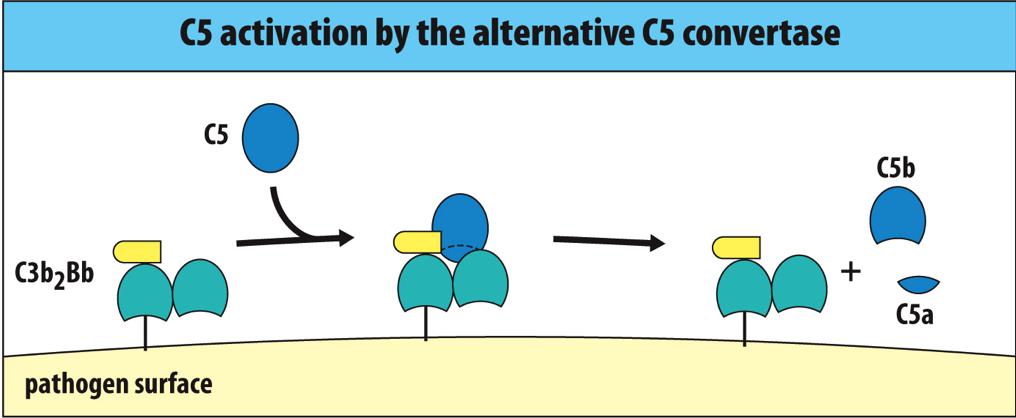
- 137What does C5a do?recruits neutrophils to infection site
*Most potent anaphylatoxin* - 138The terminal complement components that form the membrane-attack complex

- 139The terminal complement components that form the membrane-attack complex: Protein C5 (concentration in serum:85) What's its function?initiates assembly of the membrane-attack complex in solution
- 140The terminal complement components that form the membrane-attack complex: Protein C6 (concentration in serum:60) What's its function?Binds to ans stabilizes C5b. Forms a binding site for C7
- 141The terminal complement components that form the membrane-attack complex: Protein C7 (concentration in serum:55) What's its function?Binds to C5b6 and exposes a hydrophobic region that permits attachment to the cell membrane
- 142The terminal complement components that form the membrane-attack complex: Protein C8 (concentration in serum:55) What's its function?Binds to C5b67 and exposes a hydrophobic region that inserts into the cell membrane
- 143The terminal complement components that form the membrane-attack complex: Protein C9 (concentration in serum:60) What's its function?Polymerization on the C5b678 complex to form a membrane-spanning channel that disrupts the cells's integrity & results to cell death
- 144Protection on Human Cells Against MAC

- 145Complement Receptors (CR)

- 146CR 1 recognizes _____Answer: C3b
- 147What is the soluable C3 convertase and how it is formed?Answer: iC3Bb
- 148CR2 is a __-cell co-receptor and recognizes _______.Answer: B ; C3b
- 149CR3 & CR4 recognize ______.Answer: iC3b
** iC3b can be recognized
by phagocytic cells - 150What is the classical C3 convertase? What is the alternative C3 convertase? **(Hint: Both questions share the same answer)**Answer to both questions is:
C4b2a - 151“a” (anaphylatoxins) Fragments Help Lead to Inflammation, C3a and C5a contribute to ______ - ________.Acute inflammation
- 152What exactly do they( "a" fragments) do?bind mast cells, phagocytes and endothelial cells
-->release of histamine from mast cells
Histamine increases blood vessel permeability & blood flow
Activate endothelial cells ---> direct phagocytes to site of infection - 153What does C5a do?Increases adherence of monocytes and neutrophils to blood vessel walls and acts as a powerful chemotactic factor
- 154C5a is able to attract ______to areas where _______has been fixed.phagocytes;complement
- 155What about protecting the host cell, in regulatory proteins?-Proteins controls complement activation
-Ensures C3b is close-set in place on microbial surfaces; not on the surfaces of human cells
- Plasma protein = properdin (factor P) - 156Factor P binds to C3 convertase (C3bBb) on microbial surfaces and protects it from inhibition by factor ____. (Hint: one letter answer)Answer: "H"
- 157What is factor "H"?Factor H plasma protein reduces complement reactions by making C3b susceptible to cleavage by factor I creating a iC3b fragment that is incapable of forming a C3 convertase
- 158On human cells the complement pathway is stopped by human ___-_______ _______ decay-accelerating factor (DAF) and membrane co-factor protein (MCP).Answer: Cell-factor protein
- 159DAF and MCP control proteins destroy C3 convertase activity by binding to ____.Answer: C3b
- 160CR-1 also plays a protective role on ______ cells.Answer: Human
- 161When C3bBb is formed on a human cell surface it is rapidly disrupted by the action of one of the regulatory membrane proteins: ______ ______ ________ (D.A.F) or _______ ________ _______ (MCP).Answer: decay accelerating factor (DAF) or membrane cofactor protein (MCP)
- 162Complement activation limits bacterial infections…but some bacteria mimic human cells to evade the actions of complement. (Give two examples that relate to this statement)Example 1:
Streptococcus pyogenes
Example 2:
Staphylococcus aureus - 163Several classes of plasma protein limit the spread of ________.Answer: Infection
- 164—


- 165What does this symbol mean?Answer: Alpha

- 166What does this symbol mean?Answer: Beta

- 167Antimicrobial Peptides - Defensins: What are the two types of defensins?1st : Alpha -defensins
2nd : Beta -defensins. - 168Alpha Defensins?Produced mainly by neutrophils and Paneth cells (specialized epithelial cells of the small intestine)
- 169Beta Defensins?Expressed mainly by epithelial cells of the respiratory tract the urogenital tract and the skin.
- 170Amphipathic (both ________ and _________) regions.Answer: hydrophobic and hydropholic
- 171Human B1-Defensin (Figure 2.17)

- 172Alpha Defensins: Class, Name, Site of Synthesis, Tissues defended, Regulation of Synthesis Figure 2.19:

- 173Beta Defensins: Class, Name, Site of Synthesis, Tissues defended, Regulation of Synthesis Figure 2.19:

- 174What are the secondary lymphatic organs?Lymph nodes, spleen and mucosal-associated tissues
- 175What happens in secondary lymphatic organs?Trap antigen and promote lymphocyte activation
- 176Are pathogens found on human cells or pathogen cells?Answer: on pathogen cells
- 177What are the primary lymphatic organs? What happens in the primary lymphatic organs?Answer to Q1: Thymus and bone marrow
Answer to Q2: Maturation of lymphocytes - 178Chapter 3: Information in Test 1Chapter 3
- 179C- Reactive ProteinActivates classical complement cascade.
- 180What can bind to C1q to initiate a classical pathway of complement fixation in absence of Abs and also acts as an opsonin?C-reactive protein
- 181Mannose-binding lectin (MBL)-Activates the Lectin complement cascade
-Enhances complement fixation to pathogen surfaces
-Binds mannose-containing carbohydrates of bacteria and yeast - 182Acute-Phase Responseincreases the supply of the recognition molecules of innate immunity
- 183Besides showcases the acute phase response, what else does this picture showcase?It shows opsonization of pathogen by MBL and CRP

- 184MBL activates a proteolytic enzyme complex: MBL-associated serine protease = MASP. How does it initiate complement activation?-lectin pathway of complement activation;
-MBl serves as an opsonin to faciliate bacteria uptale by monocytes in the blood. - 185C-reactive protein and MBL are present at low levels in plasma: What phase occurs when these levels increase during acute-phase response?- C-reactive and MbL both bind structures that are common to pathogens but absent in human cells
-Fixation by a apthway alsomost identical to classical pathway used by Abs. - 186C4 and C3 are similar in ______, ________and the _______ bond and C2 and factor B are similar.Answer: function; structure and thioester bond
- 187What are the two C3 convertases?Alternative- C3b2a
Classical- C4b2a
- 188Classical Pathway Initiated by what?Answer: Abs

- 189Initiation of the Classical PathwayC1 binds to C-reaactive protein on the pathogen surface activates the classical pathway of complement fixation.
- 190MASP and C1 – Similar Structure and FunctionBoth have binding portions
and protease action
- 191Close structural relationships between components of the alternative, lectin-mediated & classical pathways of complement activation

Information
- Description
- Professor: Gregory Weigel Chapters 1,2 & part of Chapter 3
- Created by
- Zeynah Gomez
- Views
- 15
- Rating
More on Innate and Adaptive Immunity