
Flashcards
Inflammation
Cards in this deck (55)
- 1Shediak-Higashi syndrome?Defective phago-lysosomal fusion (cats, cows, minks, killer whales)
- 2Interaction b/w lymphocytes and macrophages in chonic inflammation?Activated T lymphocytes recruit inflammatory cells (through TNF and other) and activate macrophages (through INF gamma). In return, activated macrophages stimulate T cells by presenting antigens and via secretion of inflammatory mediators (like IL12).
- 3Name the cell-derived mediators of inflammationPlatelets, neutrophils, monocytes/macrophages, mast cells
+
Pre-existing (intracellular granules)
E.g. histamine in mast cells
Synthesized de novo (PGs, cytokines) - 4Name some plasma derived mediators of inflammationE.g. complement proteins, kinins
- Made in liver
- Circulate as inactive precursors - 5What stimulates mediators?Necrotic material (PAMPs and DAMPs)
+
Proteins of complement, kinin, and coagulation systems - 6Which vaso-active amine is mainly released by mast cells but also basophils and platelets?Histamine
- 7What is the effect of histamine release?Dilation of arterioles & increased permeability of venules
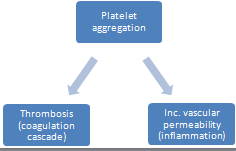
(via binding to H1 receptors on endothelium) - 8Which vaso-active amine is mainly released by platelets and neuroendocrine cells in an inflammatory response and what stimulates its release?Serotonine stimulated by platelet aggregation
- 9What are the 2 major classes of eicosanoids?Cyclooxygenase pathway (PGs)
Lipoxygenase pathway (LTs and lipoxins) - 10Leukotrienes- produced by lipoxygenases, secreted by leukocytes have effects on?Vasculature (permeability, constriction)
Chemotaxis (call in other cells)
Smooth muscle (bronchospasm) - 11Lipoxins - produced by lipoxygenase have what effect in inflammation?INHIBITORS of inflammation (particularly inhibit leukocyte recruitment)
- 12Prostaglandins - produced by actions of cyclooxygenases: COX-1 (constitutively expressed) and COX-2 (inducible) prostacyclin, thromboxane have effects on?Vasculature (dilation, constriction)
Platelets (aggregation or inhibition)
Smooth muscle
Chemotaxis
Pain / fever - 13Out of COX-1 and COX-2, which one is always activated and which one only activated in inflammation?COX-1 Always
COX- 2 Inflammation - 14Which pathway does NSAIDs act on and which eicosanoid pathway does it not have an effect on?Cyclooxygenase pathway! (COX-inhibitors)
No effect on Lipoxygenase pathway - 15Cytokines TNF and IL-1 are relased from activated macrophages in response to what?Physical injury
Endotoxins and other microbial products
Immune complexes
etc. - 16Complement system functions? (3)Inflammation(C3a, C5a)
Phagocytosis (C3b is opsonin)
Cell lysis (deposition of MAC on cell) - 17What are kinins?Vasoactive peptides e.g. bradykinin with similar effects to histamine
- 18Can you live a normal life without factor XII (Hageman factor) ?Yes
- 19True or false: Inflammatory mediators are long-acting and require a specific STOP signalFalse
Short half-lives with rapid decay or proteolysis - 20List two effects of histamineVasodilation
Increased vascular permeability - 21What stimulates the release of inflammatory mediators?Microbial products (PAMPs), necrotic material (DAMPs), other mediators
- 22What are the 2 pathways of the arachidonic acid metabolism, and what is produced by each?Cyclooxygenase: PGs
Lipoxygenase: leukotrienes and lipoxins - 23Where does arachidonic acid come from?Cell membranes
- 24How are lipoxins different from the other classes of eicosanoids?Inhibition of inflammation
- 25Which part of the arachidonic acid pathway do cortocosteroids inhibit?Entire thing (NSAIDS inhibit Cox-1 and Cox-2; not lipoxygenase)
- 26Where do "plasma-derived" proteins actually come from?Originally made in liver; circulate in inactive form
- 27List 2 effects of cytokines tnf and IL-1Leukocyte recruitment
Fever - 28What is the key step in complement fixation that is common to all pathways?C3 proteolysis
- 29What are the 3 functions of the complement system? And what proteins are most involved with each function?Inflammation (C3a and C5a)
Phagocytosis (C3b)
Cell lysis (MAC attack complex) - 30What mediator is involved in eliciting pain?Bradykinin
- 31Activation of what substance is involved in activating the four systems involved in inflammation?Hageman factor (Factor XII)
- 32List the 3 major pathogen routes of entry into lungInhaled (aerogenous)
Hematogenous
Direct entry - 33List 4 types of pneumonia and their route of entryBronchopneumonia (inhaled)
Interstitial (inhaled or hematogenous) Granulomatous (inhaled or hematogenous) Embolic (hematogenous) - 34Name the etiologies involved in enzootic pneumonias and shipping feverEnzootic pneumonia = mycoplasmas (ovipneumoniae and hyopneumoniae)
Shipping fever = Mannheimia hemolytica - 35List two causes of granulomatous pneumoniaFungal: blastomycosis, histoplasmosis, coccidiomycosis, cryptococcosis
Mycobacterium bovis - 36Recall a predisposing condition for aspiration pneumoniaMegaesophagus, handfeeding, cleft palate, downer animal
- 37Identify two predisposing conditions in a cow for embolic pneumoniaHepatic abscesses
Vegetative valvular endocarditis - 38Identify two predisposing conditions in a cow for embolic pneumoniaHepatic abscesses
Vegetative valvular endocarditis - 39What is the origin of the neoplastic cells in Jaagsiekte (OPA)Alveolar epithelial cells (type II pneumocytes and Clara cells)
- 40What bug is the cause of shipping fever?Mannheimia haemolytica
- 41What type of pneumonia is shipping fever?Acute fibrinous bronchopneumonia
(can also be suppurative or fibrinosuppurative) - 42BALT?Bronchus Associated Lymphoid Tissue
- 43Metaplasia?The reversible replacement of one differentiated cell type with another mature differentiated cell type
- 44Gross findings at interstitial pneumonia?Diffuse distribution and large lungs that do not deflate, rubbery texture "meaty"
- 45Gross findings in granulomatous pneumoniaMultifocal firm nodules (any lobe) with white/grey/tan crumbly material
- 46Which pathogens may cause suppurative bronchopneumonia?P. multocida
B. bronchiceptica
A. pyogenes
Strep spp.
Distemper virus
Parainfluenza virus - 47Which type of pneumonia may be ventilator induced?Interstitial
- 48Which bacteria is the major cause of granulomatous pneumonia?Mycobacterium bovis
- 49Which parasites may cause granulomatous pneumonia?Dictycaulus
Muelleria capillaris - 50Via what route does embolic pneumonia enter the lungs?Haematogenous
- 51What are the 3 possible causes of embolic pneumonia?Vegetative valvular endocarditis
Hepatic abscesses
Any septicaemia - 52How could you grossly differentiate b/w embolic pneumonia and for example tumours or an M. capillaris infection?Lesions in embolic pneumonia are soft like normal tissue and not nodular
- 53Jaagsiekte is what type of cancer, and what is the cause?Pulmonary adenocarcinoma
Jaagseikte Sheep Retrovirus (JSRV) - 54List the events in the resolution of acute inflammationNeutralisation/decay/degradation of chemical mediators
Normalisation of vascular permeability
Cessation of leukocyte migration - 55Name 4 types of inflammatory stimuliInfectious agents
Tissue damage
Foreign bodies
Immune reactions
Information
- Description
- BVMS Veterinary Pathology Flashcards on Inflammation, created by Marielle83 on 03/12/2014.
- Created by
- Marielle83
- Views
- 113
- Rating