
Flashcards
Nutrient cycles
Cards in this deck (32)
- 1What is a saprobiont?(Saprophyte) An organisms that gets it food from the dead or decaying remains of other organisms
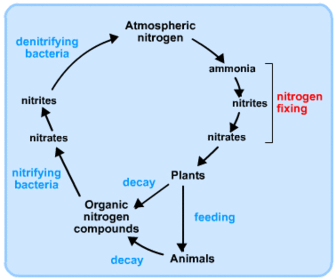
- 2What is ammonification?Production of ammonia from e.g. urea and proteins
- 3Describe the process of ammonification-Proteins are first converted to AAs by extracellular digestion of saprobionts
-The amino acids undergo deamination to produce ammonia - 4What is nitrificationConverting ammonia into nitrites and then nitrates
- 5What is nitrogen fixation?Conversion of nitrogen gas into nitrogen-containing compounds
- 6Where does nitrogen fixation take place and what kind of relationship do the species involved share?-Takes place in the root nodules of leguminous plants
-Mutualism - Pea plants get N2 from bacteria and bacteria get carbs to produce ATP needed to fix N2 - 7What is assimilation?Plants use active transport to accummulate nitrate ions in RHCs. (Plants need N2 dissolved in the form of nitrates to make proteins and nucleic acids)
- 8What is denitrification?Conversion of soil nitrates into nitrogen gas
- 9Describe the conditions and what happens in denitrification-Anaerobic denitrifying bacteria use nitrates to carry out respiration which produces nitrogen gas. The anaerobic condition is due to waterlogged soil
- 10What is leaching?Process by which nutrients are washed from the soil into watercourses
- 11What is eutrophication?Consequence of an increase in nutrients in watercourses that leads to a decrease in biodiversity
- 12Describe how nitrogen in compounds in a dead plant is made available for use by other plants-Proteins/AA broken down
-By saprophytes
-Deamination
-Ammonia formed
-Ammonia converted to nitrate
-By nitrifying bacteria
-Nitrite as intermediate
-Nitrate can be absorbed by roots - 13How do fertilisers increase productivity?-Nitrogen is need to make proteins and DNA
-Where there are more nitrates available, plants are likely to develop earlier, grow quicker and taller and cover a greater area with their leaves.
-This therefore increases the rate of photosynthesis and also increases productivity.
-Artificial fertilisers have been very beneficial in providing cheaper food - 14The over-application of fertiliser increases the rate of leaching. Explain the consequency of leaching of fertiliser into ponds and lakes-Leaching of fertilisers leads to algal bloom
-Light is blocked out
-Plants can't photosynthesise
-So plants die
-Saprobionts feed off and breakdown dead organisms
-Saprobionts use oxygen in aerobic respiration
-Oxygen becomes limiting factor and aerobic organisms die
*There is now less competition for the anaerobic organisms so they rise exponentially
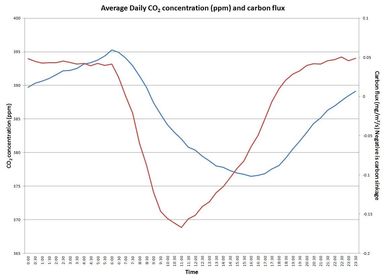
*They release Hydrogen sulphide and other toxic wastes making the water putrid - 15Why do respiration and photosynthesis cause fluctuations in CO2 concentration?-Photosynthesis removes CO2 form the environment
-Respiration gives out CO2
-Therefore, these will vary yearly and daily - 16How does CO2 conc vary daily?Day: CO2 low - PS
Night: CO2 high, no PS just resp - 17How does the CO2 concentration vary yearly?Jan - May: cold and dark, low PS so high CO2
May-Sep: warm and bright - high PS, Low CO2
Sep-Dec: cold and dark - low PS, high CO2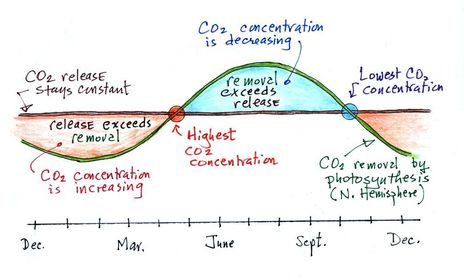
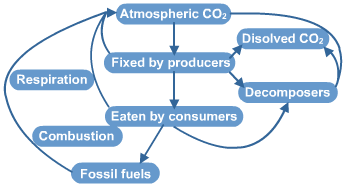
- 18Draw the carbon cycle
- 19Draw the nitrogen cycle
- 20Describe how carbon is cycled through living organisms and the non-living environment-Carbon from CO2 in the air and water becomes carbon compounds in plants when they photosynthesise.
-Carbon is then passed onto primary consumers when they eat the plants, and the secondary and tertiary consumers when they eat the other consumers
-When organisms die, the carbon in the dead organisms is digested by saprobiontic nutrition
-Carbon is returned to the atmosphere as carbon dioxide because all living organisms carry out respiration , which produce carbon dioxide
-When dead organic matter ends up in a place where there aren't any decomposers the carbon can be turned into fossil fuels over millions of years
-Carbon in fossil fuels is released back into the atmosphere when they are combusted - 21Explain why atmospheric carbon dioxide and methane concentrations have increased since the mid-19th century-Atmospheric CO2 concentration has increased rapidly since the 19th century due to increased combustion of fossil fuels
-and the increased destruction of natural carbon dioxide sinks e.g. by deforestation
-Atmospheric methane concentration has also been increasing rapidly since the mid-19th century due to things like increased extraction of fossil fuels
-more decaying wasted in landfill sites
-and more cattle giving off methane as a waste gass
-Methane can also be released when natural stores, such as fozen ground thaw - 22What is global warming? How are rising atmospheric CO2 and methane concentrations causing it?-Global warming is the term for the increase in average global temperature over the last century
-Global warming is caused by enhancement of the greenhouse effect.
-The greenhouse effect when atmospheric greenhouse gases absorb outgoing energy, so less is lost to space
-The greenhouse effect helps to keep the planet warm, but too much greenhouse gas causes the planet to warm up
-Increasing atmospheric concentrations of the greenhouse gases carbon dioxide, and methane are enhancing the greenhouse effect and so cause global warming - 23What is meant by the term "global warming" and what are the consequences?-Global warming is the theory that the earth's average temperatures are getting warmer
-It's the result of greenhouse gases, carbon dioxide and methane
-These form a "blanket" in the atmosphere allowing heat from the sun in but less to be radiated back
-Mainly a result of huan activities e.g. burning of fossil fuels, cows and rice growing
-Melting of polar ice caps causing low level flooding and loss of habitat for e.g polar bears
-Life-cycles of insect pests alter
-Migration is affected
-Drought may be decrease species diversity allowing only xerophytes to survive - 24What is the greenhouse effect?-Sun emits short wavelenght infrared
-Earth absorbs and re-emits long wavelength infrared waves
-Greenhouse gases absorb heat energy and reflect it back to the earth
-The earth get warmer - global warming - 25How or why is CO2 levels increasing?-Combustion of fossil fuels
-Destruction of natural carbon sinks
-Deforestation - 26How and why are methane levels increasing?-Fossil fuels extracted
-More decaying matter
-More cattle
-Neutral stores thaw due to increase in temperature and release methane - 27How does global warming affect crop yields?-Increases crop yields
-Due to increased CO2 concentration (LF for PS) - 28How does global warming affect insect pests?-Decreases the time in larval stage (increase of 1 degrees = 10 days faster)
-Increase in insects that like warm, wet conditions e.g. mosquitoes
-Decrease in tropical insects with specific temperature preferences - 29How does global warming affect wild animals and plants?-Distribution and number will be affected:
-Preference to warm: more widely distributed, increase in no. (e.g boarfish)
-Preference to cold: more isolated, decrease in no. (e.g. polar bears) - 30What are saprobionts and how do they feed?-Saprobionts are microbes that live on detritus.
-They use saprobiontic nutrition (don't ingest food but use extracellular digestion)
-They secrete digestive enzymes onto detritus and absorb soluble products
-The products are then broken down further by anaerobic respiration - 31What are detritivores and how do they feed?-They're small invertebrate animals that eat detritus.
-Use holozoic nutrition (ingest good, digest in gut and absorb soluble products, egest soluble waste - consists of cellulose and lignin) - 32How do detritivores help saprobionts?-Detritivores physically break up large plant tissue into smaller pieces and egest faeces (increase SA)
-Detritivores aerate the soil - saprobionts respire aerobically
-Excrete minerals that saprobionts can metabolise
Information
- Description
- A-Level Biology (Unit 4) Flashcards on Nutrient cycles, created by kiruthicka on 21/12/2014.
- Created by
- kiruthicka
- Views
- 4
- Rating