
Flashcards
Materials-Exam 2
Cards in this deck (127)
- 1The oldest brick masonry was primarily made from e material and how was this material cured?The brick composition was clay and it was sun-dried.
- 2Why was straw added to bricks?To provide tensile strength.
- 3What material was used between stone units as a cushion and bonding agent. ( Think Egyptian pyramids)Lime-sand Mortar
- 4What is the major disadvantage for using Sun-dried Clay brick?It is susceptible to rain!
- 5Name the different types of contemporary masonry materials (4).Brick
Concrete Manonry Units
Cut Stone
Mortar - 6What is unique about using volcanic ash in mortar?It hardens under water!
- 7What are 2 common applications fr contemporary masonry?Structural- load-bearing concrete masonry construction.
Finish- Brick veneer, thing cut stone slabs used for wall cladding, floor, wall, stair treads. - 8What is the purpose of using masonry mortar?Binds masonry units into an integral assembly (wall).
Seals against water and air infiltration.
Provides character (joint size/color) to the masonry assembly. - 9What are the ingredients of mortar?Portland cement+time (binder)
Sand (filler)
H2O!! - 10When mortar is plastic, what are its benefits?Workable, cohesive, easy to spread...
- 11Name 2 characteristics of mortar that are related to its water retention.Retains water without bleeding.
Retains only enough water as needed for absorption by units. - 12Mortar provides what kind of strength to a wall?Compressive and flexural tensile bond strength.
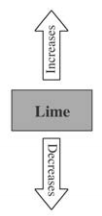
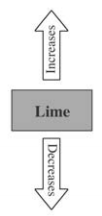
- 13As lime increases, what beneficial properties of mortar increases.Work-ability, water retention, water-tightness of wall.
- 14As lime decreases in mortar, what property increases.Strength of mortar. Therefore the wall's flexural tensile bond strength increases as well.
- 15What are the terms for the 2 items indicated in red?Masonry unit (top)
Mortar (bottom)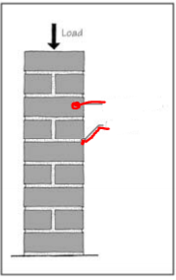
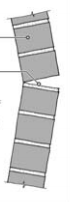
- 16Which part of a wall will fail first?It fails at the mortar joints!!
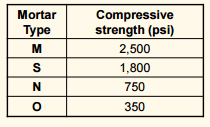
- 17Mortar has 4 strength types. What are they and what are their compressive strength values?
- 18What is this joint called?Concave Joint
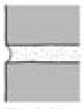
- 19What is this joint called?Raked Joint
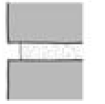
- 20What is this joint called?Flush Joint
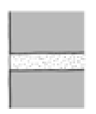
- 21What is this joint called?Weathered Joint
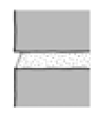
- 22What is this joint called?Struck Joint
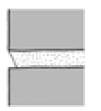
- 23T/F Weathered joints are the most weather proof mortar joints.False. The Concave Joint is the most weather-proof.
- 24What raw materials make up brick?Pulverized clay and shale: oxides of silicon and aluminum.
Water.
Minor components include metal oxides. - 25T/F for water retention of motar, you need a butt load of water ?False! Only enough water as need for absorption by units.
- 26Limes provides what for Mortar?ability to flex in a harden state, work ability, Water tightness
- 27T/F As lime increases in mortar, the stronger it gets?False, the more lime in mortar the structural capacity decreases
- 28T/F A mortar joint will fail under a load before the unit (individual brick) will?True
- 29How thick are mortar joints?3/8"
- 30T/F A weathering joint is the best joint to use for water and air protection?False
- 31What is the average compressive strength of a brick?6,000 psi
- 32Nominal size of a brick vs. Specified size of a brickNominal: 4x2-2/3x8
Specified: 3-5/8x2-1/4x7-5/8
Nominal is what is used in construction - 33The Egyptians were using what material to bond the block of the pyramids together?Lime and Sand mortar
- 34How were early bricks(8,000 BC) made?They were Sun dried
- 35What are some beneficial applications of using brick masonry?Durable against freeze/thaw.
Durable against erosion by rain or wind.
Fire resistant.
High thermal mass.
permanence and stability.
generally used for facade material. - 36Why are there holes in bricks?The holes allows for uniform hardening/firing.
- 37What is the machine that is responsible for giving bricks their holes?It's called a die...
- 38Why do you want to dry bricks before you fire them?If they're wet when you fire them, the water in the brick will evaporate (boil?) and make the bricks explode!!
- 39What are some textures available for extruded brick?Smooth, wire-cut, rock-face.
- 40What is the temperature range that a tunnel kiln operates at?400-2000
- 41Match the type of brick with the correct brick grade. Facing Brick, Building Brick, Paving Brick 1. Graded for dimensional tolerances and warpage, and durability. 2. Graded for freeze/thaw resistance and abrasion 3. Graded for durability and strength onlyFacing brick- 1.
Building Brick - 3.
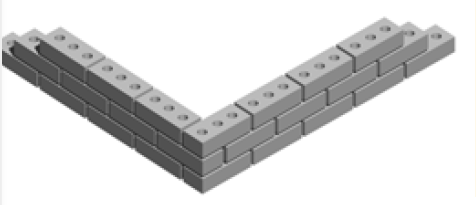
Paving Brick - 2. - 42What type of bond pattern is this?Running Bond
- 43What type of bond pattern is this?Stacked Bond
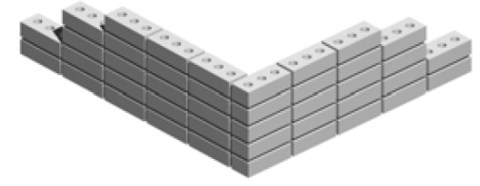
- 44Brick orientations in masonry wall: Name the faces of each brick.1. Header
2. Stretcher
3. Rowlock
4. Shiner
5. Soldier
6. Sailor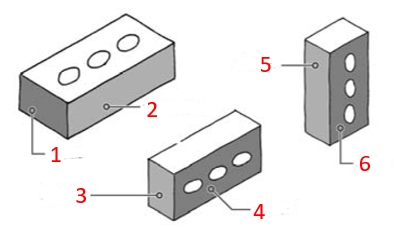
- 45What does a wythe look look like on a brick wall? Wythe: Each vertical layer of bricks in a masonry wall.Single-wythe wall: In section, a wall one brick wide.
Double-wythe wall: In section, a wall two bricks wide.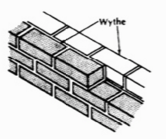
- 46What does a course look like on a brick wall? Course: Each horizontal layer of bricks in a wall assembly.
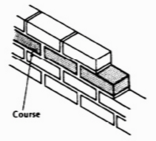
- 47T/F: Connecting any material together with mortar is masonry.Technically true. Dr. Volz said it is.
- 48T/F: Lime increases the strength of masonry mortar.False
- 49T/F: Bricks are stronger in compression than masonry mortar.True
- 50T/F: Because of their relative sizes, it takes less time to build a brick masonry wall than a CMU wall.False
- 51T/F: Wood is much stronger perpendicular to the grain than parallel to the grail.False
- 52The volume occupied by one concrete masonry unit is approximately the same as the volume occupied by _____________. 4 modular bricks 6 modular bricks 8 modular bricks 12 modular bricks12 modular bricks
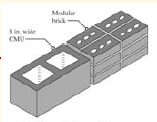
- 53What is the most commonly used bond pattern for glass masonry units?Stacked bond
- 54When constructing a typical CMU wall mortar is applied to ___________. face shells, webs, and smooth-ends of each unit webs only face shells and webs only face shells onlyface shells only
- 55When all free water is removed from wood, the moisture content is approximately _______. 19% 30% 0% 5%30%
- 56Which cut of wood is more dimensionally stable? Flat sawn Radially sawn Circumferentially sawn Rough sawnRadially Sawn
- 57Wood is ________. isotropic isothermal orthotropic anisotropicanisotropic
- 58What does CMU stand for?Concrete masonry unit.
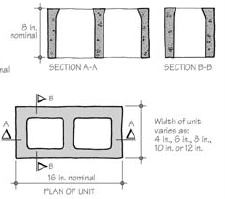
- 59Why are CMUs flared in the holes?It's easier to hold them.
- 60Name these two types of CMUs.Top - Bullnose Unit
Bottom - Scored Unit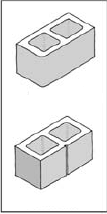
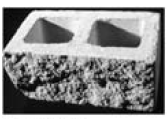
- 61What are the benefits of using split face units?It looks like stone but is cheap!
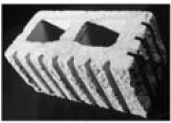
- 62What type of unit is this?Ribbed Unit! It just looks cool...
- 63What are some notable characteristics of manufacturing CMUs?Zero-slump (dry) concrete mix formed in molds to desired shape.
Mold removed immediately.
Green units stacked and cured for 24 hours in warm, supersaturated air.
Stored in yard until shipped. - 64Name this type of CMU construction.Face shelled bedding. Mortar is only places on the outside faces, NOT the web.
(You bond the flanges of the CMU to strengthen the members that are further away from the neutral axis.)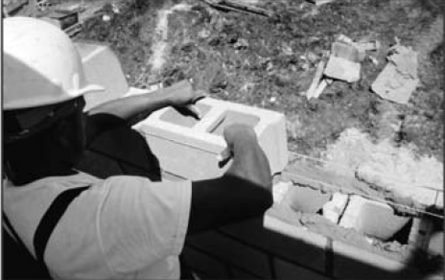
- 65T/F: Do CMUs shrink?False
- 66What terminology would you use to call the technique that this brick layer is performing.Laying the block to string.
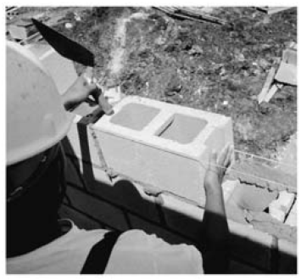
- 67Why would you want to brush off the excess mortar off of your wall after it is sufficiently dried?I don't really know...we should discuss this.
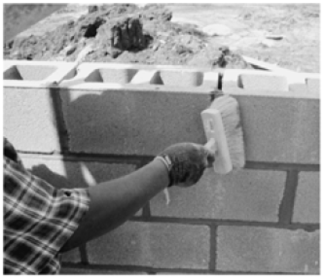
- 68What is the tool in his hand and what is it used for?It is a joint tool. It is used for making joints in the mortar between bricks and CMUs.
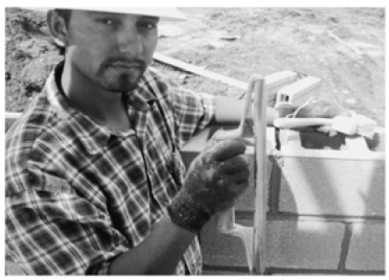
- 69What is a control joint?A joint allows the wall to contract and expand without cracking.
Adds horizontal reinforcement. - 70Why do we put control joints in a CMU wall?To control shrinkage. The mortar shrinks after it dries!
- 71Why are these embedded into masonry walls?To create additional reinforcement.
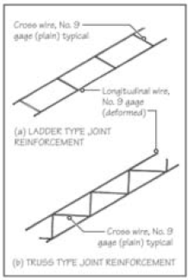
- 72How thick is a typical mortar joint that covers reinforcement bars?5/8"
- 73Expansion joints are for expansion and contraction due to ___________ changes.temperature
- 74What is the composition of grout? Why do we use it?Low slump cement-sand mix.
Grout is used to fill voids in CMU walls and combines with rebar to provide reinforcement when hardened. - 75When installing group, what are the two typical tools used and the two installation methods?Pump,Bucket
High lift, low lift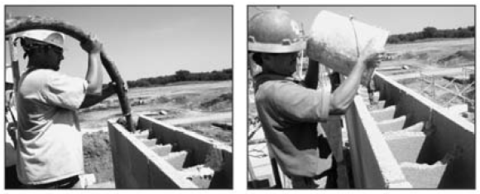
- 76Name 6 natural stone material and their rock type.Granite-igneous
Limestone-sedimentary
Marble-metamorphic
Tavertine-sedementary
Sandstone-sedimentary
Slate-metamorphic - 77Name 3 notable characteristics of Granite that relates to Materials.Strongest and most dense stone, weathers slowly, granular
- 78These characteristics describe which natural stone? Relatively easy to quary, saw and shape. Reacts with acids causing stains. Does not take a polished finish.Limestone!
- 79These characteristics describe which natural stone? Limestone subjected to high pressure and heat. Weaker than granite. Varied surface appearance: veiny, mottled or without pattern. Vulnerable to acid attack.Marble
- 80These characteristics describe which natural stone? Sediments Sediments of limestone dissolved in spring water. May have voids in rock Softer than marble, dense varieties take polish. Unstable when cut thin. Large stones used in thick masonry walls.Tavertine
- 81This characteristic describe which natural stone? Formed of layers of sand, subject to disintegrationSandstone
- 82This characteristic describe which natural stone? Morphosis of clay and mica sediments. Smooth texture with distinct cleavage planes. Used in roofing and flooring.Slate
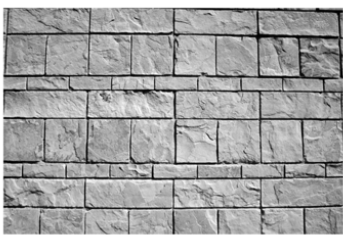
- 83Name this type of wall.Coursed rubble
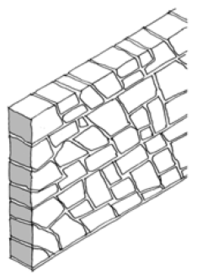
- 84Name this style of wall.Random Ashlar
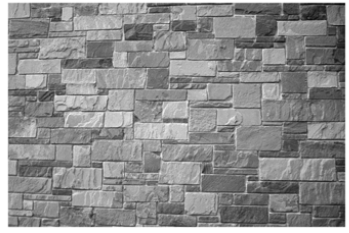
- 85Name this style of wall.Course Ashlar
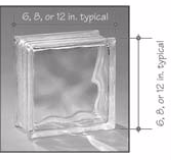
- 86What does GMU stand for?Glass Masonry Unit
- 87What is the typical size of a GMU?6, 8, or 12 square inches.
- 88T/F: GMU is known for holding significant amounts of weight.False! It can only hold its self-weight.
- 89What is the typical wall pattern for GMUs?Stacked pattern.
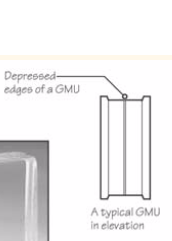
- 90T/F: A GMU is solid glass.False: It actually has a partial vacuum at the hollow center.
- 91What is the term for wood products derived directly from logs through sawing or planing?Lumber (A.K.A solid lumber, solid sawn lumber, sawn lumber)
- 92Wood products manufactured with altered or transformed wood fibers are called......?Manufactured Wood Products, plywood, oriented strand board, glue-laminated lumber
- 93Name the advantages of wood construction?Durable when protected from fire.
High strength to weight ratio (compares weight-to-weight to steel)
Renewable, reusable, low cost, simple construction techniques. - 94How do you tell the age of a tree?The number of rings in the trunk = Age
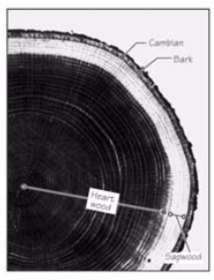
- 95How is this piece of lumber oriented in relation to the grain?Parallel
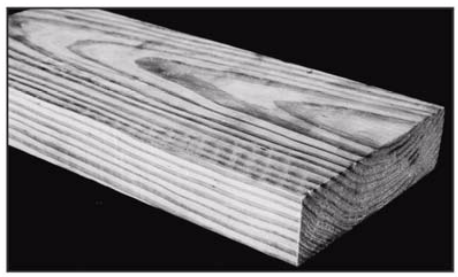
- 96Match the grain orientation with its relative strength. Weak, Strong Parallel, PerpendicularStrong-Parallel
Weak-Perpendicular - 97When wood is cut parallel to the grain, what can its strength reach? (psi)4000 psi
- 98What is the most common manufactured wood?glue-laminated wood
- 99When observing a tree's rings, you see that it has some thick rings. What does this tell you about the tree?Thick rings signify a year with a lot of growth.
- 100What do thin ring tell you about a tree?It's growing slow af...it's also thirsty af
- 101Dr. Volz related trees to straws to transport water throughout the tree...we should chat about this...some osmosis stuff...
- 102T/F Hard wood is always stronger than soft wood.False...and you're a child if you laughed at this question...
- 103What are some differences in softwoods and hardwoods?Leaves, reproduction, cellular structure
- 104Match the terms together: Evergreen, Deciduous Broad Leaves, Needles Softwood, HardwoodEvergreen, Needles, Softwood
Deciduous, Broad Leaves, Hardwod - 105T/F: Hardwoods have more complex cellular structures than softwoods.True!
- 106Is this a hardwood or softwood?softwood
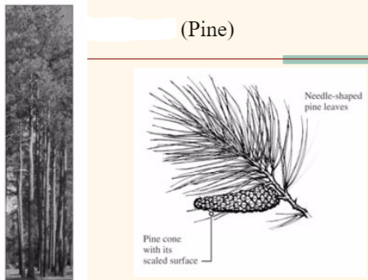
- 107Is this a hardwood or softwood?hardwood
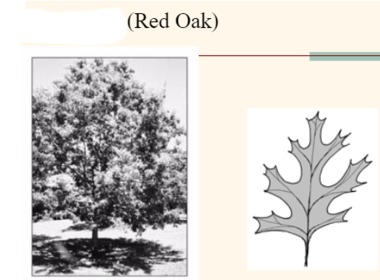
- 108The following characteristics are describing what in a tree? Provides strength. Conducts food from the ground up. Anisotropic.Cellular structure
- 109Name the orientation of the grain in this image.Top: Along-the-grain
Bottom: Across-the-grain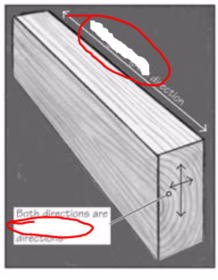
- 110Name the type of cut in these cross-sections.Left: Flat Sawn
Right: Quarter Sawn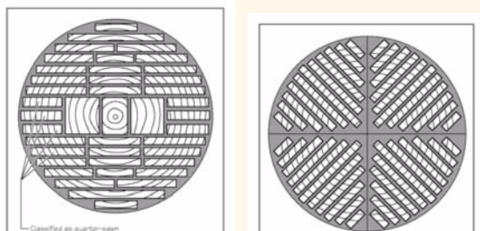
- 111T/F: Free water evaporates over time.True!
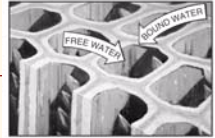
- 112Where is bound water found?Within the cell wall.
- 113What does FSP stand for?Fiber Saturated Point
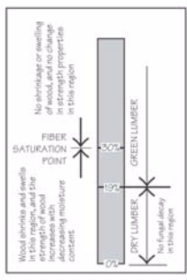
- 114When does FSP (fiber saturated point) take place?when cavity water has all evaporated, and bound water has just begun to evaporate.
- 115The average FSP in wood is... 15% 20% 30%30%
- 116Wood begins to shrink when ________ _________ begins to evaporate.bound water
- 117If the water content of your lumber is 30%, what is no longer present?The free water is allll gone!
- 118What must the water content of lumber be in order to be considered dry enough to use?less than or equal to 19%
This also means that it is no longer susceptible to fungal decay - 119What could happen if your lumber remains wet?It could get moldy...Ew.
- 120What is the slower process to seasoning lumber?Air Seasoning. It is also a natural process.
- 121What is the faster process to seasoning lumber?Kiln seasoning. High temperatures also kill any fungus!
- 122—This is just to be helpful
- 123If you receive rough sawn lumber, where has did it come from?Straight outta the forest yo.
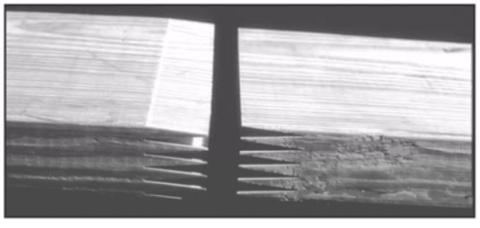
- 124What is this connection called?Finger-Joint
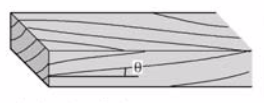
- 125If the slope of the grain increases, the strength of the member _________decreases
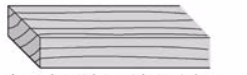
- 126A member with a _________ grain has the maximum strengthStraight Grain
- 127Where do knots come from?Branches!
Information
- Description
- Material covering Wood and Masonry for Materials Exam 2
- Created by
- Cj Alsenay
- Views
- 51
- Tags
- Rating