
Flashcards
Chittka lectures
Cards in this deck (194)
- 1What are the 2 aspects of development (how egg becomes a body) ?1. Growth - single zygote undergoes many rounds of division = Blastula
Blastula organises into 2 layer = blastocyst
Blastocyst organises into 3 germ layers during gastralation = meso, endo and ectoderm
2. Differentiation
Cell differentiates into different more specialised cell type due to intrinsic and extrinsic factors - 2If a zygote is to totipotent, what is an adult stem cell ? And what is the difference ?Multi potent
Totipotent can become all including placental cells
Multi potent can produce many cell types but for one particular organ (e.g. CNS glial and neuronal cells) - 3CNS arises from ectodermal cells. How ? This is different in mammals and amphibiansEctodermal cells under influence of many growth factors secreted by themselves (e.g. BMP2 + 4)
In amphibians: BMP antagonists (noggin, chordin) secreted from organiser initiate differentiation
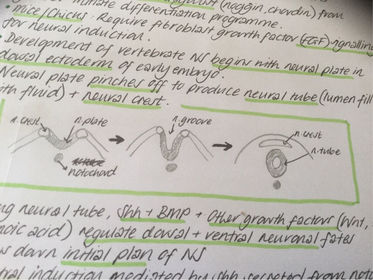
In mouse/chick: fibroblast growth factors (FGF) induce neural differentiation - 4In vertebrate NS, development begins by forming what? Describe this process ?Neural plate
This pinches off to initially form neural groove and then pinches off to form neural tube (lumen filled with fluid) and neural crest - 5What do the neural tube and neural crest give rise to?Neural tube: fore, mid, hindbrain and spinal cord
Neural crest: migrate away from tube to form peripheral cells: bone, connective tissue, para and sympathetic NS - 6How are cell fates determine along the neural tube?Shh (ventral), BMP (dorsal) + other growth factors (Wnt, FGF, retanoic acid) regulate dorsal and ventral cell fates
This lays down initial plan of NS
Ventral induction mediated by Shh secreted from notochord to form inter and motor neurons
Dorsal induction by BMP via ERK pathway (differentiation) and Wnt (proliferation) - 7In what area of neural tube do NSC (precursors for glial and neurons) divide?Ventricular zone (VZ)
- 8What do post-mitotic neurons form ?Migrate away from VZ to form grey matter
- 9How are a multitude of cell types generated from common NSC precursor ?Ultimate identity determined by cell lineage and inductive interactions
First NSC becomes progenitor, then cell lineage restricted progenitor (neuronal, astrocyte progenitor), then differentiate into mature cell (mature neuron)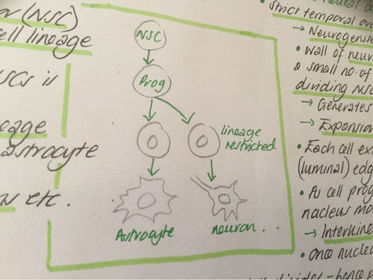
- 10What is meant by temporal neural development in the cortex ?Strict temporal order to neural differentiation
Neurogenesis proceeds gliogenesis - 11What are the 3 temporal stages of neuronal development (state days these equate to in mice) ?1. Expansion stage (day 10 in mice) = Neural tube initially comprises of rapidly symmetrically dividing NSCs to increase their numbers
2. Neurogenesis (Day 13) = NSCs undergo temporal switch from symmetrically division to asymmetrical. This produces one identicle daughter cell and one more specialised progeny
Daughter cells migrate away from VZ to become neurons
Most neuronal cells are post-mitotic, so as neurogenesis proceeds, more post-mitotic cells, proliferation slows and the neural tube thickens, assuming a 3 layered configuration
Now most NSCs lost plail connection, radial glial remain bipolar (span while cortex) and continue to differentiation into neural precursors.
3. Gliogenesis (Day 18) = When non-neuronal cells are derived from NSCs - 12Why is interkinetic nuclear migration ? And why does this dictate where NSCs divide ?Each cells in cortex extends processes from ventricular side (luminal) side to plial surface
As cell undergoes cell cycle, the nucleus moves back and forth in cytoplasm between the V and P edge
One at the V edge again the plial connection is lost and the cell divides
Leading to cell division at the ventricular zone - 13Why are non-mammals more capable of adult neurogenesis than mammals ?In mature mammals CNS radial glial become astrocytes
In non-mammals radial glial remain abundant and can still develop neural precursors later in life
Hence better at neurogenesis + regeneration - 14In terms of genes, how is temporal development maintained in CNS ?During neurogenesis, gliogenic genes repressed so only response to neuronal signals
After time neuronal fate is depressed in mammals - this is when radial glial become astrocytes - 15How does notch-delta signalling determine cell fates ? This is an example of spacial regulationRegulates neuronal vs glial fate by influencing neighbour cells
High notch (low delta) in one cell activates Low notch (high delta) in the neighbouring cell
Low notch = neuronal cell
high notch = glial
equal levels = maintains NSC, glial - 16Tissue stem cells have the ability to self renew, what is their biggest decision ?Whether to self renew or differentiate
- 17N-D signalling enhances asymmetric cell fates, name 2 other fate determinants ?1. asymmetric protein distribution during asymmetric division (e.g. NUMB antagonises NOTCH so more found in neuronal cells)
2. Transcription factors, REST/NRSF represses neuronal genes so is degraded in neuronal cells. - 18How were intrinsic developmental mechanisms discovered in NSCs (in vitro experiment) ?Embryonic stem cells in culture mimic temporal regulation
Plate ESCs with nestin + other precursors
3 hrs = nestin expressing NSCs
Day 3 in vitro: cells formed neutrons (TuJ+) and morphology changed
Day 10: Formed astrocytes (GFAP+ using anti-GFAP)
Then oligodendrites forms (O4+, anti-O4)
Nestin - TuJ- GFAP - O4 - 19What is nestin, TuJ and GFAP ?Nestin: NSC marker, intermediate filament protein downregulated when NSC differentiate
Tut: Neuronal marker, class B-III tubular found in neurons.
GFAP: Astrocyte marker, Glial fibrillary acidic protein - 20What do cells lose during differentiation ?Pluripotency - differentiation potential
- 21State the 5 main cell fate determinants ?1. Intrinsic cell mechanism
2. Temporal regulation
3. Spatial regulation (N-D signalling)
4. Asymmetric protein distribution
5. Transcription factors - 22How are genes affected during differentiation in order to determine cell fate?Gene silencing and activation via Epigenetic mechanisms
So changes in gene expression
Chromatin landscape changes throughout development - 23State 3 major epigenetic traits that remodel chromatin?1. DNA modification - methylation at CpG sites by de novo methylation (DMNT3a +b)
2. Histone modifications - acetylation (HAT), deacetylation (HDAC), phosphorylation, methylation, SUMO or ubiquitylation
3. ATP dependent chromatin remodelling - mediated by SWI/SNF complex - 24How is chromatin remodelled in terms of the protein charges effected ? And what are the 2 states chromatin can be in ?Histone tails are basic (+) and interact with (-) DNA. The tighter this interaction the less able transcription factors are to bind. Acetylation for example, reduced + histone tail to loosen chromatin structure for expression
1. Heterochromatin = tightly packed, inaccessible DNA
2. Euchromatin = loosely packed, accessible regions - 25Describe the ChIP-sequencing method? And what is it used for ?To analyse protein interactions with DNA and investigate the presence of specific histone modifications (looking at epigenome of different genes)
It combines chromatin immunoprecipitation and DNA sequencing
1. Cross link cells with FA
2. Isolate genomic DNA
3. Sonicate DNA to produce sheared, soluble chromatin
4. Add specific histone modification antibodies
5. Immunoprecipiate + purify immunocomplexes
6. Reverse crosslinks and purify DNA for sequencing (determines where modifications are) - 26What did ChIP discover in ES cells ?Bivalent modifications on many lineage specific genes
- 27What are bivalent chromatin modifications ?Regions of DNA bound to histones that have both repressing + activating epigenetic regulations in the same region (at same time)
Increase basal transcription of a gene but not enough to determine cell fate
Bivalency is resolved during differentiation - 28State the 2 major epigenetic regulators at bivalent domains of chromatin ? And the enzymes that mediate them ?1. Methylation at histone3, lysine 27 (H3K27me3) represses transcription - mediated by polycomb repressor molecule (PCR1 or 2)
2. H3K4me3 activates transcription - mediated by mixed lineage leukaemia (MLL) - 29State the 3 aspects of the epigenetic pathway ?1. Epigenator: extrinsic regulation from outside (GFs, temp, oxidation). This tells the cell there are changes to respond to
2. Epigenetic initiator: Initiates epigenetic changes and activates maintainer enzymes (DNA BPs (Erg1) or non-coding RNA)
3. Epigenetic maintainer: Modifies chromatin (E.g. HAT) and ensures the new fate is maintained - 30In terms of epigenetic changes, what do transcription factors do ?Ensure the appropriate remodellers (hat, hdac) are recruited to genes
- 31What are neurotrophins ?Growth factors that regulate function and development of NS
- 32Name 5 neurotrophins ?1. Brain derived neurotrophic factor (BDNF)
2. Nerve growth factor (NGF)
3. NT-3
4. NT-4
5. NT-5 - 33How do neurotrophins regulate NS development ?Limiting amounts act as survival factors to ensure a match between surviving neutrons and appropriate targets
Regulate: cell fate, dendritic pruning, axon growth, neurotransmitters and ion channels - 34What are the 2 classes/families of neurotrophic receptor ?1. TRK family (high affinity receptor)
2. P75NTR family (low affinity) - 35What signal cascades to neutrophil receptors mediate ?PI-3, Ras and MAP kinase
- 36The shwann cell factor (SC1) was found to interact with P75NTR. What do we know about this protein ?SC1 or PRDM4 belongs to PRDM family of transcription factors
Has 2 characteristic domains: multiple zinc fingers and PR domain
Protein activates P75NTR and this way remodels chromatin - 37What is the role of SC1 and how was is discovered ?Critical in the temporal switch from symmetric, proliferative division to asymmetric division. It maintains proliferative stem cell like state of cells
Overexpressing SC1 lead to more nestin+ NSCs
SC1 KOS began to differentiation in tuj+ neurons
So its down regulation triggers neurogenesis - 38In what way does SC1 modify histones and using what enzyme ?Symmetrically methylates arginine to repress neural genes
By recruiting type 2 protein arginine methyl transferase (PRMT5)
Substrate = H4R3 - 39How did they discover the enzyme SC1 recruits of fulfil its stem-cell maintaining role ?In neural cortical precursors, only symmetrically arginine methylation was discovered (H4R3me2s)
- 40Name the other protein arginine methyl transferase other than PRMT5 ? And what other histone residue is often methylated ?Type 1 (PRMT 1) - ASSYMETRICAL methylation (H4R3me2a) that activates genes. Unsure what it activates yet
Lysine - 41In mouse cortex, staining for symmetric and asymmetric methylation suggested what ?Different enzymes for different things and they work in different areas
Enzymes specify cell fates: High PRMT = NSC
High PRMT1 = neuronal cell - 42In what diseases can the knowledge of epigenetic mechanisms and NS development help us ?Neurodegenerative: alzheimers, parkinsons, ALS, SCA
Neurodevelopment: Autistic, schizo
Others; spinal cord injury or stroke - 43What are the 3 major challenges with regeneration in CNS?1. Neurons are post-mitotic
2. Huge variety of neurons in brain
3. Connectivity is essential for proper neuronal function - 44Ideally, we want to reprogram less differentiated cells in any desired cell type. How are we making progress in this ?induced pluripotent stem cells (often from fibroblasts) provide a way to understand mechanisms and diseases
Helps understand chromatin landscape of cell fate so we can drive directed differentiation
Started to make brain in dish (cerebral organoid) and model diseases with this - 45Why do we need in vitro models of human brain development (cerebral organdies) ?Complex human brain made it hard to study brain disorders in model animals
- 46What is a cerebral organoid ?In vitro organ resembling brain
- 47Describe the rough process of how a cerebral organoid was developed ? And how they knew if was real representation ?Used iPS cells from fibroblasts to generate cerebral organoid
PSCs - embryoid bodies - neuroectoderm - expanded neuroepithelium - cerebral tissue
When they investigated its organisation they saw it displayed discrete brain regions
They demonstrated several functional cortical neutrons were formed + it resembled cortical organisation - 48They used the cerebral organoid to model microcephaly (underdeveloped brain). What did they find when compared to control brain ?Used immunohistochemistry to stain tissue
Control cerebral organoid stained for: DCX, SOX2 and DAPI in high regions
Microcephaly organoid: had fewer newborn neurons (DCX) and smaller progenitor zones (SOX2) - 49What does the Zika virus infect ? And describe the related experiment ?NSCs
Infected iPS derived NSCs in a dish that were giving rise to cortex
Causes cell cycle arrest, cell death and gene dsyregulation
Cortical neuron precursors become replication factories. Virus spread through whole plate of cells in 3 days
Must cross BBB !? - 50ADULT NSCSADULT NSCS
- 51Neurogenesis is seen in premature mice but adult Neurogenesis has been found in postnatal guinea pigs. Where ?Hippocampus (SGZ)
Even though brain is full size there is still proliferation/division here - 52How was postnatal neurogenesis in guinea pig hippocampus discovered ? (Analogue)Neurogenesis implies cell division - looked for DNA replication
Bromodeoxyuridine (BrdU) a radioactive thymidine analogue
Incorporated into cells during S phase
Determine when + where division takes place
Kill animals and expose tissue to fluorescence
Dark stained cells are immature dark cells (neuroblasts committed to neuronal fate) - 53Where was neurogenesis found in adult canary birds ?High vocal centre (HVC) nucleus
- 54How was adult neurogenesis located in song birds (similar to guinea pigs) ?Injected 3H-thymidine in birds brain
Waited 30 days to allow new cells to differentiate, migrate and synapse
Sacrificed animal and looked under fluorescent visualiser and at cell shape
Confirmed neurogenesis taking place - 55Why do song bird require adult neurogenesis ?Survival mechanism that male birds learn a new song every year
Adult neurogenesis is crucial for learning and retaining the song - 56The HVC is under hormonal control. What is the hormone ? And how do its levels varyTestosterone
More in males so HVC more developed in males
Levels drop during neuronal death periods, after this during breeding season (fall + spring) testerone levels rise and recruitment of neutrons to the HVC peaks - 57What happens if female birds are administered testosterone ?They recruit neutrons to HVC and are induced to sing
Shows huge role in neurogenesis - 58In HVC they saw another gene/protein where neurogenesis was occurring. What was this protein and how does it work ?Alcohol dehydrogenase
Mediates synthesis of retanoic acid, which induces neurogenesis
Maybe why drunks sing !? - 59Describe neurogenesis in the SVZ ? Where do new neutrons migrate ?Forebrain SVZ is a prolific source of NSCs
These neural progenitors migrate to the olfactory bulb via restricted pathway = rostal migratory stream (RMS)
As NSCs migrate astrocytes form a sheath around them until they reach the OB
Cells differentiate into OB interneurons and synapse - 60Describe neurogenesis in the hippocampus (SGZ) ?NSCs in dentate gyrus of hippocampus
New neutrons from SGZ migrate to granular layer and make contact with ammons horn (CA3). Here they become mature granule cells of the DG - 61Neurogenesis is often researched using double labelling technique. What is this ?BrdU (new neutrons)
NeuN (adult neutrons)
Often detected by antibodies
Cells that express both show adult neurogenesis - 62What did post mortem tissue of cancer patents who volunteered for BrdU injections show ?Neurogenesis + gliogenesis occurs throughout life
- 63Where are few new neutrons generated ?Cortex
- 64What are adult stem cell niches and state 2 major ones in the CNS ?In vitro, restricted microenvironments
Niches defined by the presence of a variety of cells (endothelial, microglia and mature neurons) and different extrinsic factors that regulate cell fate
Adult niches differ to embryonic niches
1. SVZ 2. SGZ - 65As a direct consequence of interactions from stem cell niches NSCs can do one of 3 things. What are they ?1. Remain dormant
2. Self renew
3. Differentiate - 66Describe the SVZ stem cell niche ? (cells there, what NSC give rise too and role of GABA)Cells present: NSCs, transient amplifying cells, rapidly dividing immature precursors, neuroblasts and ependymal cells which separate SVZ from ventricle wall
Neuroblasts have OB lineage
Neuroblasts release GABA to inhibit NSC proliferation - 67Describe the SGZ stem cell niche ? (cells there, what NSC give rise too and role of GABA)Cells: radial NSC, non-radial NSC, neuroblast (newly born neurons)
NSCs give rise to DG mature granule cells
Mature granule cells release GABA to again control proliferation of NSCs - 68State 3 important cells in adult stem cell niches ? And what is their role ?1. Vascular endothelial cells: in SVG and SGZ vasculature is close to NSCs so influenced via bloodstream.
2. Astrocytes: endfeet contact vasculature to regulate blood stream signals and also secretes GFs themselves
3. Ependymal cells: release BMP antagonist noggin to regulate neuronal cell fate - 69In mature mammalian CNS all radial glial are depleted. What cell is thought to take over the role of neural precursor in the SVZ ?Astrocytes
- 70What experimental evidence is there that astrocytes in SVZ are NSCs ? (3 examples)Many cells express gfap+ but how do they know they are NSCs?
1. Only SVZ astrocytes remain labelled with proliferative markers after long survival in mice
2. After anti-mitotic treatment to remove neuroblasts and other dividing precursors, SVZ astrocytes divide to give these cells
3. In untreated mice, SVZ astrocytes infected with GFP-retrovirus (infects dividing cells) give rise to OB interneurons (stained with TuJ+) - 71What is the neurogenesis pathway of differentiation in the SVZ (4 steps) ?1. Astrocytes are primary neural precursors
2. Slowly + asymmetrically divide to give immature precursors
3. Rapidly divide to give neuroblasts
4. Neuroblasts migrate to give rise to OB interneurons - 72What is the less complex differentiation pathway in adult songbirds (3 steps) ?1. Radial glial remain abundant
2. Radial glial give rise to young neuron
3. Young neutron migrate out of SVZ to become post-mitotic mature neurons - 73What is the diffraction pathway in mammalian SGZ (3 steps) ?1. Astrocytes are primary neuronal precursors
2. These differentiate into immature dark cells (stained in guinea pigs)
3. Immature dark cells give rise to mature granule neutrons in DG - 74State 3 major visualisation methods to detect adult neurogenesis ?1. Fluorescent protein expression: Nestin-GFP. Use transgenic mice in which nestin+ cells marked with GFP
2. Retrovirus labelling: only infects dividing cells, coupled to GFP
3. BrdU labelling - 75There is evidence of the human brain repairing itself after 2 forms of injury. What are these ?1. Stroke
2. Ischemia - 76Neurogenesis is known to occur in SVZ, SVG + OB. But neocortical neurogenesis remains controversial. Until when ?2009 (ohari)
Neocortical neurogenesis seen in many cases when neocortex is injured by ischemia.
Suggests presence of maintained NSCs that can be activated - 77Describe the experiment evidence for neurogenesis in the cortex during ischemia ?Using immunohistochemistry (proliferative marker (Ki67) and GABAergic marker (GAD67) they found NPCs in neocortical layer 1 of rats
Clamped carotenoid artery and found proliferation of Ki67+/GAD67+ was highly activated by ischemia - 78So what type of neurons do activated NSCs in neocortex develop into ?GABAergic neurons
- 79How did they know these neocortical GABAergic neutrons integrated ?Retrovirus mediated labelling watched them migrate into deeper layer of cortex and integrate
- 80How did they confirm this GABAergic neuron integration using novel enriched environment experiment ?Exposed rats to NEE and monitored expression of GFP-c-fos marker gene for new neurons
New environment = explore = activates new neurons
Animal sacrificed and looked at GFP labelled c-fos
Saw experience specific integration - 81Where else in the brain (other than cortex) was experience specific integration seen with novel enriched environments ?Hippocampus
Looked for double labelling (BrdU/NeuN) not C-fos this time
Number of double + cells increased in NEE - 82What clinical use could new inhibitory GABAergic neutrons have ?Protecting from epilepsy and convulsions
- 83What is the purpose of neurogenesis in adults ? Compare this to the role of stem cells in other systems ?Wonder if it is necessary for proper function, but unsure of the effects of block neurogenesis ATM
Suggested that new neutrons in hippocampus enhance executive tasks which induced their production
In other systems, stem cells more useful as regulate homeostasis + generate systems upon demand - 84Most stem cells are dormant but activated when required. Why is it useful that they remain dormant ?To prevent differentiation and depletion of the NSC pool
- 85What signalling pathway keeps NSCs quiescent ?BMP signalling
1. BMP binds BMPR-1A
2. This activates P-SMAD1
3. P-SMAD1 activated quiescent programme
Inhibiting BMP leads to neural induction - 86What are FOXO proteins found in mice ? And what is their role ?Transcription factor protein
Expand lifespan by regulating NSC pool, enables NSC longevity by inducing a programme of genes that preserves quiescence and prevents differentiation
They also: control O2 metabolism, down regulate ROS and cell cycle (these may all have effect on cell fate) - 87What do FOXO KO mice possess ?Normal development but less NSCs
- 88What is the most successful story for the clinical use of adult stem cells ?Retinal regeneration following macular degeneration
- 89What are the 3 requirements for adult stem cells to be used clinically ?1. Direct neuroblasts towards specific location of damage
2. Want them to differentiate along certain pathway (parkinson = DA neutrons, stroke = cortical neurons
3. Want new neurons to integrate into existing networks - 90How have doctors used stem cells to repair spinal injury (3 steps) ?1. Removed nerve cells from nose
2. Injected them into damaged region in spine
3. These cells provide a bridge enabling spinal nerves to grown and reconnect - 91What less invasive, non-surgical delivery method for stem cells is now being investigated ?Snorting them
Snorting large sample through nasal cavity delivers many intact NSCs to the brain intact. These were located with immunohistochemistry
Could treat neurological diseases non-invasively - 92Name 2 factors that decrease neurogenesis and and 4 factors that promote it ?Decrease neurogenesis: depression and stress
Increase neurogenesis: antidepressants, exercise, learning (promotes neuron survival) and epilepsy (but don't integrate properly here) - 93Describe regeneration in other animals ?Lizards + goldfish can regenerate whole segments of the NS
Planar are excellent too but contain 60-70% undifferentiated cells (less complex) - 94What are the 2 major questions we still have in terms of NSCs ?Real significant of adult neurogenesis ?
(currently learning + enhances tasks that produced them are best we have)
Regulation of cell fates? (better understand to drive it) - 95NEURODEVELOPMENTAL DISEASESNEURODEVELOPMENTAL DISEASES
- 96What are neurodevelopment diseases ?Group of disorders were development of CNS is perturbed
Includes developmental problems which manifest as: neuropsychiatric problems (emotions), impaired motor function, learning, language and non-verbal communication - 97What are developmental disorders characterised by ?Deficits in neuropsychiatric health, motor function, learning and communication
These show in early life - 98What do developmental disorders highlight ?The need for a precisely regulated developmental programme
- 99What are the 6 major ND categories set out by the DSM-5 ?1. ADHD
2. ASD
3. Communication disorders
4. Intellectual development disorders
5. Motor disorders
6. Learning disabilities
All can coexist - 100Name 5 major neurodevelopment disorders (covered in lecture) ?1. AUTISM
2. RETT SYNDROME
3. FRAGILE X SYNDROME
4. DOWN SYNDROME
5. LEARNING DISABILITIES - 101What was autism originally used to describe in 1912 ?1. Originally describe by swiss psychiatrist in 1912 to describe schizo symptoms - psychiatric definitions are always changing
- 102What did Leo Kanner discover in 1943 ?Introduced term "early infantile autism"
8 boy and 3 girls (11 people) had innate inability to form effective contact with people, were focussed on particular objects and had a need for things to stay the same - 103What did Hans Aspergers produce a paper on before this which was ignored ?He define aspergers syndrome
Reported 4 boys that didn't mix well with peers, had stereotypical movements, didn't understand respect or politeness and disregarded adult authority - 104How has the commonality of autism changed through the years ?Used to effect 1% population
Now more common (25 in 10,000 kids)
Due to awareness and changes in diagnosis - 105What group of the population is most likely to be autistic ?Siblings of autistic (15-30x more likely)
Boys 4x more likely than girls
Occurs in all societies and backgrounds - 106Is autism progressive ?No, but it is life long
- 107What are the 3 common diagnostic features (symptoms) of autistic children ?1. impaired social interaction
2. Impaired verbal + non-verbal communication
3. Restricted and stereotypical behaviours
(These are highly sophisticated functions in humans that ASD patients don't have) - 108What are the comorbid symptoms that can come with ASD ?Sleep disorders, anxiety, aggression, ADHD
- 109When is autism diagnosed and how does this differ to aspergers ?6-18 months children don't look at you or respond when called
Aspergers later (3 years) as no language delays - 110ASG genetic factors are often mutations in genes involved in what ? And what does this lead to ?Synaptogenesis + axon motility
Leads to... microstructural, macrostructural and functional abnormalities in connectivity and activation of socioemotional processing - 111What are microstructure and macrostructural abnormalities ?microstructural = altered ratio of short and long diameter axons
macrostructural = cortical + subcortical grey matter overgrowth - 112How were functional abnormalities in ASD patients detected ?functional MRIs found under connectivity in socioemotional processing
- 113What is theory of mind and how did they test that autistic people do no have this ?Ability to understand people motivations, desires and intentions (predict how they many react)
Used doll and marble experiment
Autistic people answered incorrectly - 114What concordance rates (%) did twin studies show in terms of autism ?Monozygotic twins = 60-91% concordance rate (same genetic traits)
Dizygotic twins = 10-30% concordance rate
Considered full spectrum as higher variation
So normal siblings = 10-30% swell
Genetic traits often synaptogenesis or axon motility genes - 115What unusual trait is seen in ASD genetic factors ?Spontaneous mutations seem to form too
In another test only 30% normal siblings had same trait, meaning 70% were unique to individual - 116Many ASD genetic factors effect synaptic development and functioning. What are the 4 main categories of the genes involved ?1. Cell adhesion and scaffolding (SHANK3)
2. Signal transduction + translation (FRM1 + MECP2)
3. Receptor and enzymes (ABAT)
4. Transport (NOSTRIN) - 117What did electrophysiology studies show in ASD patients ?Altered resting state !
- 118What are environmental factors for ASD ?E always effects genes (G X E)
Perinatal, prenatal and postnatal stresses such as virus
Vaccines do not cause ASD !! - 119mRNA metabolism is a delicate + complex process that relies of what ? And what does precise regulation lead to ?Tight regulation of gene expression
Precise spatial, temporal, intrinsic and extrinsic regulation leads to properly formed neural networks - 120Early brain development is highly susceptible to small changes in what ?mRNA stability and translation
- 121What is the overall aim of a highly regulated gene expression system ?Modulate gene product production according to requirements (increase, decrease RNA or protein levels)
- 122Name 4 major regulatory processes that effect mRNA metabolism and hence gene expression ?1. mRNA nuclear export
2. Splicing (processing RNA, cuts out introns, alternative splicing makes many proteins from one RNA)
3. Nonsense-mediated mRNA decay (surveillance pathways to reduce errors in expression by eliminating mRNA transcripts with premature stop/nonsense codon)
4. Translational regulation (post-translational modifiations, rate of translation, signal dependent translation) - 123What is the most effective regulatory mechanism ?Regulating transcription rate by helping or promoting RNA polymerase
- 124After transcription, stability and distribution of transcripts is regulated by what ?RNA binding proteins
- 125What 4 post-transcriptional events do RBPs control ?1. Alternative splicing
2. Nuclear degradation
3. Nuclear export
4. Other RNA processing (polyadenylation) - 126What are monogenetic disorders ? And name 3 examplesCaused by mutation in a single gene
Rett syndrome, FXS + neurofibromatosis - 127Why are monogenetic disorders useful in terms of ASD ?All 3 examples have phenotypic overlaps with autism and are even considered to be within the spectrum
There discoveries give insight in ASD pathology and drug targets - 128What is the most frequent monogenetic cause of ASD ?FXS
50% considered to be on spectrum - 129Describe fragile X syndrome ?Dominant disease
Both sexes effect, especially males as only 1 X chromosome
Symptoms = mental retardation, delayed verbal development, autistic like behaviour - 130What causes FXS ?Trinucleotide repeat disorders
Mutation in FMR1 gene (RBP)
Normally has 6-50 CGG trinucleotide repeats, suffers have >200
CGG repeats induce CpG methylation at FRM1 promoter so gene is silenced by heavy methylation (heterochromatin state) - 131Protein synthesis is highly regulated because it has to correspond with what ?Outside stimulus/signals
- 132What is de novo synthesis necessary for in the brain ?Long lasting modifications in synaptic strength, dendritic spines, memory consolidation etc all underlie cognition
- 133What is the normal function of FRMP and how does it do this ?Polyribosome associated RBP that represses protein synthesis to regulate expression and de novo synthesis of a set of plasticity related proteins
Represses synthesis by stalling ribosomal translocation on target mRNAs - 134What do FRMP abnormalities (loss) result in ?Increases protein synthesis of plasticity related genes. This leads to defects in cognition and synaptic plasticity
- 135What can FXS help understand ?Mechanisms behind long term modification in neuronal function
- 136What do FRMP KO mice show ? (3 things)1. Increased protein synthesis
2. Exaggerated LTD in hippocampus
3. Increased dendritic spine density - 137What is minocycline and what are other future FXS treatments ?Tetracycline analogue
This and other small molecules inhibit translation by also interfering with ribosomal translation in different ways
Have similar action to FRMP so could replace it in FXS patients - 138We known FRMP represses plasticity related genes. But name some specific examples ?Metabotropic glutamate receptors, inotropic glutamate receptors (NMDA), NF1, ERK, PTEN + more
Many of these can be blocked as therapeutic targets - 139How do FRM1 abnormalities exaggerate LTD (mGluR theory) ?LTD is glutamate receptor dependent (GluR5, NMDA, AMPA + mGluR)
It requires protein synthesis
This dependency is lost in FXS patients
mGluR Theory: FRMP KO mice show exaggerated LTD due to increased protein synthesis and mGluR signalling - 140Based on mGluR theory how are FXS symptoms alleviated in mice ?Reducing mGluR (via inhibitor) restores dendritic morphology, LTD, protein synthesis and normal behaviour
- 141Name a specific drug that alleviates FXS symptoms ?CTEP administration
mGluR inhibitor - 142Describe Rett Syndrome (who gets it and symptoms) ?X-linked disorder
Recessive not dominant so only girls get it
Affects 1 in 10,000
Symptoms: autistic like behaviour, mental disabilities, loss of speech, seizures motor problems and microcephaly - 143What causes Rett syndrome ?MECP2 mutations
Methyl Cytosine-binding protein 2
Another defect in gene/mRNA regulation - 144What is the role of MECP2 ?It recognises CpG methylation on DNA and binds to it, regulating transcription that way
- 145Dr Brett found Rett syndrome could be reversible !! How ?Transgenic mice with inactive MECP2 did not explore surrounding or spread hind legs when picked up by tail.
When reactivated the gene, exploration and spread legs was restored !!
MECP2 seems to be able to reactivate - 146What have Rett and FXS highlighted ?Importance of gene/protein regulation in neurodevelopment, normal synaptic function and cognition
Genes that can be looked into as novel drug targets for autism - 147Name 3 major neurodegenerative disorders ?1. Alzheimers
2. Parkinsons
3. Triplet (trinucleotide) repeat disorders: Huntingtons, spinal cerebral ataxias (SCAs) and spinobulbar muscular atrophy (SMA) - 148What is ataxia ? What is atrophy ?Ataxia: Loss of full control of body movements
Atrophy: wasting away - 149How many people worldwide do neurodegenerative diseases effect ?25 million
Brings a lot of suffering and economic loss - 150Why is neurodegenerative diseases so key in research right not ?We are living longer so they are more common
- 151What are the pathological characteristics of prions disease (Location, microstructural and macrostructural abnormalities) ?Location: cortical
Microstructural: spongliosis, Prp-sc deposits/aggregates
Macrostructural: cerebral atrophy - 152Pathological characteristics of alzheimers ?Location: temperoparietal
Micro: Beta-amyloid (AB) plaques + tau tangles
Macro: Cerebral atrophy - 153Pathological characteristics of parkinsons ?Location: midbrain (DA neurons in nigra striatal pathway)
Micro: a-synuclein lewy bodies
Macro: paleness of substantial nigra - 154What do many neurodegenerative diseases have in common ? And what does this imply about how they are caused ?Unhealthy protein aggregation (a-synuclein, prp-sc, tau, beta-amyloid, huntingtin)
Common pathway in misregulation of protein expression - small changes through life could cause pathogenic levels - 155When do NDs normally strike ?Mid to later life
- 156What is a major environmental factor of NDs ?Ageing - increases susceptibility
- 157How long do these diseases tend to last ?10-20 years with progressive deterioration until death
- 158What symptoms tend to present first ?Loss of fine motor control
- 159What are the 2 categories NDs are grouped into and give examples of each ?1. Sporadic: Most alzheimers, parkinsons (unkown origin)
2. Inherited: Huntingtons + spinocerbellar ataxia - 160What 3 things could cause ND protein aggregation ?1. Protein misfolding, inability to fold
2. Inability to dispose of misfiled proteins
3. Misregulation of protein expression - 161What is the pathological characteristic of huntingtons ?Nucleus is gummed up with abnormal huntingtin protein
- 162What causes amyotrophic lateral sclerosis (ALS) and describe what we known about it ?Superoxide dismutase proteins (E.g. SOD1) and TDP-43 or FUS accumulate in the body and nerve projections
Kills >100,000 annually
Rapidly progressing
Sufferers lose ability to swallow, speak, move or breath
Steven hawking had this - 163What type of disease in huntingtons and is it dominant or recessive ?Triple expansion repeat disease
Autosomal dominant - 164What is the difference between one of the features of NDs and huntingtons ?It strike early-mid adulthood not mid-late
But still progresses to death (~20 years later) - 165What are the symptoms of huntingtons ?Loss of motor control, cognitive impairment
- 166How is the huntingtin protein mutated ? And where does it accumulate ?Expansion of CAG triplet repeat (>36 repeats in sufferers). This region encodes polyglutamine tract, which is cleaved and aggregates
Mutant protein accumulates in cytosol - 167What do sufferers of juvenile onset huntingtons have to deal with ?Rapid progression :(
- 168Why are trinucleotide repeats bad ? 5 reasons1. Alters normal protein sequence and structure
2. Often unstable regions
3. Can get stuck in RNA polymerase so not transcribed
4. Can induce methylation (like FXS)
5. Can cause non-ATG initiated translation which produces toxic peptides - 169Name other triplet expansion repeat diseases ?X-linked spinobulbar muscular atrophy (SMA)
Spino cerebellar ataxias - 170Common symptoms of triplet expansion diseases ?Cognitive impariements
Cerebellum, spinal tract and brain stem nuclei based - 171What causes parkinsons ? And is it more often sporadic or inherited ?a-synuclein aggregates in DA neurons kill them. Progressive loss of DA neurons mainly in substantial nigra
Majority sporadic
Familial cases rare but include mutations in: DJ-1, A-synuclein, parkin and pink1 - 172How many people worldwide does parkinsons effect1-2 % over 65
- 173What is FTD ?Frontotemporal dementia (FTD)
Plaques and tangles cause fronto/temporal lobes to die
Characterised by behavioural changes at ~50-60 years
Specifically effects language, writing, speaking and motor skills (primary aphasia) - 174What other ND is FTD similar to (symptoms often co-occur) ?ALS
Motor function disorder very similar to ALS - 175What do FTD + ALS have in common?Share some genetic mutations (e.g. TDP-43, FUS + C9orf72)
Chromosome 9 open reading frame and other RNA Binding protein
Share RNA based pathology - 176What specific common mutated gene do ALS + FTD share ?Hexanucleotide (GGGGCC) expansion repeat in C9orf72
This effects normal protein expression - 177What is the theory as to why hexanucleotide repeat expansion in C9orf72 effects its expression ?RNA is translated through non-ATG initiated translation. This forms + accumulates toxic dipeptide repeat proteins
The expansion also comprises nucleocytoplasmic transport - 178What 3 common animals are used to study NDs ?transgenic mice, drosophila + c.elegans
- 179Name the two expanded glutamine tract diseases ?huntingtons + SCA
- 180Protein misfolding is a common pathway to pathogenesis in NDs. Why do cells form inclusion bodies ?To protect themselves from misfolded proteins
Cells that don't form inclusion bodies are most susceptible to neurodegeneration - 181What did scientists find in terms of chaperones in NDs ?Many chaperones found in aggregates
In mouse + fly models, over expression of HSPs facilities folding and alleviates symptoms - 182Mutant poly-Q proteins interact with key transcriptional regulators. What are these ? How does over expressing these improve NDs ?E.g. Poly-Q-peptides interact with CREB protein. These reduces acetylation, decreasing protein expression
Over expression of T.regulators in mice reverses some pathogenesis in SCA + huntingtons - 183What do transcriptional cofactors serve as ?Modifiers of disease phenotype
- 184Describe mitochondrial dysfunction in huntingtons ?Mitochondria in patients lymphoblasts have decreased membrane potential so depolarise at lower Ca2+ concentrations
Mouse models shows same in brain - 185Mitochondrial dysfunction in parksinsons too, describe ?Parkinsons fly models show PINK1 loss leads to mitochondrial dysfunction. No autophagy of damaged mitochondria so cell stress causes cell death of DA neurons
- 186In what way are cytoplasmic aggregates more toxic ?more toxic in affecting nucleocytoplasmic transport of RNA + proteins
- 187What do familial NDs have many mutation in ?RNA binding proteins
- 1882 way repeat expansion diseases interfere with RNa processing in cells ?1. associated with abnormal transcription + generation of toxic RNA which can sequester RBPs fro others RNAs
2. Cause repeat associated non-ATG translation which generates abnormal toxic RNA + PROTEIN that interferes with RNA processing in cells - 189State the 3 main pathogenic mechanisms associated with repeat expansion disorders ( in coding and non-coding regions of RNA) ?1. Expansion in coding region leads to protein gain of function (Poly-Q stretch cleaved and make toxic aggregates in cytoplasm)
2. In non-coding regions leads to protein loss of function (methylation)
3. In non-coding regions, leads to RNA gain of function - 190Describe RNA gain of function in more detail (hexanucleotide repeat in C9orf72) ? 3 step process1. Hexanucleotide repeat in this gene form quadruplex structures in DNA + DNA:RNA hybrid + RNA
2. Expanded RNA forms RNA foci due to RNA BP recruitment
3. Subsequent removal of RNABPs from RNA foci leads to alternative splicing in other mRNAs - 191What other two effects do expanded gained function RNA cause ?Expanded c9ORF72 forms structure able to recruit nucleolin which leads to nuclear stress
Disrupts nucleocytoplasmic transport
Repeat transcripts that escape nucleus to cytoplasm are translated by RAN = synthesis of toxic dipeptides - 192Describe possible ND therapies ?DA replacement therapy for parkinsons, targeting chaperones (HSPs), overexpressing transcription regulators that reduce histone acetylation
Ideally target at early stage, to allow recovery of function - 193Why are NDs being increasing seen as neuroimmune disorders ?Immune cells of CNS (microglial) involvement and initiation
- 194—
Information
- Description
- undergraduate neuroscience Flashcards on Chittka lectures, created by George West on 28/04/2016.
- Created by
- George West
- Views
- 0
- Rating