
Flashcards
Evolution
Cards in this deck (56)
- 1What is the phylogenetic species concept?This states that a species is the smallest diagnosable cluster of individual organisms within which there is a parental pattern of ancestry and descent. This IS applicable to asexual and extinct species, but is a little vague.
- 2What is the evolutionary species concept?This states that a species is a single lineage of ancestor-descendant populations which maintain its identity from other such lineages and which has its own evolutionary tendencies and historical fate. This includes asexual and extinct species but is quite vague.
- 3Give some examples of reproductive isolating mechanisms.Pre-zygotic isolation may include behavioural differences, incompatibility of mating structures (pre-mating) or sperm unable to fertilise egg (post-mating), as well as ecologica, geographical or temporal isolation. An example of ecological isolation is pollinators favouring certain flower morphs. Temporal isolation may include species being 'in season' at different times.
- 4What is allopatric speciation?Allopatric speciation involves habitat fragmentation to separate a population (geographical isolation). The two populations formed undergo genetic drift, selection and mutation (but of course not gene flow) so that when the populations are reunited they are different species and may not be able to breed.
- 5What is parapatric speciation?This is the evolution of two adjacent populations (i.e. in adjacent geographically-related niches) into distinct species, despite limited interbreeding between the two.
- 6What is peripatric isolation?This occurs when organisms of a species are better adapted to a niche of one environment that other members (i.e. as a result of mutation and selection) and so they enter a new niche and undergo reproductive isolation.
- 7What is sympatric isolation?This occurs when a population diverges into two species despite there being no geographical isolation. It may be a result of peripatric isolation or genetic drift.
- 8What is macroevolution?Macroevolution is the patterns of change of species composition over geological time periods.
- 9What is MacFadden's calculation for the rate of evolution (in Darwins)?r = (lnX2 - lnX1)/delta T
The rate of evolution = (natural log of the mean measurement of a characteristic in the more recent specimen - natural log of the mean measurement of the same characteristic in the more ancient specimen) / the distance apart between specimens in millions of years. - 10Measuring the number of structures in fossils is one way of estimating rates of evolution. What structure did Sheldon count in Trilobites?The number of ribs on the pygidium of the fossils. This is inferior to the thorax.
- 11What is punctuated evolution?Punctuated evolution occurs when long periods of no evolutionary change are punctuated by rapid evolution when speciation occurs - producing a 'stepwise' graph of morphology against time. This is thought to be a result of small isolated populations evolving rapidly and these small ancestral ranges make fossils rare.
- 12What are reasons for species extinction?Predators may kill a species' prey, parasites may kill a species' host, superior competitors may eliminate inferior ones, a species' food supply may disappear.
- 13When were the dinosaurs made extinct?During the cretacious/tertiary mass extinction 65 million years ago in which ~30% of marine species and all dinosaur species were eliminated.
- 14What is the evidence for the cretacious/tertiary mass extinction being a result of an environmental cause?The K-T earth boundary is 65 million years old and exceptionally high amounts of rare elements are found in it - particularly iridium, which is found in large amounts in extraterrestrial objects, suggesting that the earth could have been hit by an asteroid which would cause an ash cloud that could obscure the sun for months/years.
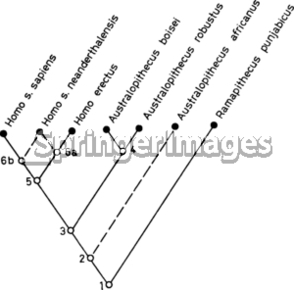
- 15What is cladistics?Cladistics is a taxonomical technique that shows evolutionary branches of species, starting from their shared characteristics. It is more accurate than Linnaean taxonomy which can be too polarised e.g. classifying birds as having feathers but the Archaeopteryx is a bird with reptilian features as well as feathers. Cladograms show these evolutionary/morphological divergences.
- 16What ape species are humans most closely related to?Chimpanzees - including Pan troglodytes and Pan bonobo.
- 17Which family and subfamily do humans, chimpanzees and gorillas belong to?Family hominidae and subfamily homininae. The subfamily includes African (specifically) great apes and humans.
- 18What is a synapomorphy?A trait that is shared between two or more taxa of a clade and their most recent ancestor.
- 19What are the synapomorphies in the family Hominidae?Large brain, no tail, more erect posture, hip/ankle/wrist/thumb flexibility.
- 20What is an autapomorphy?A derived trait that is unique to a terminal group of a clade.
- 21What are autapomorphies of the subfamily Homininae?Elongate skulls, large brow ridges, short canine teeth, reduced hairiness.
- 22Hominin refers to......humans and human-like ancestors.
- 23Where do Old World and New World monkeys originate from?Africa and South America, respectively.
- 24What is a molecular clock?Synonymous DNA substitutions do not change the amino acid sequence because the genetic code is redundant and occur at a fairly uniform rate because there is no selection advantage/disadvantage. The amount of species divergence can be calculated as a rate and the 'molecular' clock is said to record the passage of time by the substitution of amino acids.
- 25What is the formula for calculating the rate of evolutionary divergence?r = K /(2T)
The rate of evolutionary divergence = the number of substitutions / (how many of the divergent products/proteins the substitution is occurring in (2) x time (in millions of years)). - 26What is the rate of evolutionary divergence?3.5 - 6.5 substitutions per billion years.
- 27State a genetic similarity and a genetic difference between humans and other great apes.Humans and chimpanzees share 95% of base pairs, including those for mitochondrial cytochrome oxidase, but human chromosome 2 is a fusion of 2 chromosomes in other great apes such as chimpanzees and gorillas.
- 28What is the Great Rift Valley and what effect did it have on human evolution?The Great Rift Valley is a geological feature associated with active mountain building and faulting that isolated East Africa from the rest of the continent. The east became a savannah while the rest remained lush and arboreal. 'Pre-human' fossils have been found only in the east and it is proposed that the harsh climate change resulted in the great apes having to adapt and evolve into bipeds.
- 29Name the species of the proposed common ancestor of chimpanzees and humans.Sahelanthropus tchadensis.
- 30Which form of hominids are humans proposed to have evolved from?
- 31What is microevolution?The change in frequency in alleles in a population over time.
- 32What species is 'Lucy' and what is her significance?Lucy is of the Australopithecus afarensis species and is thought to be one of the oldest 'pre-human' species in the divergence from great apes to humans.
- 33Which is the oldest species of the genus Homo (probably)?Homo ergaster.
- 34How many years is the species Homo sapiens estimated to have been present?30-32000 years.
- 35What are the two theories of how modern human populations have evolved and expanded throughout the world?The multi-regional theory states that hominid evolution began in Africa and then ~1 million years ago hominids radiated out to other regions of the world.
The out-of-Africa theory states that several independent hominid lineages existed in Africa and only one of these left Africa while the others went extinct.
The latter is supported by the most genetic diversity being found in sub-saharan fossil species and the least being found in species that spread out. (fewer genes were available for variation as species spread out). - 36Homo s neanderthalis is thought to have coexisted with modern humans. What are their features?Neanderthals often had larger brain cases than modern humans, ~1450 cm3 compared with our ~1200cm3, were around 5'6 tall and had thick heavy bones and powerful musculature. They were formidable hunters but had tools and weapons which did not advance much over time, which is probably how modern humans out-competed them for resources.
Neanderthals possessed the genes to laugh and communicate(FOXP2 in particular). - 37List characteristics of humans not shared by other extant primates:Bipedal locomotion, manufacture and use of complex tools, language, and large brains.
- 38Explain the four processes that affect microevolution.Mutation, selection, genetic drift and gene flow affect microevolution. Mutation may result in a change in the alleles but is not enough to drive evolution on its own, selection pressures such as a changing environment or food source are required for mutations to affect microevolution. Genetic drift refers to changes in allele frequencies that occur by chance - these are particularly important in small populations and an example is the combination of alleles in the offspring of at least one heterozygote. Gene flow refers to the exchange of alleles between populations - the rate of microevolution may decrease as a result of population isolation, for example.
- 39What anatomical features are associated with modern humans having a better grasp on tools than chimpanzees?The flexus pollicis longus muscle and thicker metacarpals.
- 40What is a balanced polymorphism? Give an example.Polymorphism refers to different forms of something - for example, different alleles of a gene. A balanced polymorphism refers to one in which both forms are present roughly equally. For example, the mutation of B-haemoglobin that causes sickle cell anaemia is prevalent because it protects against malaria, which is what kills non-sickle cell homozygotes, and heterozygotes are not particularly affected by sickle cell and not susceptible to malaria - so there is no reason for it to disappear.
- 41List the advantages and disadvantages of humans having large brains.Advantages: an increased capacity to make and use tools, and an increased capacity for language.
Disadvantages: it requires a lot of energy to maintain, it generates heat, and it makes birth difficult. - 42What is speciation?Speciation is the formation of new and distinct species in the process of evolution.
- 43What is the morphological species concept?This states that a species is a group of interbreeding organisms with shared morphological features - but butterflies can't interbreed with their mimics.
- 44What is the biological species concept?This states that species are groups of actually or potentially interbreeding natural populations that are reproductively isolated from other such groups. However, this does not take into account asexual species.
- 45What were Darwin's key observations on the HMS Beagle?There were similarities between extinct species (fossils) and extant species (living); there was geographical grouping of similar organisms; and island organism populations varied but were more like the organisms on the nearest mainland.
- 46What are Darwin's finches and why are they significant?Darwin noticed finches on the Galapagos islands had large or small beaks, and each phenotype prevailed during different climates based on the size of seeds - in dry years large seeds were abundant so finches with large beaks were selected for, and those with small beaks were selected for in wet years when small seeds were abundant.
- 47What was Darwin's main conclusion in his paper 'On the Origin of Species'?Individuals with favourable characteristics survive and reproduce better and leave more descendants.
- 48What are the conditions required for evolution?More individuals are produced than can survive; there is heritable variation between individuals; some individuals will be better adapted to survive than others and these will leave behind the most offspring.
- 49What were some of the opposition points to evolution?Paley's argument from design - that something complex could not just appear from nature but had to be designed by an intelligent creator (e.g. an eye). If evolution occurs by the accumulation of small changes, why were so many intermediates missing from the fossil record? Lord Kelvin had estimated the age of the earth as 19 million years old which wasn't nearly enough time. Blending theory states that a new variation on a gene would be distributed in ever diminishing amounts throughout a population, suggesting that they would be lost over generations.
- 50Define homologous:Something that is similar in position, structure, and evolutionary origin but does not necessarily have the same function.
- 51Define analogous:A structure that performs a similar function to another but that has a different evolutionary origin.
- 52What is the evidence for evolution from comparative anatomy?Homologous structures existing between organisms (e.g. pentadactyl limbs of vertebrates) suggest evolutionary divergence in the past. Analogous structures existing between organisms (e.g. wings of insects and birds) suggest convergent evolution to similar environments. There are similarities in embryos across vertebrate species and it is said that ontogony recapitulates phylogeny - differentiation is seen. Vestigial organs suggest evolution to a changing environment or different needs, such as vestigial lower limb bones of whales and snakes or ear muscles in humans which used to be used to pick up danger.
- 53What is the evidence for evolution from paleontology?Relative dating can produce an evolutionary record but it is inaccurate as the layers of rock may not be as old as they are thought to be. Radiometric dating, or absolute dating, depends on the measuring the rate of decay of isotopes, e.g. 14C (5730 years) or 40K (1.25 bn years) which, in fossils, are not in equilibrium with the environment as they are with living organisms.
- 54What is the evidence for evolution from selection?PEPPERED MOTHS. Darwin's finches. Bacterial resistance to antibiotics. Emergence of two different types of corn.
- 55What is the evidence for evolution from biochemistry?Organisms share the same genetic code and the same vital proteins so measuring DNA sequence similarity can show evolutionary relationships. This tends to conform to traditional taxonomic groups. Only a small proportion of genes correspond with morphology, most are vital genes such as that for RNA for transcription which explains why humans and chimpanzees can be 90% genetically similar and humans and yeast are 60% genetically similar!
- 56What evidence for evolution existed before/at the time of Darwin's research and proposal?Fish present on top of mountains (suggesting the mountains used to be under the sea), vertebrates had common pentadactyl limbs, fossils of organisms could be seen to form sequences, embryos across species bore large resemblances, dog breeding and pedigrees demonstrated artificial selection of genes/phenotypes, organisms possessed evidence of rudimentary organs (e.g. snakes and whales have rudimentary leg bones) and organisms in Australia are vary different from other continents (e.g. koalas and kangaroos).
Information
- Description
- Charles Darwin, evidence and human evolution.
- Created by
- sophietevans
- Views
- 238
- Tags
- Rating