
Flashcards
Spoken Child Language
Cards in this deck (40)
- 1Early Communication- Children can understand and respond in appropriate ways before they speak
- Cry to indicate hunger, pain, fatigue (reflex responses)
- Learn to cry to gain attention (social interaction resource) - 23 monthsCooing
- 36 monthsBabbling
- Children start to take on tone, stress and rhythm patterns of speech community which child belongs to
Uses voice as a verbal doodling for own pleasure - 46-9 months6 months - Children show broad range of sound and intonation, exercising control over their capacity to vocalise
9 months - Children begin to narrow down and refine these sounds, using them consistently for specific purposes - 59 months- Some expressions emerge, recognisable to those around but not corresponding to adult repertoire
-These sounds are for getting things done (e.g. nananana = give me)
- Functions which emerge at this time are:
i) Instrumental - to get what they want
ii) Regulatory - to control behaviour of others
iii) Interactional - to open and sustain conversation
iv) Personal - to register feelings or reactions - 69 months +- Protoforms emerge - functionally orientated expressions
- Accommodation takes place between child and caregiver who interprets language while child learns theirs
- Conditions which help emergence of protoforms:
i) Interaction w/ small no. of significant others ( e.g. 1:1)
ii) Activities w/ children often repetitive
ii) Communication embedded in the 'here and now' - 716 months- Children will have approx. 40 expressions
- Acquired new purposes for utterances:
i) Imaginative -play
ii) Heuristic - Learning about their environment - 8Holophrases- Bridge gap between protolanguage and adult language
- At 12-18 months child begins to use single word utterances (e.g. juice)
- Vocal limited. Applies to 'hear and now'
Single word phases can be used in multiple ways:
i) Naming objects (e.g. shoe)
ii) opening/closing encounters (e.g. hi/bye)
iii) Attracting attention (e.g. Dada)
iv) Directing (e.g. there)
v) Refusing course of action (e.g. no) - 9First words- Babies use 'name' category most frequently
- First words usually nouns as easy to pick up and classify due to physical existence and related to child immediate environment
- Children use 1 word utterances to convey multiple messages (E.g 'Juice' can mean = 'Ive spilt my juice' OR 'I want more juice') - 10JEAN STILWELL PECCEI (1999)- Looked at vocal learning
- Child A: Uses 'duck' to refer to water with/without duck in it
- Overextension = Child attempts to discover limits of words application. Needs to narrow down until arrive at specific meaning
- Child B: Uses white to only describe snow. Doesn't understand white can be used to describe other objects
- Underextension = Restricts use of word - 11RESCORLA (1980)- Studied children over extensions
- Divided them into 3 main types:
i) Categorical
ii) Analogical
ii) Statements
- Found majority of overextensions categorical. Few analogical. - 12RESCORLA i) CategoricalWord for a member of clear category is extended to other words in that category
(E.g. Apple - other fruit) - 13RESCORLA ii) AnalogicalWord for 1 object extended to another object which is not in same category but has similarities ( E.g. Cat - Soft scarf)
- 14RESCORLA iii) StatementLike one-word sentences. Not labelling object but making statement about it in relation to another object ( E.g. dolly - empty dolls bed)
- 15Verbs- 'Put' and 'take' sometimes often incorrectly used - both involve someone causing something to change location
- 'Make' also involves something causing change in something else BUT involves change in state rather than location
- Errors that children make in their usage are reflections of a more gradual process of learning more subtle distinctions - 16BOWERMAN (1982)- Observed that errors like ones above most commonly occur once child has developed fairly large vocal and have started to notice patterns in their language. Begin to test limits of regularities
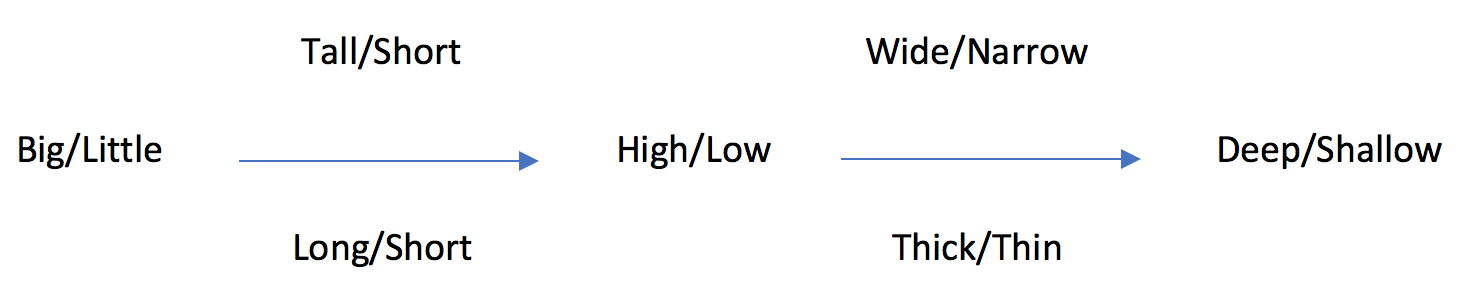
- Children are packaging = learning range of meanings conveyed by nouns and verbs - 17Adjectives- Spatial adjectives difficult to acquire
- Order reflects frequency with which these words are used in speaking to young children + relative simplicity of meanings involved (E.g. Big/little used more often than Tall/short)
- Words differ in terms of dimensions (e.g. Big = general size. Tall = vertical extension)
- As child grows older, learn subtle distinctions between adjectives and range of concepts they can be applied to - 18Hypernyms + Hyponyms- Used to label specific items
- Hypernym = Generic word that can apply to original word and others (e.g. animal)
- Hyponym = Specific term of hypernym (e.g. dog)
- Children networking - making connections between partial adjectives and hypernyms/hyponyms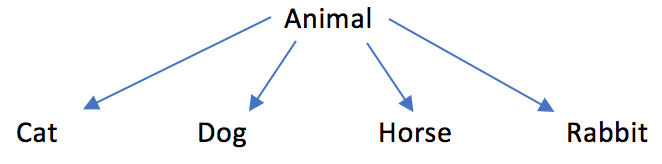
- 19HALLIDAY'S taxonomy- Identifies some of the key functions used by children
- Found most of child’s early utterances are direct expressions of physical needs BUT strong suggestion that these interactions between child and caregiver are rehearsing social interaction - 20HALLIDAY'S Taxonomy i) Instrumental- Language used to fulfil need on part of speaker
- Directly concerned with obtaining food/drink - 21HALLIDAYS Taxonomy ii) Interactional- To influence behaviour of others
- Persuading/ Commanding/ Requesting others to do things you want - 22HALLIDAY'S Taxonomy iii) Personal- To express personal preferences and identity of speaker
- Sometimes referred to as ‘Here I am” function – announcing oneself to world - 23HALLIDAY'S Taxonomy iv) Representational- To exchange info
- Relaying/ requesting info - 24HALLIDAY'S Taxonomy v) Heuristic- To learn/explore environment
- Using language to learn (e.g. asking questions) - 25HALLIDAY'S Taxonomy vi) Imaginative- To explore imagination
- During play as children create imaginary words - 26JOHN DORE'S Infant Language Functions- Alternative to HALLIDAY'S Taxonomy
Child language functions:
i) Labeling
ii) Repeating
iii) Answering
iv) Requesting info
v) Calling
vi) Greeting
vii) Potesting
viii) Practising - 27JOHN DORE'S Infant Language Functions i) LabellingNaming/identifying person/ object/ experience
(E.g. Dada) - 28JOHN DORE'S Infant Language Functions ii) RepeatingEchoing something spoken by adult
(E.g. Daddy stink) - 29JOHN DORE'S Infant Language Functions iii) AnsweringGiving direct response to utterance from another speaker
(E.g. (when speaking to mum about hair) Mummy got nice hair) - 30JOHN DORE'S Infant Language Functions iv) Requesting actionDemanding food/ toy/ assistance etc
(E.g. Juice) - 31JOHN DORE'S Infant Language Functions v) CallingAttracting attention by shouting
(E.g. Look at me mummy) - 32JOHN DORE'S Infant Language Functions vi) GreetingSelf-evident
(e.g. Dada) - 33JOHN DORE'S Infant Language Functions vii) ProtestingObjecting to requests etc
(E.g. I don't want play that game) - 34JOHN DORE'S Infant Language Functions viii) PractisingUsing + repeating language when no adult present
(E.g. (playing alone) That doesn't fit) - 35JEAN AITCHISON (1987) - 3 stages in acquisition of vocabi) Labelling
ii) Packaging
ii) Network building - 36JEAN AITCHISON - 3 stages in acquisition of vocab i) Labelling- Involves making link between sounds of particular words and objects to which they refer
(E.g. Child must learn ‘Mummy’ refers to his/her mother) - 37JEAN AITCHISON - 3 stages in acquisition of vocab ii) Packaging- Involves understanding words range of meaning
- Underextension and overextension occur before this stage successfully negotiated - 38JEAN AITCHISON - 3 stages in acquisition of vocab iii) Network Building- Involves grasping connections between words
- Understanding some words have opposite meanings
(E.g. understanding relationship between hypernyms and hyponyms) - 39PIAGET'S Cognitive Theory- Children acquires increasingly complex forms of language only when their intellectual development in ready
- Argues that to classify a word, child must gain understanding of object permanence (ability to understand objects have independent existence). Before they understand this, child believes object ceases to exist when out of sight
- Development of object permanence begins during 1st year. Not complete till approx 18 months
- After this stage, increases in vocab. Argues once child realises object permanence, next stage is to learn names
- As children grow, develop awareness of concepts (e.g. size). So can acquire terms to express these concepts (e.g bigger) - 40PIAGET'S Cognitive theory Evaluation- Seems to be a connection between cognitive and linguistic development
- BUT several studies of children whose mental development has been retarded BUT still able to speak fluently
Information
- Description
- A level English Flashcards on Spoken Child Language, created by Millie Rodgers on 20/04/2017.
- Created by
- Millie Rodgers
- Views
- 0
- Rating