
Flowchart
Social Changes CHINA
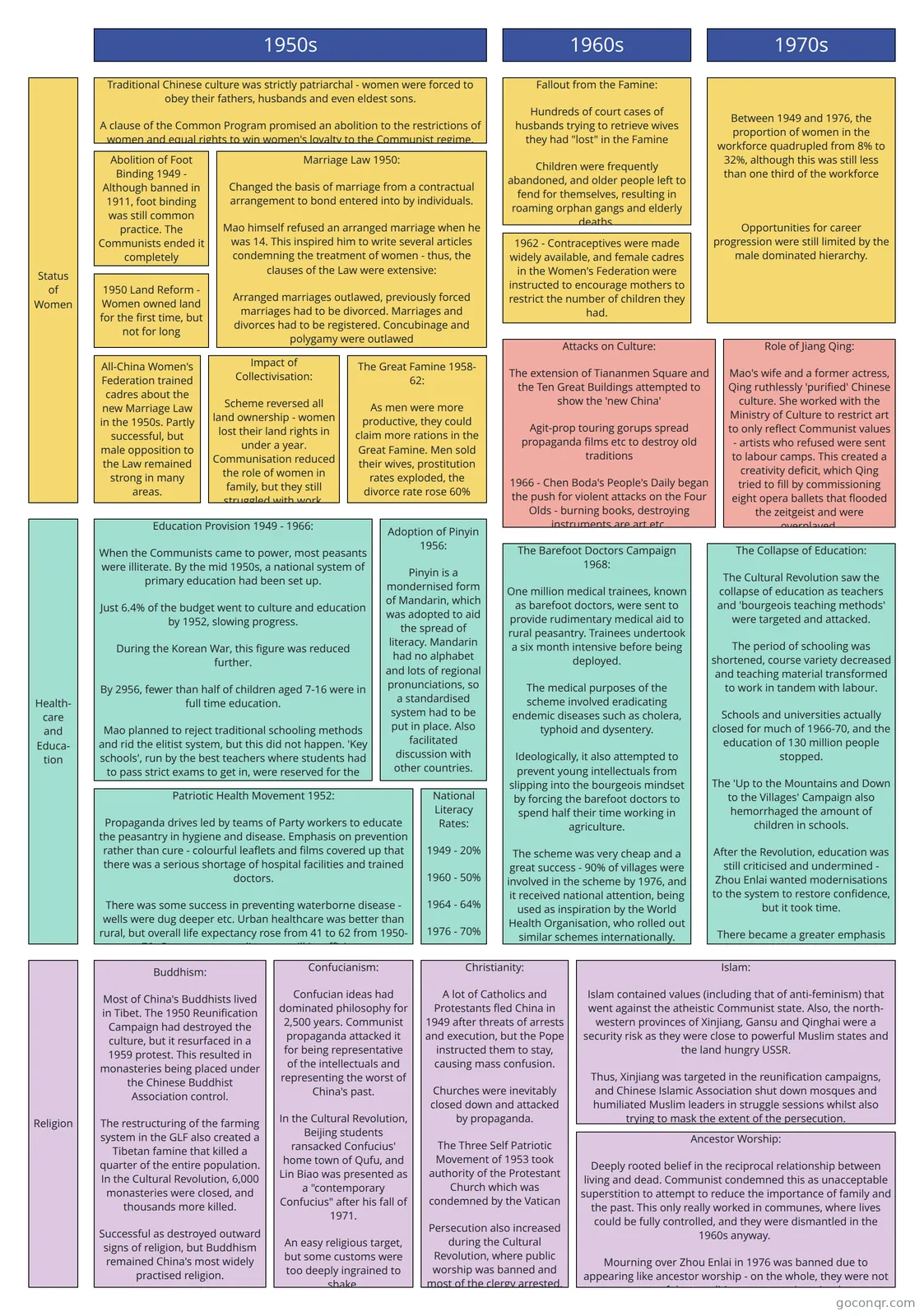
Flowchart: Social changes in China
Flowchart content
Status of Women
Health-care and Educa-tion
Religion
1950s
1970s
1960s
Traditional Chinese culture was strictly patriarchal - women were forced to obey their fathers, husbands and even eldest sons.
A clause of the Common Program promised an abolition to the restrictions of women and equal rights to win women's loyalty to the Communist regime.
Marriage Law 1950:
Changed the basis of marriage from a contractual arrangement to bond entered into by individuals.
Mao himself refused an arranged marriage when he was 14. This inspired him to write several articles condemning the treatment of women - thus, the clauses of the Law were extensive:
Arranged marriages outlawed, previously forced marriages had to be divorced. Marriages and divorces had to be registered. Concubinage and polygamy were outlawed
Abolition of Foot Binding 1949 - Although banned in 1911, foot binding was still common practice. The Communists ended it completely
Impact of Collectivisation:
Scheme reversed all land ownership - women lost their land rights in under a year. Communisation reduced the role of women in family, but they still struggled with work.
1950 Land Reform - Women owned land for the first time, but not for long
The Great Famine 1958-62:
As men were more productive, they could claim more rations in the Great Famine. Men sold their wives, prostitution rates exploded, the divorce rate rose 60%
Fallout from the Famine:
Hundreds of court cases of husbands trying to retrieve wives they had "lost" in the Famine
Children were frequently abandoned, and older people left to fend for themselves, resulting in roaming orphan gangs and elderly deaths.
All-China Women's Federation trained cadres about the new Marriage Law in the 1950s. Partly successful, but male opposition to the Law remained strong in many areas.
1962 - Contraceptives were made widely available, and female cadres in the Women's Federation were instructed to encourage mothers to restrict the number of children they had.
Between 1949 and 1976, the proportion of women in the workforce quadrupled from 8% to 32%, although this was still less than one third of the workforce
Opportunities for career progression were still limited by the male dominated hierarchy.
Education Provision 1949 - 1966:
When the Communists came to power, most peasants were illiterate. By the mid 1950s, a national system of primary education had been set up.
Just 6.4% of the budget went to culture and education by 1952, slowing progress.
During the Korean War, this figure was reduced further.
By 2956, fewer than half of children aged 7-16 were in full time education.
Mao planned to reject traditional schooling methods and rid the elitist system, but this did not happen. 'Key schools', run by the best teachers where students had to pass strict exams to get in, were reserved for the children of high-ranking Party officials.
National Literacy Rates:
1949 - 20%
1960 - 50%
1964 - 64%
1976 - 70%
Adoption of Pinyin 1956:
Pinyin is a mondernised form of Mandarin, which was adopted to aid the spread of literacy. Mandarin had no alphabet and lots of regional pronunciations, so a standardised system had to be put in place. Also facilitated discussion with other countries.
Patriotic Health Movement 1952:
Propaganda drives led by teams of Party workers to educate the peasantry in hygiene and disease. Emphasis on prevention rather than cure - colourful leaflets and films covered up that there was a serious shortage of hospital facilities and trained doctors.
There was some success in preventing waterborne disease - wells were dug deeper etc. Urban healthcare was better than rural, but overall life expectancy rose from 41 to 62 from 1950-70. Government sending was still insufficient.
The Barefoot Doctors Campaign 1968:
One million medical trainees, known as barefoot doctors, were sent to provide rudimentary medical aid to rural peasantry. Trainees undertook a six month intensive before being deployed.
The medical purposes of the scheme involved eradicating endemic diseases such as cholera, typhoid and dysentery.
Ideologically, it also attempted to prevent young intellectuals from slipping into the bourgeois mindset by forcing the barefoot doctors to spend half their time working in agriculture.
The scheme was very cheap and a great success - 90% of villages were involved in the scheme by 1976, and it received national attention, being used as inspiration by the World Health Organisation, who rolled out similar schemes internationally.
The Collapse of Education:
The Cultural Revolution saw the collapse of education as teachers and 'bourgeois teaching methods' were targeted and attacked.
The period of schooling was shortened, course variety decreased and teaching material transformed to work in tandem with labour.
Schools and universities actually closed for much of 1966-70, and the education of 130 million people stopped.
The 'Up to the Mountains and Down to the Villages' Campaign also hemorrhaged the amount of children in schools.
After the Revolution, education was still criticised and undermined - Zhou Enlai wanted modernisations to the system to restore confidence, but it took time.
There became a greater emphasis on practical work and vocational training, with fewer exams.
Buddhism:
Most of China's Buddhists lived in Tibet. The 1950 Reunification Campaign had destroyed the culture, but it resurfaced in a 1959 protest. This resulted in monasteries being placed under the Chinese Buddhist Association control.
The restructuring of the farming system in the GLF also created a Tibetan famine that killed a quarter of the entire population. In the Cultural Revolution, 6,000 monasteries were closed, and thousands more killed.
Successful as destroyed outward signs of religion, but Buddhism remained China's most widely practised religion.
Christianity:
A lot of Catholics and Protestants fled China in 1949 after threats of arrests and execution, but the Pope instructed them to stay, causing mass confusion.
Churches were inevitably closed down and attacked by propaganda.
The Three Self Patriotic Movement of 1953 took authority of the Protestant Church which was condemned by the Vatican
Persecution also increased during the Cultural Revolution, where public worship was banned and most of the clergy arrested.
Islam:
Islam contained values (including that of anti-feminism) that went against the atheistic Communist state. Also, the north-western provinces of Xinjiang, Gansu and Qinghai were a security risk as they were close to powerful Muslim states and the land hungry USSR.
Thus, Xinjiang was targeted in the reunification campaigns, and Chinese Islamic Association shut down mosques and humiliated Muslim leaders in struggle sessions whilst also trying to mask the extent of the persecution.
Confucianism:
Confucian ideas had dominated philosophy for 2,500 years. Communist propaganda attacked it for being representative of the intellectuals and representing the worst of China's past.
In the Cultural Revolution, Beijing students ransacked Confucius' home town of Qufu, and Lin Biao was presented as a "contemporary Confucius" after his fall of 1971.
An easy religious target, but some customs were too deeply ingrained to shake.
Ancestor Worship:
Deeply rooted belief in the reciprocal relationship between living and dead. Communist condemned this as unacceptable superstition to attempt to reduce the importance of family and the past. This only really worked in communes, where lives could be fully controlled, and they were dismantled in the 1960s anyway.
Mourning over Zhou Enlai in 1976 was banned due to appearing like ancestor worship - on the whole, they were not successful, as traditions were too ingrained.
Attacks on Culture:
The extension of Tiananmen Square and the Ten Great Buildings attempted to show the 'new China'
Agit-prop touring gorups spread propaganda films etc to destroy old traditions
1966 - Chen Boda's People's Daily began the push for violent attacks on the Four Olds - burning books, destroying instruments are art etc.
Role of Jiang Qing:
Mao's wife and a former actress, Qing ruthlessly 'purified' Chinese culture. She worked with the Ministry of Culture to restrict art to only reflect Communist values - artists who refused were sent to labour camps. This created a creativity deficit, which Qing tried to fill by commissioning eight opera ballets that flooded the zeitgeist and were overplayed.
Information
- Description
- A level History (China) Flowchart on Social Changes CHINA, created by Josh Parker on 10/06/2018.
- Created by
- Josh Parker
- Views
- 0
- Rating