
Mind map
FORMS OF INTELLECTUAL PROPERTY
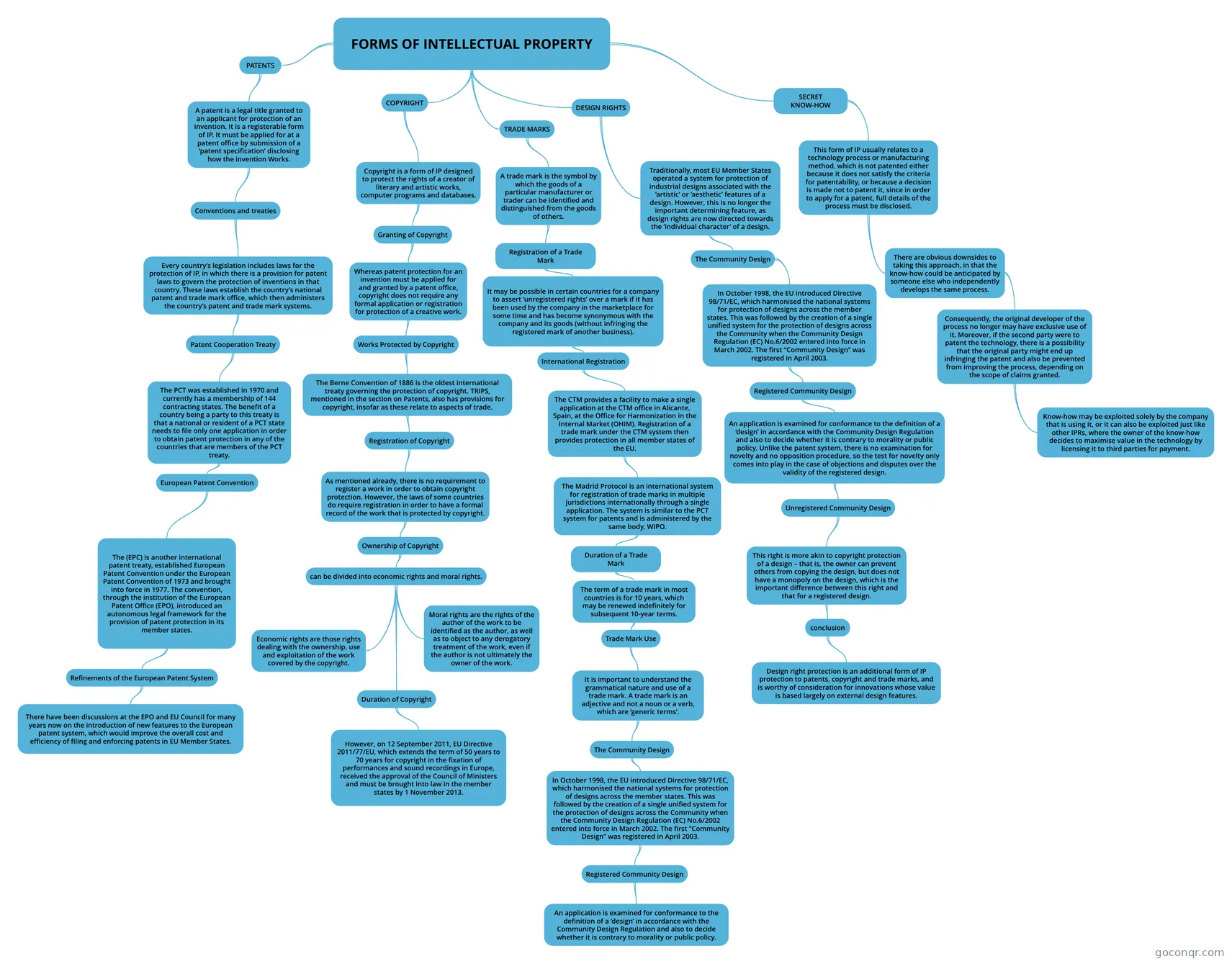
Mind map: Forms of Intellectual Property
Map content
FORMS OF INTELLECTUAL PROPERTY
PATENTS
- A patent is a legal title granted to an applicant for protection of an invention. It is a registerable form of IP. It must be applied for at a patent office by submission of a ‘patent specification’ disclosing how the invention Works.
- Conventions and treaties
- Every country’s legislation includes laws for the protection of IP, in which there is a provision for patent laws to govern the protection of inventions in that country. These laws establish the country’s national patent and trade mark office, which then administers the country’s patent and trade mark systems.
- Patent Cooperation Treaty
- The PCT was established in 1970 and currently has a membership of 144 contracting states. The benefit of a country being a party to this treaty is that a national or resident of a PCT state needs to file only one application in order to obtain patent protection in any of the countries that are members of the PCT treaty.
- European Patent Convention
- The (EPC) is another international patent treaty, established European Patent Convention under the European Patent Convention of 1973 and brought into force in 1977. The convention, through the institution of the European Patent Office (EPO), introduced an autonomous legal framework for the provision of patent protection in its member states.
- Refinements of the European Patent System
- There have been discussions at the EPO and EU Council for many years now on the introduction of new features to the European patent system, which would improve the overall cost and efficiency of filing and enforcing patents in EU Member States.
- Refinements of the European Patent System
- The (EPC) is another international patent treaty, established European Patent Convention under the European Patent Convention of 1973 and brought into force in 1977. The convention, through the institution of the European Patent Office (EPO), introduced an autonomous legal framework for the provision of patent protection in its member states.
- European Patent Convention
- The PCT was established in 1970 and currently has a membership of 144 contracting states. The benefit of a country being a party to this treaty is that a national or resident of a PCT state needs to file only one application in order to obtain patent protection in any of the countries that are members of the PCT treaty.
- Patent Cooperation Treaty
- Every country’s legislation includes laws for the protection of IP, in which there is a provision for patent laws to govern the protection of inventions in that country. These laws establish the country’s national patent and trade mark office, which then administers the country’s patent and trade mark systems.
- Conventions and treaties
- A patent is a legal title granted to an applicant for protection of an invention. It is a registerable form of IP. It must be applied for at a patent office by submission of a ‘patent specification’ disclosing how the invention Works.
COPYRIGHT
- Copyright is a form of IP designed to protect the rights of a creator of literary and artistic works, computer programs and databases.
- Granting of Copyright
- Whereas patent protection for an invention must be applied for and granted by a patent office, copyright does not require any formal application or registration for protection of a creative work.
- Works Protected by Copyright
- The Berne Convention of 1886 is the oldest international treaty governing the protection of copyright. TRIPS, mentioned in the section on Patents, also has provisions for copyright, insofar as these relate to aspects of trade.
- Registration of Copyright
- As mentioned already, there is no requirement to register a work in order to obtain copyright protection. However, the laws of some countries do require registration in order to have a formal record of the work that is protected by copyright.
- Ownership of Copyright
- can be divided into economic rights and moral rights.
- Economic rights are those rights dealing with the ownership, use and exploitation of the work covered by the copyright.
- Moral rights are the rights of the author of the work to be identified as the author, as well as to object to any derogatory treatment of the work, even if the author is not ultimately the owner of the work.
- Duration of Copyright
- However, on 12 September 2011, EU Directive 2011/77/EU, which extends the term of 50 years to 70 years for copyright in the fixation of performances and sound recordings in Europe, received the approval of the Council of Ministers and must be brought into law in the member states by 1 November 2013.
- can be divided into economic rights and moral rights.
- Ownership of Copyright
- As mentioned already, there is no requirement to register a work in order to obtain copyright protection. However, the laws of some countries do require registration in order to have a formal record of the work that is protected by copyright.
- Registration of Copyright
- The Berne Convention of 1886 is the oldest international treaty governing the protection of copyright. TRIPS, mentioned in the section on Patents, also has provisions for copyright, insofar as these relate to aspects of trade.
- Works Protected by Copyright
- Whereas patent protection for an invention must be applied for and granted by a patent office, copyright does not require any formal application or registration for protection of a creative work.
- Granting of Copyright
- Copyright is a form of IP designed to protect the rights of a creator of literary and artistic works, computer programs and databases.
TRADE MARKS
- A trade mark is the symbol by which the goods of a particular manufacturer or trader can be identified and distinguished from the goods of others.
- Registration of a Trade Mark
- It may be possible in certain countries for a company to assert ‘unregistered rights’ over a mark if it has been used by the company in the marketplace for some time and has become synonymous with the company and its goods (without infringing the registered mark of another business).
- International Registration
- The CTM provides a facility to make a single application at the CTM office in Alicante, Spain, at the Office for Harmonization in the Internal Market (OHIM). Registration of a trade mark under the CTM system then provides protection in all member states of the EU.
- The Madrid Protocol is an international system for registration of trade marks in multiple jurisdictions internationally through a single application. The system is similar to the PCT system for patents and is administered by the same body, WIPO.
- Duration of a Trade Mark
- The term of a trade mark in most countries is for 10 years, which may be renewed indefinitely for subsequent 10-year terms.
- Trade Mark Use
- It is important to understand the grammatical nature and use of a trade mark. A trade mark is an adjective and not a noun or a verb, which are ‘generic terms’.
- The Community Design
- In October 1998, the EU introduced Directive 98/71/EC, which harmonised the national systems for protection of designs across the member states. This was followed by the creation of a single unified system for the protection of designs across the Community when the Community Design Regulation (EC) No.6/2002 entered into force in March 2002. The first “Community Design” was registered in April 2003.
- Registered Community Design
- An application is examined for conformance to the definition of a ‘design’ in accordance with the Community Design Regulation and also to decide whether it is contrary to morality or public policy.
- Registered Community Design
- In October 1998, the EU introduced Directive 98/71/EC, which harmonised the national systems for protection of designs across the member states. This was followed by the creation of a single unified system for the protection of designs across the Community when the Community Design Regulation (EC) No.6/2002 entered into force in March 2002. The first “Community Design” was registered in April 2003.
- The Community Design
- It is important to understand the grammatical nature and use of a trade mark. A trade mark is an adjective and not a noun or a verb, which are ‘generic terms’.
- Trade Mark Use
- The term of a trade mark in most countries is for 10 years, which may be renewed indefinitely for subsequent 10-year terms.
- Duration of a Trade Mark
- The Madrid Protocol is an international system for registration of trade marks in multiple jurisdictions internationally through a single application. The system is similar to the PCT system for patents and is administered by the same body, WIPO.
- The CTM provides a facility to make a single application at the CTM office in Alicante, Spain, at the Office for Harmonization in the Internal Market (OHIM). Registration of a trade mark under the CTM system then provides protection in all member states of the EU.
- International Registration
- It may be possible in certain countries for a company to assert ‘unregistered rights’ over a mark if it has been used by the company in the marketplace for some time and has become synonymous with the company and its goods (without infringing the registered mark of another business).
- Registration of a Trade Mark
- A trade mark is the symbol by which the goods of a particular manufacturer or trader can be identified and distinguished from the goods of others.
DESIGN RIGHTS
- Traditionally, most EU Member States operated a system for protection of industrial designs associated with the ‘artistic’ or ‘aesthetic’ features of a design. However, this is no longer the important determining feature, as design rights are now directed towards the ‘individual character’ of a design.
- The Community Design
- In October 1998, the EU introduced Directive 98/71/EC, which harmonised the national systems for protection of designs across the member states. This was followed by the creation of a single unified system for the protection of designs across the Community when the Community Design Regulation (EC) No.6/2002 entered into force in March 2002. The first “Community Design” was registered in April 2003.
- Registered Community Design
- An application is examined for conformance to the definition of a ‘design’ in accordance with the Community Design Regulation and also to decide whether it is contrary to morality or public policy. Unlike the patent system, there is no examination for novelty and no opposition procedure, so the test for novelty only comes into play in the case of objections and disputes over the validity of the registered design.
- Unregistered Community Design
- This right is more akin to copyright protection of a design – that is, the owner can prevent others from copying the design, but does not have a monopoly on the design, which is the important difference between this right and that for a registered design.
- conclusion
- Design right protection is an additional form of IP protection to patents, copyright and trade marks, and is worthy of consideration for innovations whose value is based largely on external design features.
- conclusion
- This right is more akin to copyright protection of a design – that is, the owner can prevent others from copying the design, but does not have a monopoly on the design, which is the important difference between this right and that for a registered design.
- Unregistered Community Design
- An application is examined for conformance to the definition of a ‘design’ in accordance with the Community Design Regulation and also to decide whether it is contrary to morality or public policy. Unlike the patent system, there is no examination for novelty and no opposition procedure, so the test for novelty only comes into play in the case of objections and disputes over the validity of the registered design.
- Registered Community Design
- In October 1998, the EU introduced Directive 98/71/EC, which harmonised the national systems for protection of designs across the member states. This was followed by the creation of a single unified system for the protection of designs across the Community when the Community Design Regulation (EC) No.6/2002 entered into force in March 2002. The first “Community Design” was registered in April 2003.
- The Community Design
- Traditionally, most EU Member States operated a system for protection of industrial designs associated with the ‘artistic’ or ‘aesthetic’ features of a design. However, this is no longer the important determining feature, as design rights are now directed towards the ‘individual character’ of a design.
SECRET KNOW-HOW
- This form of IP usually relates to a technology process or manufacturing method, which is not patented either because it does not satisfy the criteria for patentability, or because a decision is made not to patent it, since in order to apply for a patent, full details of the process must be disclosed.
- There are obvious downsides to taking this approach, in that the know-how could be anticipated by someone else who independently develops the same process.
- Consequently, the original developer of the process no longer may have exclusive use of it. Moreover, if the second party were to patent the technology, there is a possibility that the original party might end up infringing the patent and also be prevented from improving the process, depending on the scope of claims granted.
- Know-how may be exploited solely by the company that is using it, or it can also be exploited just like other IPRs, where the owner of the know-how decides to maximise value in the technology by licensing it to third parties for payment.
- Consequently, the original developer of the process no longer may have exclusive use of it. Moreover, if the second party were to patent the technology, there is a possibility that the original party might end up infringing the patent and also be prevented from improving the process, depending on the scope of claims granted.
- There are obvious downsides to taking this approach, in that the know-how could be anticipated by someone else who independently develops the same process.
- This form of IP usually relates to a technology process or manufacturing method, which is not patented either because it does not satisfy the criteria for patentability, or because a decision is made not to patent it, since in order to apply for a patent, full details of the process must be disclosed.
Information
- Description
- ingeniería industrial Mind Map on FORMS OF INTELLECTUAL PROPERTY, created by Mariana Paredes bayona on 10/03/2020.
- Created by
- Mariana Paredes bayona
- Views
- 2
- History
-
- Created by Mariana Paredes bayona · Mar 10, 2020
- Copied by Mariana Paredes bayona · Mar 10, 2020
- Rating
More on Types of Intellectual Property