
Mind map
Experiments- Method, Control of Variables, Design, Types
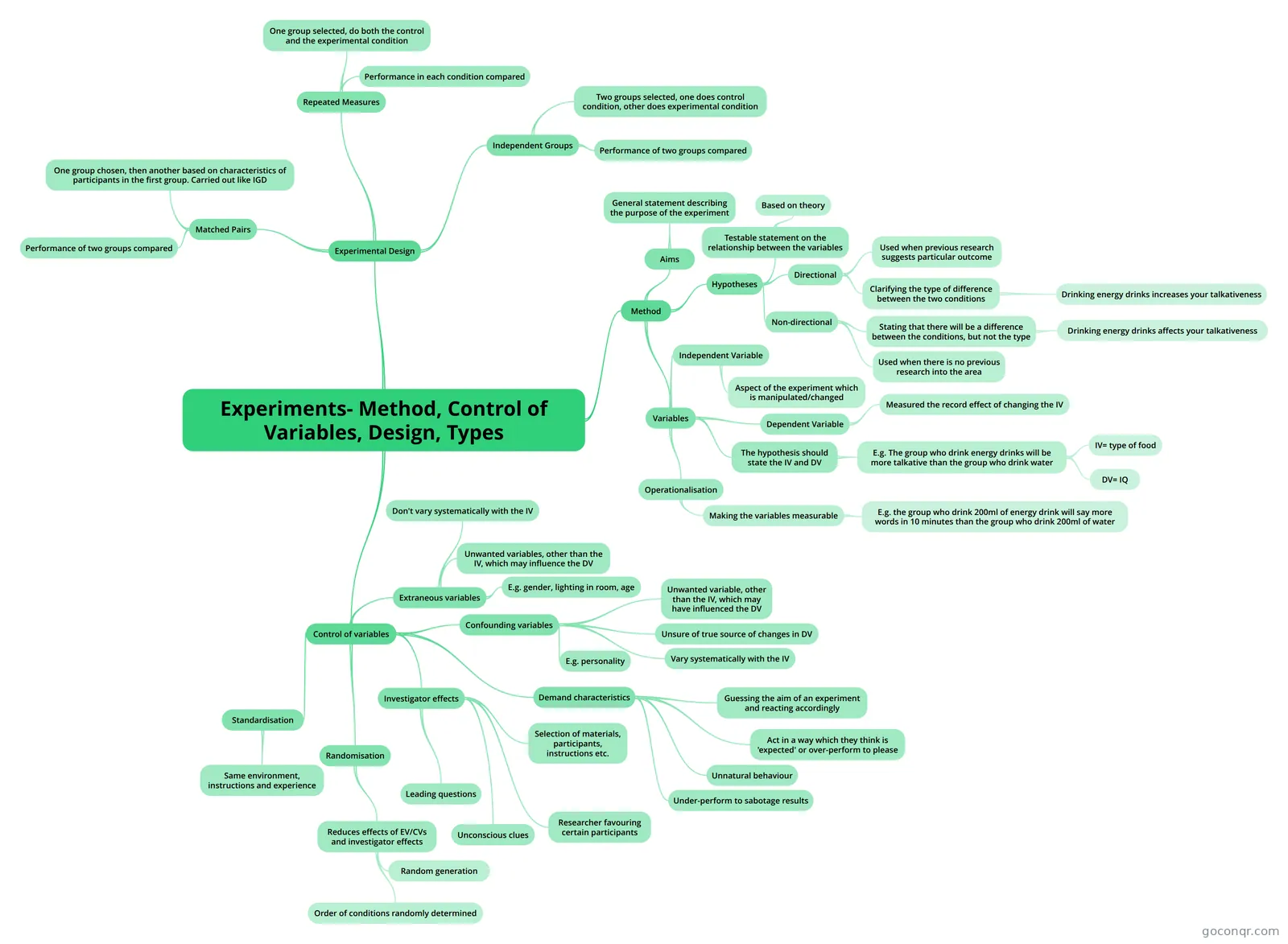
Mind map: experiments method and variables
Map content
Experiments- Method, Control of Variables, Design, Types
Method
- Aims
- General statement describing the purpose of the experiment
- Hypotheses
- Testable statement on the relationship between the variables
- Based on theory
- Directional
- Clarifying the type of difference between the two conditions
- Drinking energy drinks increases your talkativeness
- Used when previous research suggests particular outcome
- Clarifying the type of difference between the two conditions
- Non-directional
- Stating that there will be a difference between the conditions, but not the type
- Drinking energy drinks affects your talkativeness
- Used when there is no previous research into the area
- Stating that there will be a difference between the conditions, but not the type
- Testable statement on the relationship between the variables
- Variables
- Independent Variable
- Aspect of the experiment which is manipulated/changed
- Dependent Variable
- Measured the record effect of changing the IV
- The hypothesis should state the IV and DV
- E.g. The group who drink energy drinks will be more talkative than the group who drink water
- IV= type of food
- DV= IQ
- E.g. The group who drink energy drinks will be more talkative than the group who drink water
- Operationalisation
- Making the variables measurable
- E.g. the group who drink 200ml of energy drink will say more words in 10 minutes than the group who drink 200ml of water
- Making the variables measurable
- Independent Variable
- Aims
Control of variables
- Extraneous variables
- Unwanted variables, other than the IV, which may influence the DV
- E.g. gender, lighting in room, age
- Don't vary systematically with the IV
- Confounding variables
- Unwanted variable, other than the IV, which may have influenced the DV
- Unsure of true source of changes in DV
- Vary systematically with the IV
- E.g. personality
- Demand characteristics
- Guessing the aim of an experiment and reacting accordingly
- Act in a way which they think is 'expected' or over-perform to please
- Under-perform to sabotage results
- Unnatural behaviour
- Investigator effects
- Researcher favouring certain participants
- Unconscious clues
- Selection of materials, participants, instructions etc.
- Leading questions
- Randomisation
- Reduces effects of EV/CVs and investigator effects
- Random generation
- Order of conditions randomly determined
- Reduces effects of EV/CVs and investigator effects
- Standardisation
- Same environment, instructions and experience
- Extraneous variables
Experimental Design
- Independent Groups
- Two groups selected, one does control condition, other does experimental condition
- Performance of two groups compared
- Repeated Measures
- One group selected, do both the control and the experimental condition
- Performance in each condition compared
- Matched Pairs
- One group chosen, then another based on characteristics of participants in the first group. Carried out like IGD
- Performance of two groups compared
- Independent Groups
Information
- Description
- AQA AS and A Level Research Methods: Includes experimental methods, control of variables, experimental design, and types of experiment.
- Created by
- Grace Fawcitt
- Views
- 167
- Tags
- Rating