
Mind map
Parkinson's Disease
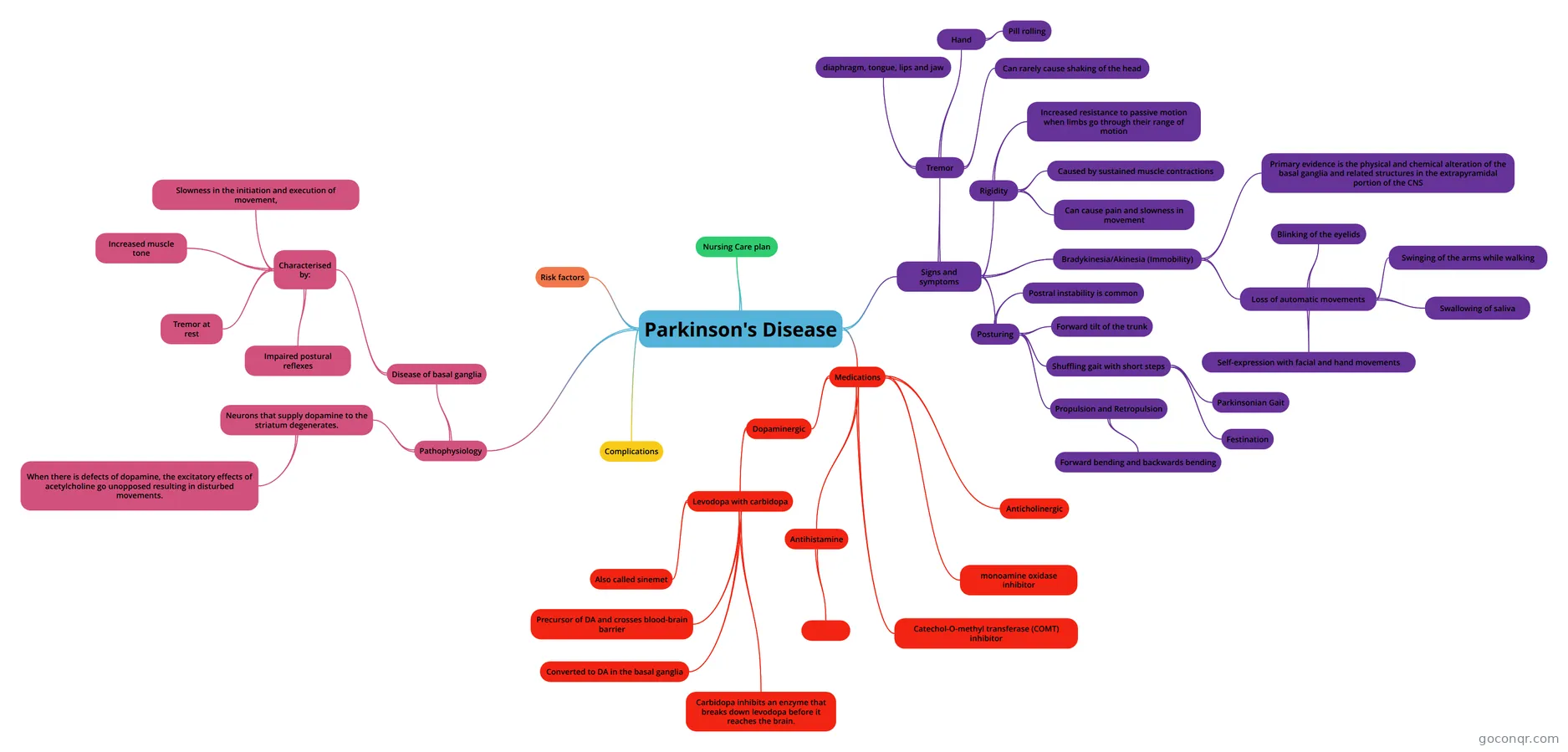
Mind map: Parkinson's disease
Map content
Parkinson's Disease
Risk factors
Nursing Care plan
Pathophysiology
- Disease of basal ganglia
- Characterised by:
- Slowness in the initiation and execution of movement,
- Increased muscle tone
- Tremor at rest
- Impaired postural reflexes
- Characterised by:
- Neurons that supply dopamine to the striatum degenerates.
- When there is defects of dopamine, the excitatory effects of acetylcholine go unopposed resulting in disturbed movements.
- Disease of basal ganglia
Signs and symptoms
- Tremor
- Hand
- Pill rolling
- diaphragm, tongue, lips and jaw
- Can rarely cause shaking of the head
- Hand
- Rigidity
- Increased resistance to passive motion when limbs go through their range of motion
- Caused by sustained muscle contractions
- Can cause pain and slowness in movement
- Bradykinesia/Akinesia (Immobility)
- Loss of automatic movements
- Blinking of the eyelids
- Swinging of the arms while walking
- Swallowing of saliva
- Self-expression with facial and hand movements
- Primary evidence is the physical and chemical alteration of the basal ganglia and related structures in the extrapyramidal portion of the CNS
- Loss of automatic movements
- Posturing
- Shuffling gait with short steps
- Parkinsonian Gait
- Festination
- Postral instability is common
- Forward tilt of the trunk
- Propulsion and Retropulsion
- Forward bending and backwards bending
- Shuffling gait with short steps
- Tremor
Medications
- Anticholinergic
- Dopaminergic
- Levodopa with carbidopa
- Also called sinemet
- Precursor of DA and crosses blood-brain barrier
- Converted to DA in the basal ganglia
- Carbidopa inhibits an enzyme that breaks down levodopa before it reaches the brain.
- Levodopa with carbidopa
- Antihistamine
- monoamine oxidase inhibitor
- Catechol-O-methyl transferase (COMT) inhibitor
Complications
Information
- Description
- Nursing Mind Map on Parkinson's Disease, created by Nicole Russell on 05/09/2017.
- Created by
- Nicole Russell
- Views
- 30
- Rating