
Mind map
Cultural Competence
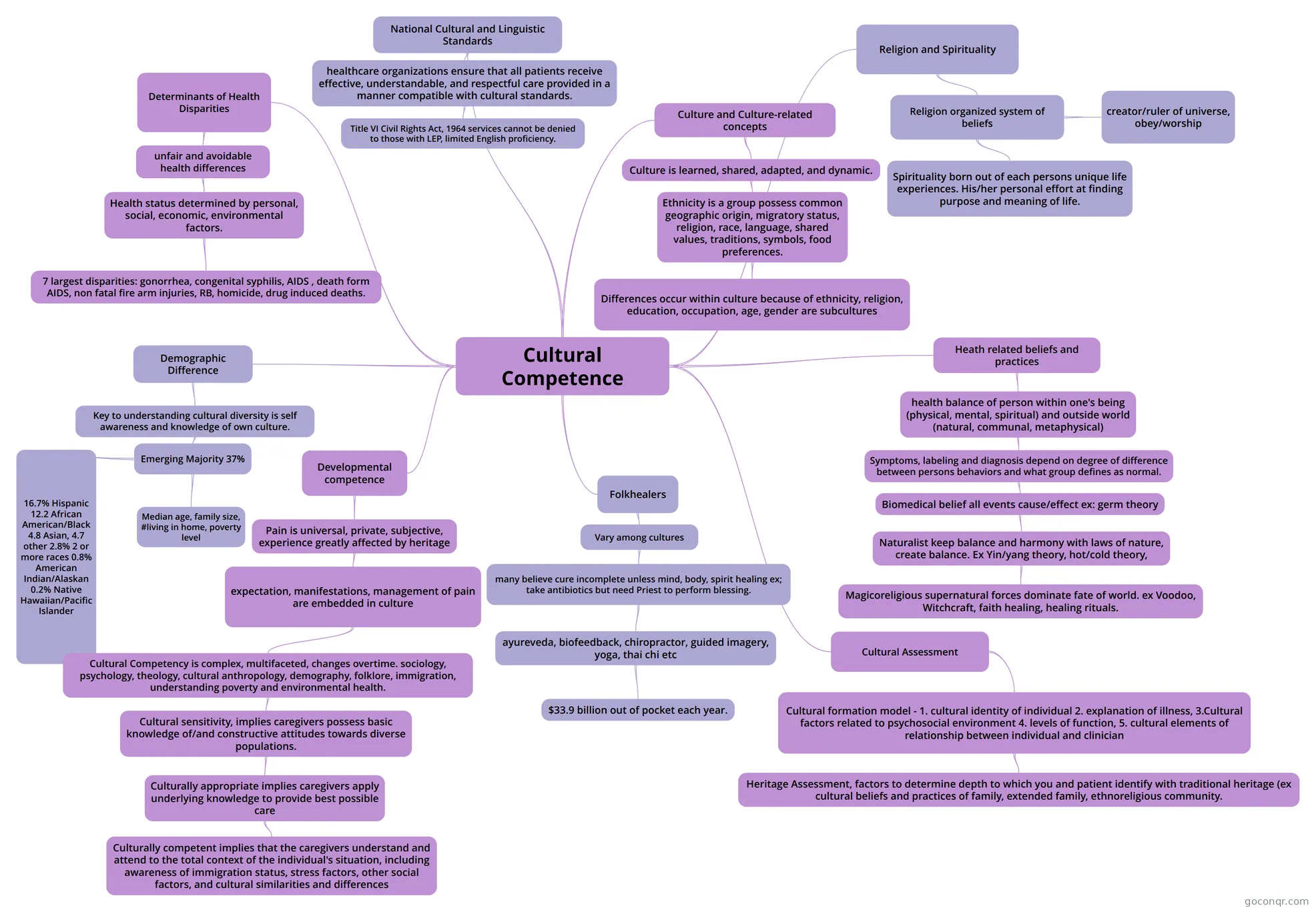
Mind map: Cultural competence
Map content
Cultural Competence
Demographic Difference
- Key to understanding cultural diversity is self awareness and knowledge of own culture.
- Emerging Majority 37%
- Median age, family size, #living in home, poverty level
- 16.7% Hispanic 12.2 African American/Black 4.8 Asian, 4.7 other 2.8% 2 or more races 0.8% American Indian/Alaskan 0.2% Native Hawaiian/Pacific Islander
- Emerging Majority 37%
- Key to understanding cultural diversity is self awareness and knowledge of own culture.
Determinants of Health Disparities
- unfair and avoidable health differences
- Health status determined by personal, social, economic, environmental factors.
- 7 largest disparities: gonorrhea, congenital syphilis, AIDS , death form AIDS, non fatal fire arm injuries, RB, homicide, drug induced deaths.
- Health status determined by personal, social, economic, environmental factors.
- unfair and avoidable health differences
National Cultural and Linguistic Standards
- healthcare organizations ensure that all patients receive effective, understandable, and respectful care provided in a manner compatible with cultural standards.
- Title VI Civil Rights Act, 1964 services cannot be denied to those with LEP, limited English proficiency.
- healthcare organizations ensure that all patients receive effective, understandable, and respectful care provided in a manner compatible with cultural standards.
Culture and Culture-related concepts
- Culture is learned, shared, adapted, and dynamic.
- Ethnicity is a group possess common geographic origin, migratory status, religion, race, language, shared values, traditions, symbols, food preferences.
- Differences occur within culture because of ethnicity, religion, education, occupation, age, gender are subcultures
- Ethnicity is a group possess common geographic origin, migratory status, religion, race, language, shared values, traditions, symbols, food preferences.
- Culture is learned, shared, adapted, and dynamic.
Religion and Spirituality
- Religion organized system of beliefs
- Spirituality born out of each persons unique life experiences. His/her personal effort at finding purpose and meaning of life.
- creator/ruler of universe, obey/worship
- Religion organized system of beliefs
Heath related beliefs and practices
- health balance of person within one's being (physical, mental, spiritual) and outside world (natural, communal, metaphysical)
- Symptoms, labeling and diagnosis depend on degree of difference between persons behaviors and what group defines as normal.
- Biomedical belief all events cause/effect ex: germ theory
- Naturalist keep balance and harmony with laws of nature, create balance. Ex Yin/yang theory, hot/cold theory,
- Magicoreligious supernatural forces dominate fate of world. ex Voodoo, Witchcraft, faith healing, healing rituals.
- Naturalist keep balance and harmony with laws of nature, create balance. Ex Yin/yang theory, hot/cold theory,
- Biomedical belief all events cause/effect ex: germ theory
- Symptoms, labeling and diagnosis depend on degree of difference between persons behaviors and what group defines as normal.
- health balance of person within one's being (physical, mental, spiritual) and outside world (natural, communal, metaphysical)
Folkhealers
- Vary among cultures
- many believe cure incomplete unless mind, body, spirit healing ex; take antibiotics but need Priest to perform blessing.
- ayureveda, biofeedback, chiropractor, guided imagery, yoga, thai chi etc
- $33.9 billion out of pocket each year.
- ayureveda, biofeedback, chiropractor, guided imagery, yoga, thai chi etc
- many believe cure incomplete unless mind, body, spirit healing ex; take antibiotics but need Priest to perform blessing.
- Vary among cultures
Developmental competence
- Pain is universal, private, subjective, experience greatly affected by heritage
- expectation, manifestations, management of pain are embedded in culture
- Cultural Competency is complex, multifaceted, changes overtime. sociology, psychology, theology, cultural anthropology, demography, folklore, immigration, understanding poverty and environmental health.
- Cultural sensitivity, implies caregivers possess basic knowledge of/and constructive attitudes towards diverse populations.
- Culturally appropriate implies caregivers apply underlying knowledge to provide best possible care
- Culturally competent implies that the caregivers understand and attend to the total context of the individual's situation, including awareness of immigration status, stress factors, other social factors, and cultural similarities and differences
- Culturally appropriate implies caregivers apply underlying knowledge to provide best possible care
- Cultural sensitivity, implies caregivers possess basic knowledge of/and constructive attitudes towards diverse populations.
- Cultural Competency is complex, multifaceted, changes overtime. sociology, psychology, theology, cultural anthropology, demography, folklore, immigration, understanding poverty and environmental health.
- expectation, manifestations, management of pain are embedded in culture
- Pain is universal, private, subjective, experience greatly affected by heritage
Cultural Assessment
- Cultural formation model - 1. cultural identity of individual 2. explanation of illness, 3.Cultural factors related to psychosocial environment 4. levels of function, 5. cultural elements of relationship between individual and clinician
- Heritage Assessment, factors to determine depth to which you and patient identify with traditional heritage (ex cultural beliefs and practices of family, extended family, ethnoreligious community.
- Cultural formation model - 1. cultural identity of individual 2. explanation of illness, 3.Cultural factors related to psychosocial environment 4. levels of function, 5. cultural elements of relationship between individual and clinician