
Mind map
R&D Chap 3: Globalisation and Related Processes
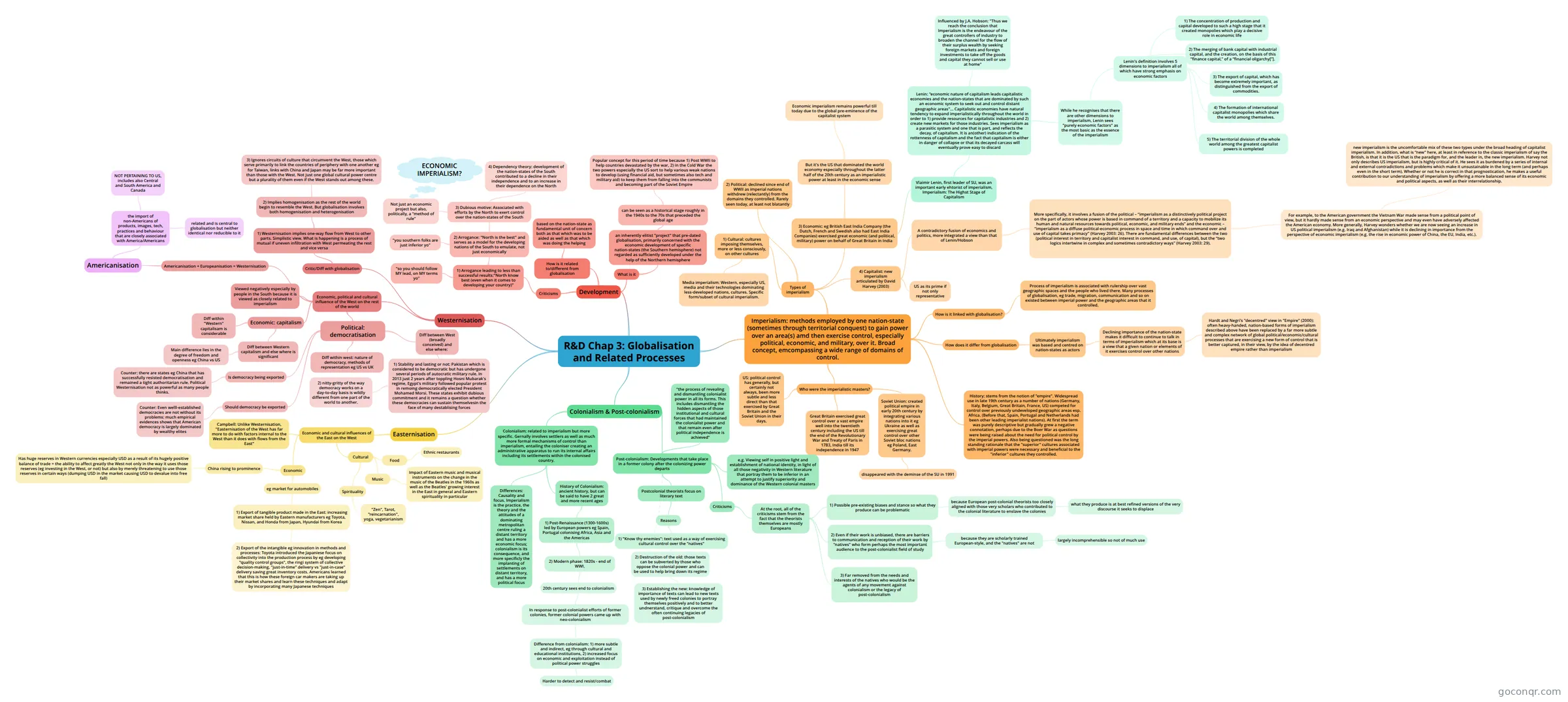
Mind map: Globalisation and related processes
Map content
R&D Chap 3: Globalisation and Related Processes
Imperialism: methods employed by one nation-state (sometimes through territorial conquest) to gain power over an area(s) amd then exercise control, especially political, economic, and military, over it. Broad concept, emcompassing a wide range of domains of control.
- Types of imperialism
- 1) Cultural: cultures imposing themselves, more or less consciously, on other cultures
- Media imperialism: Western, especially US, media and their technologies dominating less-developed nations, cultures. Specific form/subset of cultural imperialism.
- 2) Political: declined since end of WWII as imperial nations withdrew (relectantly) from the domains they controlled. Rarely seen today, at least not blatantly
- 3) Economic: eg British East India Company (the Dutch, French and Swedish also had East India Companies) exercised great economic (and political, military) power on behalf of Great Britain in India
- But it's the US that dominated the world economy especially throughout the latter half of the 20th century as an imperialistic power at least in the economic sense
- Economic imperialism remains powerful till today due to the global pre-eminence of the capitalist system
- Vlaimir Lenin, first leader of SU, was an important early ehtorist of imperialism, Imperialism: The Highst Stage of Capitalism
- Lenin: "economic nature of capitalism leads capitalistic economies and the nation-states that are dominated by such an economic system to seek out and control distant geographic areas"... Capitalistic economies have natural tendency to expand imperialistically throughout the world in order to 1) provide resources for capitalistic industries and 2) create new markets for those industries. Sees imperialism as a parasitic system and one that is part, and reflects the decay, of capitalism. It is an(other) indication of the rottenness of capitalism and the fact that capitalism is either in danger of collapse or that its decayed carcass will eventually prove easy to discard
- Influenced by J.A. Hobson: "Thus we reach the conclusion that Imperialism is the endeavour of the great controllers of industry to broaden the channel for the flow of their surplus wealth by seeking foreign markets and foreign investments to take off the goods and capital they cannot sell or use at home"
- While he recognises that there are other dimensions to imperialism, Lenin sees "purely economic factors" as the most basic as the essence of the imperialism
- Lenin's definition involves 5 dimensions to imperialism all of which have strong emphasis on economic factors
- 1) The concentration of production and capital developed to such a high stage that it created monopolies which play a decisive role in economic life
- 2) The merging of bank capital with industrial capital, and the creation, on the basis of this “finance capital,” of a “financial oligarchy[”].
- 3) The export of capital, which has become extremely important, as distinguished from the export of commodities.
- 4) The formation of international capitalist monopolies which share the world among themselves.
- 5) The territorial division of the whole world among the greatest capitalist powers is completed
- Lenin's definition involves 5 dimensions to imperialism all of which have strong emphasis on economic factors
- Lenin: "economic nature of capitalism leads capitalistic economies and the nation-states that are dominated by such an economic system to seek out and control distant geographic areas"... Capitalistic economies have natural tendency to expand imperialistically throughout the world in order to 1) provide resources for capitalistic industries and 2) create new markets for those industries. Sees imperialism as a parasitic system and one that is part, and reflects the decay, of capitalism. It is an(other) indication of the rottenness of capitalism and the fact that capitalism is either in danger of collapse or that its decayed carcass will eventually prove easy to discard
- But it's the US that dominated the world economy especially throughout the latter half of the 20th century as an imperialistic power at least in the economic sense
- 4) Capitalist: new imperialism articulated by David Harvey (2003)
- US as its prime if not only representative
- A contradictory fusion of economics and politics, more integrated a view than that of Lenin/Hobson
- More specifically, it involves a fusion of the political – “imperialism as a distinctively political project on the part of actors whose power is based in command of a territory and a capacity to mobilize its human and natural resources towards political, economic, and military ends” and the economic – “imperialism as a diffuse political-economic process in space and time in which command over and use of capital takes primacy” (Harvey 2003: 26). There are fundamental differences between the two (political interest in territory and capitalist interest in command, and use, of capital), but the “two logics intertwine in complex and sometimes contradictory ways” (Harvey 2003: 29).
- For example, to the American government the Vietnam War made sense from a political point of view, but it hardly made sense from an economic perspective and may even have adversely affected the American economy. More generally, Harvey wonders whether we are now seeing an increase in US political imperialism (e.g. Iraq and Afghanistan) while it is declining in importance from the perspective of economic imperialism (e.g. the rise in economic power of China, the EU, India, etc.).
- new imperialism is the uncomfortable mix of these two types under the broad heading of capitalist imperialism. In addition, what is “new” here, at least in reference to the classic imperialism of say the British, is that it is the US that is the paradigm for, and the leader in, the new imperialism. Harvey not only describes US imperialism, but is highly critical of it. He sees it as burdened by a series of internal and external contradictions and problems which make it unsustainable in the long term (and perhaps even in the short term). Whether or not he is correct in that prognostication, he makes a useful contribution to our understanding of imperialism by offering a more balanced sense of its economic and political aspects, as well as their interrelationship.
- For example, to the American government the Vietnam War made sense from a political point of view, but it hardly made sense from an economic perspective and may even have adversely affected the American economy. More generally, Harvey wonders whether we are now seeing an increase in US political imperialism (e.g. Iraq and Afghanistan) while it is declining in importance from the perspective of economic imperialism (e.g. the rise in economic power of China, the EU, India, etc.).
- More specifically, it involves a fusion of the political – “imperialism as a distinctively political project on the part of actors whose power is based in command of a territory and a capacity to mobilize its human and natural resources towards political, economic, and military ends” and the economic – “imperialism as a diffuse political-economic process in space and time in which command over and use of capital takes primacy” (Harvey 2003: 26). There are fundamental differences between the two (political interest in territory and capitalist interest in command, and use, of capital), but the “two logics intertwine in complex and sometimes contradictory ways” (Harvey 2003: 29).
- 1) Cultural: cultures imposing themselves, more or less consciously, on other cultures
- How is it linked with globalisation?
- Process of imperialism is associated with rulership over vast geographic spaces and the people who lived there. Many processes of globalisation, eg trade, migration, communication and so on existed between imperial power and the geographic areas that it controlled.
- History: stems from the notion of "empire". Widespread use in late 19th century as a number of nations (Germany, Italy, Belgium, Great Britain, France, US) competed for control over previously undeveloped geographic areas esp. Africa. (Before that, Spain, Portugal and Netherlands had been other leading imperialist nations). At first the term was purely descriptive but gradually grew a negative connotation, perhaps due to the Boer War as questions were being raised about the need for political control by the imperial powers. Also being questioned was the long standing rationale that the "superior" cultures associated with imperial powers were necessary and beneficial to the "inferior" cultures they controlled.
- Who were the imperialistic masters?
- Great Britain exercised great control over a vast empire well into the twentieth century including the US till the end of the Revolutionary War and Treaty of Paris in 1783, India till its independence in 1947
- Soviet Union: created political empire in early 20th century by integrating various nations into it eg Ukraine as well as exercising great control over other Soviet bloc nations eg Poland, East Germany.
- disappeared with the deminse of the SU in 1991
- US: political control has generally, but certainly not always, been more subtle and less direct than that exercised by Great Britain and the Soviet Union in their days.
- How does it differ from globalisation
- Ultimately imperialism was based and centred on nation-states as actors
- Declining importance of the nation-state makes it difficult to continue to talk in terms of imperialism which at its base is a view that a given nation or elements of it exercises control over other nations
- Hardt and Negri's "decentred" view in "Empire" (2000): often heavy-handed, nation-based forms of imperialism described above have been replaced by a far more subtle and complex network of global political/economic/cultural processes that are exercising a new form of control that is better captured, in their view, by the idea of decentred empire rather than imperialism
- Declining importance of the nation-state makes it difficult to continue to talk in terms of imperialism which at its base is a view that a given nation or elements of it exercises control over other nations
- Ultimately imperialism was based and centred on nation-states as actors
- Types of imperialism
Colonialism & Post-colonialism
- Colonialism: related to imperialism but more specific. Gernally involves settlers as well as much more formal mechanisms of control than imperialism, entailing the coloniser creating an administrative apparatus to run its internal affairs including its settlements within the colonised country.
- Differences: Causality and focus. Imperialism is the practice, the theory and the attitudes of a dominating metropolitan centre ruling a distant territory and has a more economic focus; colonialism is its consequence, and more specificly the implanting of settlements on distant territory, and has a more political focus
- History of Colonialism: ancient history, but can be said to have 2 great and more recent ages
- 1) Post-Renaissance (1300-1600s) led by European powers eg Spain, Portugal colonising Africa, Asia and the Americas
- 2) Modern phase: 1820s - end of WWI.
- 20th century sees end to colonialism
- In response to post-colonialist efforts of former colonies, former colonial powers came up with neo-colonialism
- Difference from colonialism: 1) more subtle and indirect, eg through cultural and educational institutions, 2) increased focus on economic and exploitation instead of political power struggles
- Harder to detect and resist/combat
- Difference from colonialism: 1) more subtle and indirect, eg through cultural and educational institutions, 2) increased focus on economic and exploitation instead of political power struggles
- In response to post-colonialist efforts of former colonies, former colonial powers came up with neo-colonialism
- 20th century sees end to colonialism
- 2) Modern phase: 1820s - end of WWI.
- 1) Post-Renaissance (1300-1600s) led by European powers eg Spain, Portugal colonising Africa, Asia and the Americas
- Post-colonialism: Developments that take place in a former colony after the colonizing power departs
- “the process of revealing and dismantling colonialist power in all its forms. This includes dismantling the hidden aspects of those institutional and cultural forces that had maintained the colonialist power and that remain even after political independence is achieved”
- e.g. Viewing self in positive light and establishment of national identity, in light of all those negativity in Western literature that portray them to be inferior in an attempt to justify superiority and dominance of the Western colonial masters
- Postcolonial theorists focus on literary text
- Reasons
- 1) "Know thy enemies": text used as a way of exercising cultural control over the "natives"
- 2) Destruction of the old: those texts can be subverted by those who oppose the colonial power and can be used to help bring down its regime
- 3) Establishing the new: knowledge of importance of texts can lead to new texts used by newly freed colonies to portray themselves positively and to better undnerstand, critique and overcome the often continuing legacies of post-colonialism
- 2) Destruction of the old: those texts can be subverted by those who oppose the colonial power and can be used to help bring down its regime
- 1) "Know thy enemies": text used as a way of exercising cultural control over the "natives"
- Reasons
- Criticisms
- At the root, all of the criticisms stem from the fact that the theorists themselves are mostly Europeans
- 1) Possible pre-existing biases and stance so what they produce can be problematic
- because European post-colonial theorists too closely aligned with those very scholars who contributed to the colonial literature to enslave the colonies
- what they produce is at best refined versions of the very discourse it seeks to displace
- because European post-colonial theorists too closely aligned with those very scholars who contributed to the colonial literature to enslave the colonies
- 2) Even if their work is unbiased, there are barriers to communication and reception of their work by "natives" who form perhaps the most important audience to the post-colonialist field of study
- because they are scholarly trained European-style, and the "natives" are not
- largely incomprehensible so not of much use
- because they are scholarly trained European-style, and the "natives" are not
- 3) Far removed from the needs and interests of the natives who would be the agents of any movement against colonialism or the legacy of post-colonialism
- 1) Possible pre-existing biases and stance so what they produce can be problematic
- At the root, all of the criticisms stem from the fact that the theorists themselves are mostly Europeans
- Colonialism: related to imperialism but more specific. Gernally involves settlers as well as much more formal mechanisms of control than imperialism, entailing the coloniser creating an administrative apparatus to run its internal affairs including its settlements within the colonised country.
Development
- What is it
- an inherently elitist "project" that pre-dated globalisation, primarily concerned with the economic development of specific nation-states (the Southern hemisphere) not regarded as sufficiently developed under the help of the Northern hemisphere
- can be seen as a historical stage roughly in the 1940s to the 70s that preceded the global age
- Popular concept for this period of time because 1) Post WWII to help countries devastated by the war, 2) in the Cold War the two powers especially the US sort to help various weak nations to develop (using financial aid, but sometimes also tech and military aid) to keep them from falling into the communists and becoming part of the Soviet Empire
- can be seen as a historical stage roughly in the 1940s to the 70s that preceded the global age
- an inherently elitist "project" that pre-dated globalisation, primarily concerned with the economic development of specific nation-states (the Southern hemisphere) not regarded as sufficiently developed under the help of the Northern hemisphere
- How is it related to/different from globalisation
- based on the nation-state as fundamental unit of concern both as that which was to be aided as well as that which was doing the helping
- Criticisms
- 1) Arrogance leading to less than successful results:"North know best (even when it comes to developing your country)"
- 2) Arrogance: "North is the best" and serves as a model for the developing nations of the South to emulate, not just economically
- "you southern folks are just inferior yo"
- 3) Dubious motive: Associated with efforts by the North to exert control over the nation-states of the South
- Not just an economic project but also, politically, a "method of rule"
- ECONOMIC IMPERIALISM?
- 4) Dependency theory: development of the nation-states of the South contributed to a decline in their independence and to an increase in their dependence on the North
- Not just an economic project but also, politically, a "method of rule"
- "so you should follow MY lead, on MY terms yo"
- 2) Arrogance: "North is the best" and serves as a model for the developing nations of the South to emulate, not just economically
- 1) Arrogance leading to less than successful results:"North know best (even when it comes to developing your country)"
- What is it
Westernisation
- Critic/Diff with globalisation
- 1) Westernisation implies one-way flow from West to other parts. Simplistic view. What is happening is a process of mutual if uneven infiltration with West permeating the rest and vice versa
- 2) Implies homogenisation as the rest of the world begin to resemble the West. But globalisation involves both homogenisation and heterogenisation
- 3) Ignores circuits of culture that circumvent the West, those which serve primarily to link the countries of periphery with one another eg for Taiwan, links with China and Japan may be far more important than those with the West. Not just one global cultural power centre but a plurality of them even if the West stands out among these.
- 2) Implies homogenisation as the rest of the world begin to resemble the West. But globalisation involves both homogenisation and heterogenisation
- 1) Westernisation implies one-way flow from West to other parts. Simplistic view. What is happening is a process of mutual if uneven infiltration with West permeating the rest and vice versa
- Economic, political and cultural influence of the West on the rest of the world
- Political: democratisation
- Should democracy be exported
- Counter: Even welll-established democracies are not without its problems: much empirical evidences shows that American democracy is largely dominated by wealthy elites
- Is democracy being exported
- Counter: there are states eg China that has successfully resisted democratisation and remained a tight authoritarian rule. Political Westernisation not as powerful as many people thinks.
- Diff between West (broadly conceived) and else where:
- 1) Stability and lasting or not: Pakistan which is considered to be democratic but has undergone several periods of autocratic military rule. In 2013 just 2 years after toppling Hosni Mubarak's regime, Egypt's military followed popular protest in remoing democratically elected President Mohamed Morsi. These states exhibit dubious commitment and it remains a question whether these democracies can sustain themselvesin the face of many destablising forces
- 2) nitty-gritty of the way democracy works on a day-to-day basis is wildly different from one part of the world to another.
- 1) Stability and lasting or not: Pakistan which is considered to be democratic but has undergone several periods of autocratic military rule. In 2013 just 2 years after toppling Hosni Mubarak's regime, Egypt's military followed popular protest in remoing democratically elected President Mohamed Morsi. These states exhibit dubious commitment and it remains a question whether these democracies can sustain themselvesin the face of many destablising forces
- Diff within west: nature of democracy, methods of representation eg US vs UK
- Should democracy be exported
- Economic: capitalism
- Diff between Western capitalism and else where is significant
- Main difference lies in the degree of freedom and openness eg China vs US
- Diff within "Western" capitalisam is considerable
- Diff between Western capitalism and else where is significant
- Viewed negatively especially by people in the South because it is viewed as closely related to imperialism
- Americanisation + Europeanisation = Westernisation
- Americanisation
- the import of non-Americans of products, images, tech, practices and behaviour that are closely associated with America/Americans
- related and is central to globalisation but neither identical nor reducible to it
- NOT PERTAINING TO US, includes also Central and South America and Canada
- the import of non-Americans of products, images, tech, practices and behaviour that are closely associated with America/Americans
- Americanisation
- Political: democratisation
- Critic/Diff with globalisation
Easternisation
- Economic and cultural influences of the East on the West
- Campbell: Unlike Westernisation, "Easternisation of the West has far more to do with factors internal to the West than it does with flows from the East"
- Economic
- eg market for automobiles
- 1) Export of tangible product made in the East: increasing market share held by Eastern manufacturers eg Toyota, Nissan, and Honda from Japan, Hyundai from Korea
- 2) Export of the intangible eg innovation in methods and processes: Toyota introduced the Japaniese focus on collectivity into the production process by eg developing "quality control groups", the ringi system of collective decision-making, "just-in-time" delivery vs "just-in-case" delivery saving great inventory costs. Americans learned that this is how these foreign car makers are taking up their market shares and learn these techniques and adapt by incorporating many Japanese techniques
- 1) Export of tangible product made in the East: increasing market share held by Eastern manufacturers eg Toyota, Nissan, and Honda from Japan, Hyundai from Korea
- China rising to prominence
- Has huge reserves in Western currencies especially USD as a result of its hugely positive balance of trade = the ability to affect greatly the West not only in the way it uses those reserves (eg investing in the West, or not) but also by merely threatening to use those reserves in certain ways (dumping USD in the market causing USD to devalue into free fall)
- eg market for automobiles
- Cultural
- Food
- Ethnic restaurants
- Music
- Impact of Eastern music and musical instruments on the change in the music of the Beatles in the 1960s as well as the Beatles' growing interest in the East in general and Eastern spirituality in particular
- Spirituality
- "Zen", Tarot, "reincarnation", yoga, vegetarianism
- Food
- Economic and cultural influences of the East on the West
Information
- Description
- Social Science Mind Map on R&D Chap 3: Globalisation and Related Processes, created by Li Baihui on 20/09/2017.
- Created by
- Li Baihui
- Views
- 0
- Rating
More on Theories and debates about globalisation