Mind map
Tissues
Map content
Tissues
Epithelial
- Simple
- Squamous
- Structure
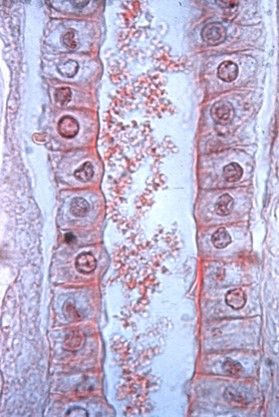
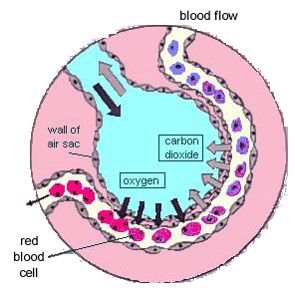
- Sheets of cells are thin and delicate. Found in the capillaries.
- Function
- Found in places where protective covering needs to let substances pass through. e.g alveolar walls- during the process of respiration, the oxygen diffused into the alveolar wall into the bloodstream through the squamous tissue. In the capillaries, the walls need to let oxygen, carbon dioxide and glucose pass through.
- Structure
- Cuboidal
- Structure
- cells are only 1 layer, but the shape is more cuboid so it is stronger. It can withstand a lot more trauma than, for example, the alveolus wall.
- Function
- Allows substances ti pass through by diffusion- for example, the water in the kidney tubules. It is good at getting rid of substances e.g medines inn the kidneys tubules.
- Structure
- Ciliated columnar
- Structure
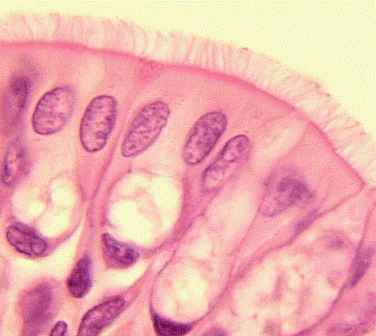
- often have goblet cells inbetween them.
- Function
- Goblet cells produce mucous. Microvolli on the top of the the cells move the mucous. The mucous traps the dust and germs. The mucous is carries up out trachea by the microvilli and we sneeze/cough the dust and germs out
- Structure
- Squamous
- Stratified
- Keratinised
- Structure
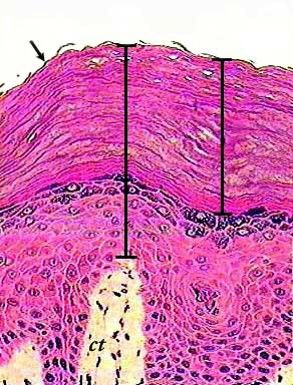
- the skin layers on top of our skin are flat layers that are dead-filled with a protein called keratin The layers under the skin are cuboidal and divide to form cells (found in dust at home!)
- Function
- the keratin in th cell makes our skin waterproof so the water doesnt seep into out body through our skin.
- Structure
- Non Keratinised
- Structure
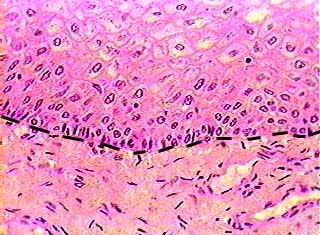
- Found in moist cavities or tubes with in the body e.g the mouth, cornea and oesophagus
- Function
- cells on the surface are 'sloughed off' through friction (think inside of your mouth with teeth) these cells are replaces by cuboidal cells underneath.
- Structure
- Keratinised
- Simple
Muscle
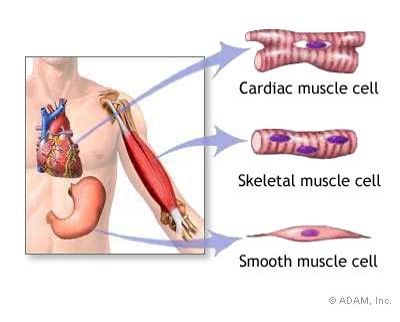
- Skeletal
- Structure
- It is striated which means its got bands running along it
- Function
- Also known as striated. Its under conscious control. It moves the skeleton and tissues including limbs, fingers and controlling facial expressions.
- Structure
- Smooth
- Structure
- it is smooth, not striated. It moves subconsciously
- Function
- purpose is smooth muscle is to narrow muscles. Smooth muscle tissue is under subconscious control. An example of smooth muscle is: It helps food move down the gastrointestinal tract. It breaks the food down and flushes fluds through the body. Another example is when we swallow, our oesophagus squeezes the food/drink down.
- Structure
- Cardiac
- Sructure
- It is striated, so is subconsciously controlled
- Function
- Cardiac Muscle is the heart muscle. It moves subconsciously.
- Sructure
- Skeletal
Nervous
- Neurones
- Structure
- snesitive to temperature, brightness and pressue
- Function
- They transfer nerve impulses around the body. Sensory neurons receive information which gives action whereas the motor neurons send the message to muscles telling them to act.
- Structure
- Neurones
Connective
- Blood
- Function
- To carry oxygen and carbon dioxide around the body
- Structure
- found inside blood vessels blood has many componants, the main one being plasma
- Function
- Cartilage
- Function
- support and cushion because ts softer than bone, It gives flexibility but has less stability than bone
- Structure
- flexible tissues that are loacted around the body
- Function
- Bone Tissue
- Function
- Main structure and supportive tissues of the body. forms hard rigid structure of skeletal system.
- Structure
- Main structural and supportive tissue of the body
- Function
- Apidose
- Structure
- Known as fat tissue and is mainly made of adipose. Mainly found under the skinsbut can sometimes be found between muscles.
- Function
- Its function is to keep us warm and to store energy
- Structure
- Blood