
Mind map
Buddhism
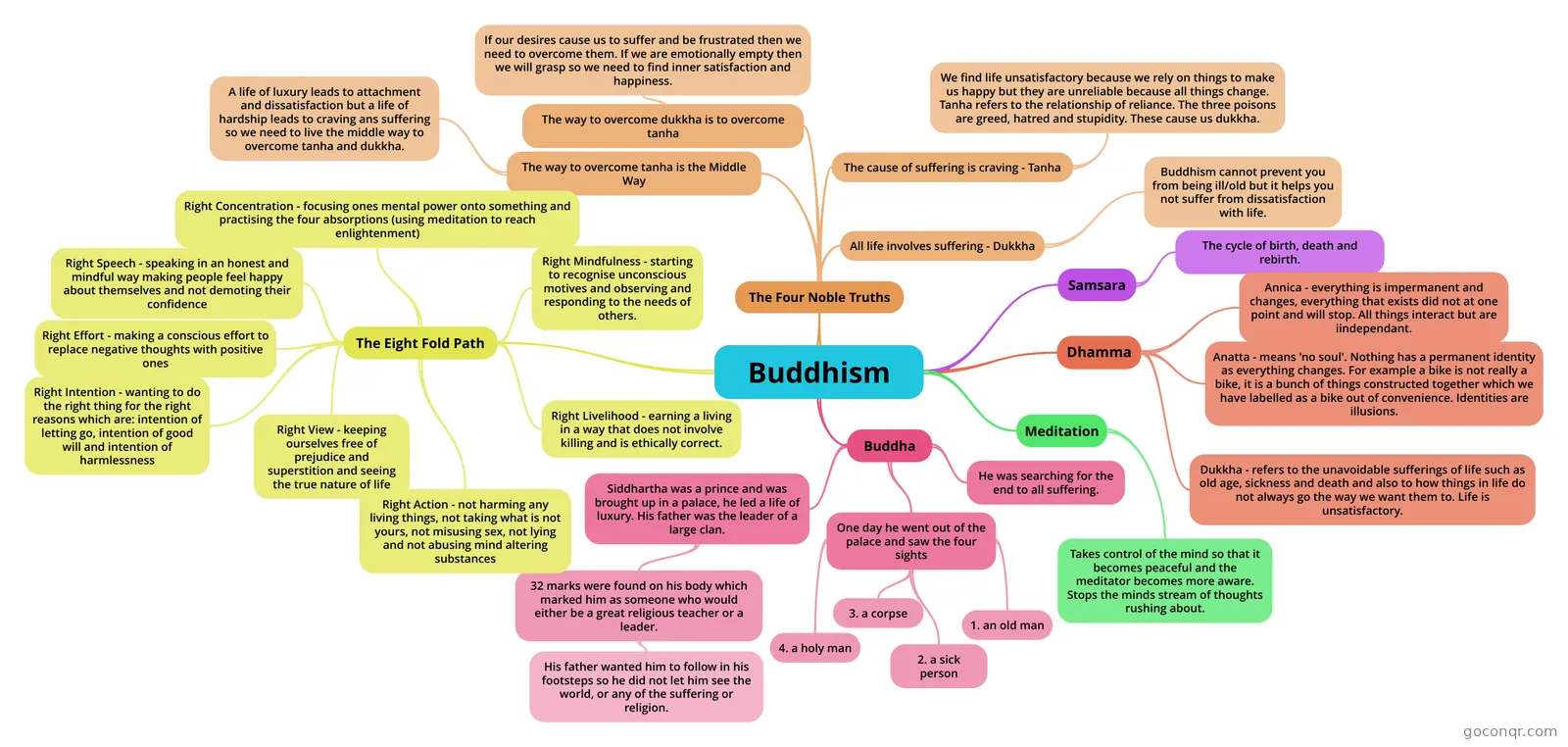
Mind map: Buddhism
Map content
Buddhism
Buddha
- Siddhartha was a prince and was brought up in a palace, he led a life of luxury. His father was the leader of a large clan.
- 32 marks were found on his body which marked him as someone who would either be a great religious teacher or a leader.
- His father wanted him to follow in his footsteps so he did not let him see the world, or any of the suffering or religion.
- 32 marks were found on his body which marked him as someone who would either be a great religious teacher or a leader.
- He was searching for the end to all suffering.
- One day he went out of the palace and saw the four sights
- 1. an old man
- 2. a sick person
- 3. a corpse
- 4. a holy man
- Siddhartha was a prince and was brought up in a palace, he led a life of luxury. His father was the leader of a large clan.
Meditation
- Takes control of the mind so that it becomes peaceful and the meditator becomes more aware. Stops the minds stream of thoughts rushing about.
The Four Noble Truths
- All life involves suffering - Dukkha
- Buddhism cannot prevent you from being ill/old but it helps you not suffer from dissatisfaction with life.
- The cause of suffering is craving - Tanha
- We find life unsatisfactory because we rely on things to make us happy but they are unreliable because all things change. Tanha refers to the relationship of reliance. The three poisons are greed, hatred and stupidity. These cause us dukkha.
- The way to overcome dukkha is to overcome tanha
- If our desires cause us to suffer and be frustrated then we need to overcome them. If we are emotionally empty then we will grasp so we need to find inner satisfaction and happiness.
- The way to overcome tanha is the Middle Way
- A life of luxury leads to attachment and dissatisfaction but a life of hardship leads to craving ans suffering so we need to live the middle way to overcome tanha and dukkha.
- All life involves suffering - Dukkha
Samsara
- The cycle of birth, death and rebirth.
The Eight Fold Path
- Right Mindfulness - starting to recognise unconscious motives and observing and responding to the needs of others.
- Right Concentration - focusing ones mental power onto something and practising the four absorptions (using meditation to reach enlightenment)
- Right Effort - making a conscious effort to replace negative thoughts with positive ones
- Right Livelihood - earning a living in a way that does not involve killing and is ethically correct.
- Right Action - not harming any living things, not taking what is not yours, not misusing sex, not lying and not abusing mind altering substances
- Right Speech - speaking in an honest and mindful way making people feel happy about themselves and not demoting their confidence
- Right Intention - wanting to do the right thing for the right reasons which are: intention of letting go, intention of good will and intention of harmlessness
- Right View - keeping ourselves free of prejudice and superstition and seeing the true nature of life
Dhamma
- Annica - everything is impermanent and changes, everything that exists did not at one point and will stop. All things interact but are iindependant.
- Anatta - means 'no soul'. Nothing has a permanent identity as everything changes. For example a bike is not really a bike, it is a bunch of things constructed together which we have labelled as a bike out of convenience. Identities are illusions.
- Dukkha - refers to the unavoidable sufferings of life such as old age, sickness and death and also to how things in life do not always go the way we want them to. Life is unsatisfactory.
Information
- Description
- Cambridge IGCSE RS Mind Map on Buddhism, created by harbornec on 27/05/2013.
- Created by
- harbornec
- Views
- 43
- Tags
- Rating